User:MIGUELbM/Muna v3.0
Introduction
Phonology
| Bilabial | Labiodental | Alveolar | Velar | Glottal | ||||||
|---|---|---|---|---|---|---|---|---|---|---|
| Nasal | m | n | ||||||||
| Plosive | p | b | t | d | k | g | ||||
| Flap / tap | ɾ | |||||||||
| Fricative | f | s | x | |||||||
| Approximant | ʋ | l | h | |||||||
| Front | Near- front | Central | Near- back | Back | ||
| Close | 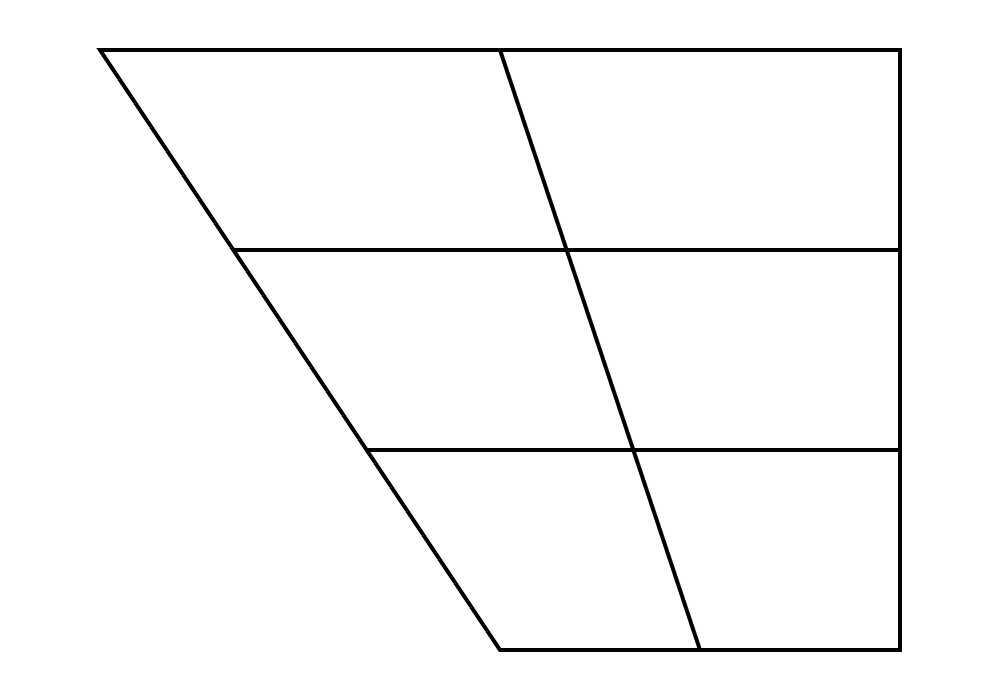
| |||||
| Near-close | ||||||
| Close-mid | ||||||
| Mid | ||||||
| Open-mid | ||||||
| Near-open | ||||||
| Open | ||||||
Phonotactics
Syllables are minimally V and maximally CrVVK
| Syllable | |||
|---|---|---|---|
| Onset | Medial | Nucleus | Coda |
| (C) | (r) | V (V) | (K) |
|
|
|
|
- Medial /ɾ/ can only go after a voiceless consonant and reduces to [l] after a fricative.
- Coda /n/ and /s/ assimilate by place of articulation to the following consonant
- Intersyllabic /ɾ.ɾ/ are fortitioned into /r./
Stress
It has a pitch-accent system that is mostly used to differentiate verbs from non-verbs.
Grammar summary
Basic sentence structure is SOXV, or Subject Object Oblique Verb.
Clause types
Relative
Muna uses a gapping strategy with a participle marking in the verb
- [late come-ptcp] girl-agt sad
- The girl [who came late] is sad.
Comparative
Muna uses an exceed type of comparative, in which a verb roughly meaning 'to exceed' is used with the two compared arguments.