Minhast: Difference between revisions
| Line 1,253: | Line 1,253: | ||
==== Preverb 3 Control Affixes ==== | ==== Preverb 3 Control Affixes ==== | ||
The Inverse Volitional affix interacts with the semantics of the verb root. If a verb root semantically implies the Agent has no control over an event, or the event is by happenstance and not by deliberate intent, the Inverse Volitional derives a verb that implies the Agent has control of an event or is actively seeking to determine its outcome. As an illustration, the verb root ''-sar-'' (to see) implies happenstance, where as the addition of the Inverse Volitional affix, yielding the form ''kaħsaran'' < ''-kah-sar-'' changes the meaning to "to look at" or even "to stare at". In contrast, the verb root ''-misk-'' (to be ill) semantically implies lack of control. Adding the Inverse Volitional Affix plus the Reflexive-Benefactive ''-sakšar-'' to yield the form '' | The Inverse Volitional affix interacts with the semantics of the verb root. If a verb root semantically implies the Agent has no control over an event, or the event is by happenstance and not by deliberate intent, the Inverse Volitional derives a verb that implies the Agent has control of an event or is actively seeking to determine its outcome. As an illustration, the verb root ''-sar-'' (to see) implies happenstance, where as the addition of the Inverse Volitional affix, yielding the form ''kaħsaran'' < ''-kah-sar-'' changes the meaning to "to look at" or even "to stare at". In contrast, the verb root ''-misk-'' (to be ill) semantically implies lack of control. Adding the Inverse Volitional Affix plus the Reflexive-Benefactive ''-sakšar-'' to yield the form ''kaħmisiksakšaran'' < ''-kah-misk-sakšar'' changes the meaning to "to deliberately infect oneself in order to play hooky". | ||
{| class="bluetable lightbluebg" | {| class="bluetable lightbluebg" | ||
Revision as of 03:37, 30 August 2017
| Minhast | |
|---|---|
| Minhast | |
| Pronunciation | [/'min.hɑst/] |
| Created by | – |
| Native to | Minhay |
| Native speakers | 26,232,430 (2005) |
Nahenic
| |
| Official status | |
Official language in | Republic of Minhay |
 | This article is a featured language. It was voted featured thanks to its level of quality, plausibility and usage capabilities.
Sapim kirim išpidustittuytammēru. Wahēk, kirim wahepraħmahan, kantašmahan, markakramaku, wahēk ezzakennemaru wammīn. |
Introduction
Minhast (Minhast min kirim, lit. "Minhast-speak") is the spoken language of the Republic of Minhay, with a robust speech community of nearly 26 million people, approximately one million of them living in expatriate communities, with the largest concentrations residing in the Ming Empire, the Kingdom of Koguryeo, the Rajahnate of Kirmai, the Sultunate of Daligan, the Xayda Federated Republic, and Western Canada. Significant numbers also exist in Northern Europe, principally in the Scandinavian nations Sweden and Norway.
The language is divided into two major branches, Upper Minhast and Lower Minhast, each of which is divided into several smaller dialects, such as the Salmon Speaker variant of the Upper Minhast dialect, and the Osprey Speaker variant of the Lower Minhast dialect. The subject of Minhast dialectology has sparked much research and controversy; more details on the research of dialectology may be found in Minhast Dialectology
Located just 1,232 km from northeast Japan, this Northeast Asian language bears few if any similarities with its nearest neighbors, the former Yamato Empire (Japan), the Kingdom of Koguryeo (Korea) and Ainushir (the Ainu Democratic Federation). Two other languages in the island nation, Peshpeg and Ín Duári (Golahát), both of which are moribund, are also unrelated; any similarities existing between the two languages and Minhast are due to areal features, with Minhast as the dominant influence. Linguists investigated possible relationships with the Altaic and Native North American languages, but failed to find any conclusive evidence. Words from Paleosiberian languages, principally Ainu, Nivkh and Chutchki, appear in the lexicon, however these have been identified as loanwords, albeit some of the loans appear to be very old, e.g. Minhast siħ ("trace") vs Nivkh zif ("tracks").
For these reasons, Minhast had long been classified as a language isolate. However, in a breakthrough study by Ming Wei and Jaeng Tae-Moon at the Department of Linguistics in Beijing Imperial University discovered shared features between Minhast, the Northwest Pacific language Nankôre, and the Native American language Nahónda, the latter two languages also having been classified as language isolates. Fossilized verbalizer morphemes afffixed to body parts, the relatively intact preservation of the form of the Causative affix and its relative position in each language's verbal template, and cognate sets and sound change correspondences demonstrated these far-flung languages as having a common ancestry. A major impediment to discovering Minhast's relationship to other languages was hampered by the paucity of literature on Nankôre; it was through the extensive documentation of this language by Brian Mills, from the Department of Indian Anthropology and Linguistics at the University of North Carolina that provided the material needed to link Minhast with Nankôre and Nahónda.
Typologically, Minhast is an ergative, polysynthetic language. Verbal morphology is highly aggluginative and performs noun incorporation and other complex valence operations. Unmarked word order is SOV. Ergativity surfaces both at the morphologic and syntactic levels. Both its ergative and polysynthetic characteristics have generated much academic research in comparative and theoretical linguistics.
Phonology and Orthography
Phonemic Inventory
The following chart contains the consonants in the Minhast phonology. Common dialectal variants are marked with an asterisk (*). The phonemes /q/ and /χ/ are found only in the Seal and Wolf Speaker dialects. The origin of these phonemes in the Seal Speaker dialect is unknown, and occurs in only a handful of words. The Wolf Speakers have acquired these phonemes from contact with the Seal Speakers, and they are found only in words of Seal Speaker origin.
The Seal Speaker, Wolf Speaker, Horse Speaker and Gull Speaker dialects have either acquired or developed /ɣ/ or [ɣ]. The origin of this phone in the Seal Speaker dialect is unknown, and occurs in only a handful of words, nevertheless it is phonetically distinct. In the Horse Speaker dialect,the phone [ɣ] occurs as a result of assimilation of /r/ → /x/; however the phone has not acquired phonemic status. In the Gull Speaker dialect, [ɣ] occurs as a result of assimilation of /r/ → /g/; again, the phone has not acquired phonemic status.
Only the Horse Speaker dialect has /ħ/ as an independent phoneme. If preceded by a vowel, /ħ/ causes it to lengthen. In contrast, the phone is treated by the other dialects as an allophone of [h], and occurs frequently under predictable phonotactic rules.
| Bilabial | Alveolar | Palatal | Velar | Uvular | Glottal | Laryngeal | Pharyngeal | |
|---|---|---|---|---|---|---|---|---|
| Nasal | m | n | ŋ | |||||
| Plosive | p b | t d | k g | q* | ʔ | |||
| Fricative | f | s z | ʃ | x ɣ* | χ* | h | ħ | |
| Affricates | ||||||||
| Approximants | w | j | ||||||
| Trill | r | |||||||
| Lateral Approximant | l |
Minhast Vowel Inventory
| Front | Near- front | Central | Near- back | Back | ||
| Close | 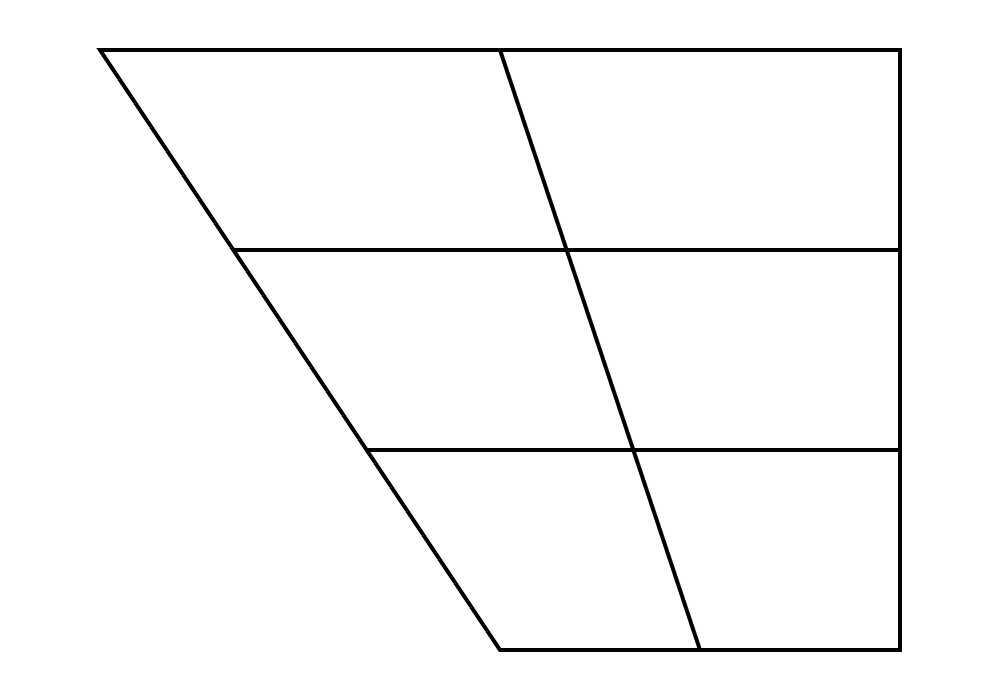
| |||||
| Near-close | ||||||
| Close-mid | ||||||
| Mid | ||||||
| Open-mid | ||||||
| Near-open | ||||||
| Open | ||||||
Vowel length in Minhast is distinctive. Devoiced vowels occur as allophones frequently, based on regular phonotactic rules:
| Short | Long | Devoiced |
|---|---|---|
| /a/ | /a:/ <ā> | [ạ] |
| /ɛ/ | /e:/ <ē> | [ẹ] |
| /ɪ/ | -- | [ị] |
| -- | /i:/ <ī> | -- |
| /u/ | /u:/ <ū> | [ụ] |
Syllabic Structure and Phonemic Interactions
Minhast words are subject to complex morphophonemic changes resulting from interactions with other morphemes occurring in the word. The verb is particularly complex in the various sound changes that may occur as a result of noun incorporation as well as the aggluginative processes involved in conjugation or other inflectional processes. These phonemic changes can be broken down according to the following classifications:
- Assimilation
- Metathesis
- Syncope
- Epenthesis
- Voicing/Devoicing
- Aspiration
These complex morphophonemic interactions operate according to the general phonological principals outlined below:
- No syllable can have a consonant cluster of more than two consonants. Syncope can be applied only if a biconsonantal cluster is formed, and the vowel is not a part of a heavy syllable (i.e. the vowel is long, or it occurs in a VCC sequence).
- No Minhast word can have an initial consonant cluster. After any initial consonant cluster results from one or more of the possible morphophonemic alternations described below, an epenthetic is automatically appended to the head of the word to form the permissible iCC- pattern.
- An epenthetic vowel is always inserted between two syllables if combining the syllables results in a triconsonantal cluster. The default epenthetic vowel is -i-, but the other 3 vowels may also be used, depending on multiple factors (e.g. vowel harmony, an underlying quiescent initial vowel as part of the attached morpheme, etc.)
- Minhast has a strong tendency to form intermedial clusters, either or , providing that Rules #1-#3 are observed. If necessary, an epenthetic vowel may be added before or after the syllable to create these syllabic patterns, e.g. e.g. kanut-maris-kar- >> -kant-(u)-maris-kar
- The tendency to form intermedial consonant clusters creates complex assimilation interactions that nevertheless are predictable and almost always regular. These interactions are illustrated in Table X below:
Minhast Phonotactics Table
Initial
ConsonantFinal Consonant f p b k x g t d s š z l r m n h w y f ff pp pp fk fx fk ft ft fs ff fs fl fr fm fn ff fw fy p pp pp pp pk xp pk pt pt ps ħp ps pl pr pm pn ħp pw py b pp pp bb pk xp mg pt mb ps ħp ps bl br mb mb ħp bw by k kf kp kp kk kk kk kt kt ks kš ks kl kr km kn ħk kw ky x xf xp xp kk xx gg xt xt ss šš ss xl xr xm xn xx xw xy g kf kp gb kk kk gg kt gd ks ħk zg lg gr gm gn ħk gw gy t ft pt pt kt xt kt tt tt st št st tt rt mt nt ħt wt šš d ft pt bb kt xt gd tt dd st ħt zd ld rd mb nd ħt dw dy s sp sp sp sk šš sk st st ss šš ss sl
ssss sm sn ħs sw šš š šf šp šp šk šš šk št št ss šš ss šl
šššš šm šn ħš šw šš z sp sp zb sk ss zg st zd ss šš zz zl
zzzz zm zn ħs zw zy l lf pp lb kk xl lg tt ld sl
ssšl
ššzl
zzll rr lm
mmnn ħl lw yy r rf rp rb rk rx rg rt rd
ddrs
ssrš
ššzz ll rr rm
mmnn rħ
ħrrw ry m mf mp mb nk xn mg mt md ns šm nz lm
mlmr mm nn mh ww my n mf mp mb nk xn mg
ngnt nd sn
ss
(ns)šn
šš
(nš)nz ll rr mm nn nh nw ny
yyh ff ħp ħp ħk xx ħk ħt ħt ħs ħš ħs ħl ħr ħm ħn ħħ ħw ħħ
- Vowels are classified according to a "weak-strong" gradient, where the "strong" vowels are more resistant to syncope than neighboring "weak(er)" vowels. All long vowels are by definition "strong", so the weak-strong gradient really applies to short vowels: Table X: Vowel Gradients In Order of Increasing Strength
- The shape of a -CVCVC- syllable may contract either to a -CCVC- or -CVCC- pattern, depending on the strength gradients of the vowels with respect to one another. The -CaCaC- syllable pattern is the only one that does not contract. Syllables consisting of the same vowels may appear in either -CCVC- or -CVCC- patterns; the pattern they resolve to is influenced by interactions from surrounding syllables. These contractions are summarized in the following table:
Initial Pattern Final Contraction -CaCaC- (no change) -CaCuC- -CaCeC-
-CaCiC-
-CaCC- -CuCaC- -CeCaC-
-CiCaC-
-CCaC- -CuCuC- -CuCeC-
-CuCiC-
-CuCC- -CuCuC- CeCuC-
-CiCuC-
-CCuC- -CeCeC- -CeCiC-
-CeCC- -CeCeC- -CiCeC-
-CCeC- -CiCiC- -CCiC- -CiCC-
- A verb root or an incorporated noun tends to lose one or more vowels to form at least one biconsonant cluster. The vowel that is lost depends on its strength gradient in relation to the noun of the neighboring syllable.
- With the exception of pattern -CaCa-, when two adjoining syllables have vowels within the same gradient, vocalic syncope resolves to CVCC.
- The pattern (C)VVCC always resolves to (C)VCC
- Compared to nominal and verbal roots, inflectional morphemes (e.g. theme, aspect, tense, person, etc) are resistant to syncope because this may lead to the inflectional morpheme to be changed beyond recognition. For example,-šp-irak- he informed (him) (lit. "he caused him to know") does not resolve to -šip-rak-, even though this would prevent the impermissible CCV pattern from occurring. Instead, an epenthetic vowel is added before the causative affix to prevent this impermissible consonant cluster from occurring.
- Although inflectional morphemes do not experience syncope, they still may experience phonological changes in the form of metathesis and devoicing.
- Vowel devoicing occurs in C'VħC, C'VxC', C'VsC', or C'VC' syllables, where C' is any of the unvoiced consonants listed in Table X.
- The initial consonant in syllables with devoiced vowels are strongly aspirated.
- Liquids and nasals devoice in the word-final syllabic patterns CVC'l, CVC'r, CVC'm, and CVC'n, where C' is any of the unvoiced consonants listed in Table X.
- Two consecutive syllables with the pattern CVħCVħ resolves to CVCCVħ, due to the difficulty of pronouncing the allophone in two consecutive closed syllables. Additionally, the vowel in the previous syllable may be devoiced if its adjacent consonants are voiceless, as in Example A, where the verb root vowel -a- which occurs the voiceless consonants -k- and -h- devoices to -ạ-. Note also the epenthetic vowel -i- appearing between the verb root and the 1st person incl. pl. affix ,-ħk- e.g.: nattiħkemkaraban >> *naħtiħkemaraban >> *naħt-hkem-ar-ab-an "We were (being) annoying" (lit.: annoying-we.and.you-[past]-[ imperf.]-[intrans]) nekạħtikemaraban >> *nekạħtịħkemaraban >> *nekạħt-ħkem-ar-ab-an "I was avoiding..."
- Dissimilation occurs in CVC-patterns involving š-Vš, resolving to s-Vš. A prime example is the number "twenty", e.g.*šan-šentāz >> *san-šentāz > > saššentāz
- Dissimilation occurs in CVC-patterns involving mVm, resolving to nVm.
Orthography
Minhast uses two writing systems. One of them is a variant of the Latin script, called "Ammerkast". This variant is an adaptation of the Americanist phonetic notation, with the exception of the grapheme <ħ>, which was adopted from IPA. Note the glottal stop <'> is usually not written unless there is a hiatus between two vowels.
| Ammerkast Characters |
|---|
| a, ā, e, ē, i, ī, u, ū, ('), b,p,f, d, t, g, k,x n, m, l,r, z, s, š,h, ħ, w,y |
However, Minhast has an indigenous script. This script is descended from a Philippine abugida called Baybayin, the official script of both the Rajahnate of Kirmai and the Sultunate of Daligan. The Baybayin script itself is ultimately descended from the Sankrit script. Merchants from the two principal Philippine powers are believed to have brought the script to Minhay around 1300 CE. The Salmon Speakers appear to have been the first to adopt the Baybayin. The following graphic shows the present-day standardized Baybayin that predominates in the Philippine nations:
The Baybayin

Shortly after the adoption of the Baybayin, the Salmon Speakers introduced several modifications. Some of the modifications arose due to the constraints the materials for writing: wood is an abundant resource in Salmon Speaker Country, and knives and metal blades were the principal instruments available for incising the scripts onto this medium. Thus, the curved lines of the Baybayin characters were either unsuitable or inefficient in writing; the material the Salmon Speakers had favored straight and angular lines, and so they created a straight-incision style. Additionally, the Salmon Speakers added new characters to represent sounds not represented in the original orthography, such as /r/. The script was reorganized such that consonants with the same points of articulation, e.g. all labial consonants, voiced, unvoiced, stops, and fricatives, would be represented by a single character with extensions to represent the different phonemes. Another innovation the Salmon Speakers added was to retain some characters from the older ideographic-logographic script, partly due to their usefulness as a type of shorthand, or due to some conservative/traditionalist influences. These changes eventually led to what has become today's script, know as the Širkattarnaft, which literally means "that which is scratched across a surface". This script is shown in the following graphic:
The Širkattarnaft

The relationship between the glottal stop in the Baybayin and that of the Širkattarnaft is recognizable. The Širkattarnaft glyph for <d> is actually an inverted form of the Baybayin glyph for <t>. Similarly, the Širkattarnaft glyph for <z> is descended from the Baybayin glyph <s>. Other discernable similarities can be found with the glyphs <l> and <m>. Some phonemes not found in the Tagalog or Ilocano languages were innovated, but these innovations came from a method of deriving additional glyphs from a base glyph from which certain classes of phonemes could be derived.
The Širkattarnaft was modified from the original Baybayin to map a base glyph and its variants to certain related phonemes (e.g. the base glyph <b> and its variants to the labial consonants). For example, the glyphs for the labials <p> and <f> are based on the glyph <b>. Additions of dashes to the base glyph distinguish voiced, unvoiced, and fricatives. This explains why there is less variability in the Širkattarnaft script. The glyphs for the dentals /d/ and /t/ in the Baybayin are represented by two separate glyphs that have no resemblance to each other; in contrast the glyphs in the Širkattarnaft for these same phonemes differ from each other only by the addition of a dash to the base glyph <d> to derive the glyph <t> . As can be seen from the chart, the voiced consonant is assigned the base glyph, and dashes are added to this base glyph for unvoiced and fricatives for a given phonemic class (labials, dentals, aleveolars, etc). The Širkattarnaft is thus more economical.
Each glyph of the Širkattarnaft has a default underlying vowel /a/; all other vowels must be marked explicitly attached to the vowel signs (indicated in the lower right-hand corner; the box is simply a representation of where the base glyph would be located). Long vowels are represented by a vertical dash through the diamonds representing the short vowels <u> and <e>, and a horizontal one between the diamonds of the vowel <i>.
The Širkattarnaft, unlike the Baybayin, is written vertically, from right to left.
The ideographic-logographic elements that were preserved in the Širkattarnaft include determinatives used to indicate case or even verbal tense. Glyphs for common words, such as conjunctions, connectives, existential particles, and negators were also preserved. Some of these glyphs are combinations of two glyphs, as in the glyph for hambin ("there is no X"), which is a combination of the negator hatāʔ and matti ("there is an X"). The characters for the case clitics =(a)ran (Dative), =ni (Benefactive), =yar (Ablative), =par (Instrumental), etc. can actually appear before a verb written in the Širkattarnaft, in which case these characters represent the Applicative affixes -dut-, -rak-, -raħk-, -ngar-, respectively.
To see the evolution of the Baybayin to the Širkattarnaft, the following graphic illustrates how the Širkattarnaft characters map to the corresponding Baybayin characters from which they were derived:
Mapping of Širkattarnaft to Baybayin Characters

Nouns
Gender, Number, and Case Marking
1) Gender: All nouns have an intrinsic gender; interestingly, some nouns may have multiple genders, each gender conveying different meanings; these should be considered separate lexical entities. However, nouns are not inflected or marked by gender affixes or clitics. Instead, cross-reference affixes in the verb identify the gender of the nouns that serve as core arguments of a clause; in contrast, oblique argument, however, do not receive any marking. Thus, gender of each noun must be memorized in order to choose the correct verbal affix, or to identify the gender of a noun serving as an oblique argument.
2) Number: Nouns do not inflect for number. Verbal cross-reference affixes (see section below on verbal Pronominal Affixes) can mark number on Ergative and Absolutive noun phrases, but do not provide any information about number for non-core NPs. Speakers must rely on context or use numbers in a min construction using the formula [number + min + NP], e.g. “šānī min redad” (i.e. “two man”) to mark plurality; otherwise the default number is singular.
3) Case: Although nouns are not overtly marked for gender or number by inflection or clitics, they do take case marking clitics that attach to the end of the noun or noun phrase. There are two core nominal arguments: the Absolutive which receives zero marking, and the Ergative clitic =de. The Genitive derives from the same =de clitic as the Ergative, and in most declension tables are thus listed as the Ergative-Genitive case. However, there are several allomorphs where the Ergative and the Genitive diverge in form, as illustrated in the following table:
| Resulting Form | ||||
|---|---|---|---|---|
| Preceding Phoneme(s) | Ergative | Genitive | Genitive + Ergative | |
| (V)V, g, z | =de | =de | =de | |
| l,r, n | =de | =t | =te | |
| f, p,k, x, s, š,h | =te | =t | =te | |
| m | =be | =t | =te | |
| b | =mbe | =pt | =pte | |
| d | =e | =te =tide |
=te =tide | |
| t | =te =tide |
=te | =te =tide | |
| C1C2 | =e =ide |
=e | =e | |
| nk ng |
=ide | =ide | =ide | |
| CC | =e =ide |
=ide | =e =ide | |
Additionally, there are seven basic Oblique case clitics to non-core NP arguments, plus a few others that are dialectal, rare or have fallen out of use, such as the Inessive =kīr/=kir. Most of the Oblique clitics have two forms, one form with a short medial vowel, and the other with a long medial vowel. Use of both forms are acceptable, but native speakers tend to use the clitics with short vowels when the clitic is preceded by a long vowel, while the converse is true for the clitics forms with long vowels. Highly uncommon postpositions, such as the aforementioned Inessive =kīr/=kir are marked with a double asterisk (**).
| Case | Postposition |
|---|---|
| Dative-Allative | =āran =(a)ran |
| Benefactive | =nī =ni |
| Ablative | =yār =yar |
| Locative | =kī =ki |
| Inessive ** | =kīr =kir |
| Instrumental | =pār =par |
| Commitative | =kān =kan |
| Malefactive | =daħ =dāħš =dāš |
4) Tense-Aspect Marking
Interestingly, nouns can receive the same TA marking of verbs. Minhast lacks a copula; instead, two separate NPs are simply juxtaposed, e.g. Ruggāyam kaslubekte ("Ruggāyam is my dog"). However, if the statement refers to a past or future event, simple juxtaposition cannot convey tense information. Therefore, the NP may be marked with any TA marker, in lieu of a copular verb, as in Ruggāyam kaslubekt-ar ("Ruggāyam was my dog"). The TA marker could just have easily been added to the first NP as opposed to the second, Ruggāyam-ar kaslubekt; or even both NPs could be marked, Ruggāyam-ar kaslubekt-ar.
Noun Classes
Nouns are divided into three classes based on the syllabic pattern of the final syllable of the noun. The Class I nouns (also known as “Strong Stem” nouns) are those whose Absolutive forms end in a single consonant, or a short vowel. Additions of a short-vowel clitic do not change the noun stem's final vowel. The rules of vowel apocopation, however, still apply.
Class II nouns are divided into three subtypes, with Absolutive forms ending with the glides -ea, -ia, or -ua. Class II nouns undergo a morphophonemic process whereby the final -a of the noun stem is dropped and the preceding vowel is automatically lengthened when either a short or a long-vowel case clitic is attached to the noun stem. Additionally, during noun incorporation the entire glide is elided. Examples are as follows for marua, yarea, and simmia, meaning “the 'star' Venus”, “young girl”, and “moonless night”, respectively.
Class III nouns all terminate with either a consonant cluster or gemminate consonnants. If the following clitic that attaches to it has a quiescent vowel, such as the Dative clitic =(a)ran, the quiescent vowel resurfaces to prevent an impermissible CCC pattern, or the epenthetic vowels -i- or -e- is inserted. An additional feature is that these nouns will select the long-vowel forms of case clitics if they do exist.
These nouns are contrasted against the Class I noun gāl (“horse”).
| Absolutive | Pre-clitic Form | Incorporated Form | Examples | Meaning | |
|---|---|---|---|---|---|
| Class I | gāl | gal= |
-gal- |
galde, galyār | horse |
| Class II | marua | marū= |
-mar- |
marūde, marūpar | the "star" Venus |
| yarea | yarē= |
-yar- |
yarēde, yarēran | young girl | |
| simmia | simmī= |
-simm- |
simmīde, simmīkan | moonless night | |
| Class III | asr | asr-, asre- |
-asr- |
asride, asrenī | nose |
| niss | niss-,nisse- |
-niss- |
nisside, nissekī | branch covered by snow |
Interrogative Pronouns
| English | Minhast |
|---|---|
| Who | šikk, darad |
| What | bak |
| Which | ādan min; adānim |
| When | sippan, sippamey |
| Why | bakran, širekka |
| How | bakpār |
| Where at | nakkī |
| Where to, whither | nakran |
| Where from, whence | nakyar |
| At which location | nakkīdān |
| From which location | nakkīdanyār |
| To which location | nakkīdarrān |
| How many/how much | yuški, bitakku |
Quantifiers
| Quantifier | Substantive | Attributive |
|---|---|---|
| All | rea | rem
suppī min |
| Most | šie | šim |
| Some | rem | azarim
ikyem |
| Many | san, addua | sam, addum |
| Both | šani | šanim |
| Each | uššumī | uššumīm |
| Few | kattua | kattum |
| Another/Other | xani
nexāni |
xanim
nexāni min |
Pronominal Forms
| Person - Number - Gender | Independant Forms | Bound Forms | ||
|---|---|---|---|---|
| Ergative | Absolutive | Oblique | Attributive | |
| 1st Sg. | yakte | yak | yak- | -ek |
| 2nd Sg. | tahte | taħ | tah-,taħ- | -taħ |
| 3rd Masculine - Common Sg. | kūde | kua | kū- | -na |
| 3rd Feminine Sg. | lēde- | lea | lē-, ley- | -lea |
| 3rd Neuter Animate Sg. | šemet | šea | šē-, šey- | -šea |
| 3rd Neuter Inanimate Sg. | mēde | mea | mē-,mey- | -mea |
| Plural | ||||
| 1st Plural Inclusive | hakemt(e) | hak | hak- | -(h)akkem |
| 1st Pl Exclusive | nemt(e) | nem | nem- | -nem |
| 2nd Pl. | taħtemt(e),tahemt(e) | taħtem,tahem | taħtem-, tahem-, taħm- | -taħtem, -tahem, -taħm |
| 3rd Masc./Common Pl | kemt(e) | kem | kem- | -kem |
| 3rd Fem. Pl. | wext(e) | wexī, weššī | wex- | (n/a) |
| 3rd Neut. Anim. Pl. | sešt(e) | seš | sešš(i)- | -sseš |
| 3rd Neut. Inanim Pl. | maħt(e) | maħ | mah-, maħ- | -maħ |
Demonstrative Pronouns
Minhast demonstrative pronouns make a four-way distinction. As attributives, they precede their heads, joined by the connective min to the NP they modify. They may also be cliticized to their heads. The cliticized forms tend to be used in the Lower Minhast and City Speaker dialects, particularly in informal speech.
| Independent | Attributive | Clitic | Comments | |||
|---|---|---|---|---|---|---|
| Absolutive | Ergative | Absolutive | Ergative | |||
| Proximal | sap | sapte | sapim, sap min | =sap | =sapte | this one, near the speaker |
| Medio-proximal | nax | naxt(e) | naxtim | =nax | =naxt(e) | this/that one near the listener |
| Distal | waššī | wašt(e) | waššim | =waš | =wašt(e) | far from both speaker and listener |
| Invisible | kiryit | kirte | kiryit min | =kirit | =kiryit | n/a |
The personal deictic pronouns are portmanteaus of the interjective demonstrative particles, e.g. eyha (here is), plus the verbal pronominal absolutive affixes, with the exception of the second singular and third masculine singular forms, which appear to be from the clitic stative forms. Other forms are portmanteaus of the deictic adverbs tāra (there next to you), and kāmu/aššak (over there, away from us) cliticized by a pronominal clitic. An Invisible form does not occur.
| Person | Proximal | Medio-Proximal | Distal | |
|---|---|---|---|---|
| 1st Sg. | eyhak | -- | -- | |
| 2nd Sg. | ettaħ | tartaħ | kamtaħ/aššaktaħ | |
| 3rd Masculine - Common Sg. | ennu | tārannu | kannu/aššaknu | |
| 3rd Feminine Sg. | eyhal | tāral | kāmul/aššakl | |
| 3rd Neuter Animate Sg. | eyhaš | tāraš | kāmuš/aššakš | |
| 3rd Neuter Inanimate Sg. | eyham | tāram | kāmum/aššakam | |
| Plural | ||||
| 1st Plural Inclusive | eħħak | --- | --- | |
| 1st Pl Exclusive | eyham | --- | --- | |
| 2nd Pl. | ettam | tartam | kāmtam/aššaktam | |
| 3rd Common Pl. | eyhakm | tārakm | kāmukm/aššakukm | |
| 3rd Neut. Anim. Pl. | eyhi | tāri | kāmi/aššaki | |
| 3rd Neut. Inanim Pl. | eyhammaħ | tārammaħ | kāmmaħ/aššakmaħ | |
Numbers
Cardinal and ordinal numbers are one of the [two/XX] groups of true adjectives in the Minhast language. Minhast employs a vigesimal, i.e. base-20, counting system. Numeric expressions involve binding the number and modified noun in a specific construct involving the ligature: Both cardinal and ordinal numbers can take possessive pronominal suffixes (see Part III "Syntax - Possession" for discussion of possessive constructs), which then convey "X number of..." in the case of cardinal numbers, and "the Xth one of/among..." for ordinals, e.g.:
Meneħnemš nasxēreħ inkunnuħnemaran "Four of us went out there into the forest."
Menhakkem nasxēreħ inkunnuħkēmaran "The fourth one among them went into the forest."
The numbers 1-10 even have intransitive verbal forms, meaning "There were X number of us/you/them." The cardinal, ordinal, and verbal forms are summarized below:
| Number | Cardinal | Ordinal | Verbal |
|---|---|---|---|
| one | šūmi | sanannūx, manx | -šūmi-an |
| two | šānī | šānāx | -šān-an- |
| three | duxt | duxtāx | -duxut-an, -duxt-an |
| four | meneħ | menhāx | -mene-an, -menh-an |
| five | kaħtam | kaħtamāx | -katam-an |
| six | silix | silxāx | -silix-an, -silx-an |
| seven | gelix | gilxāx | -gelix-an, -gelx-an |
| eight | mun | munāx | -mun-an |
| nine | karun | karnāx | -karun-an, -karn-an |
| ten | tazem | tazmāx | -tazem-an, -tazm-an |
| eleven | šiktāz | šiktezāx | ---- |
| twelve | sen | senāx | ---- |
| thirteen | halk | halkāx | ---- |
| fourteen | duggalk | duggalxāx | ---- |
| fifteen | āš | āšāx | ---- |
| sixteen | neš | nešāx | ---- |
| seventeen | manšat | manšatāx | ---- |
| eighteen | zenat | zenatāx | ---- |
| nineteen | zelkark | zelkarkāx | ---- |
| twenty | šentāz | šentezāx | ---- |
| twenty-one | šentāz-u-šum | šentāz-u-manāx | ---- |
| twenty-two | šentāz-u-šan | šentāz-u-šanāx | ---- |
| twenty-three | šentāz-u-duxt | šentāz-u-duxtāx | ---- |
| thirty | šentāz-u-tazem | šentāz-u-tazmāx | ---- |
| forty | saššentāz | saššentezāx | ---- |
| fifty | saššentāz-u-tazem | saššentāz-u-tazmāx | ---- |
| sixty | duššentāz | duššentezāx | ---- |
| seventy | duššentāz-u-tazem | duššentezāx-u-tazmāx | ---- |
| eighty | meneštazem | meneštazmāx | ---- |
| ninety | meneštazem-u-tazem | meneštazmāx-u-tazmāx | ---- |
| one hundred | gādi | gādyāx | ---- |
| one thousand | gaggādi | gaggadyāx | ---- |
Verbs
Minhast possesses a complex grammar, demonstrated in particular by the elaborate polysynthetic morphology of its verbal system. The Minhast verb inflects not only for tense and aspect, but can inflect to indicate mood, modality, causation, potentiality, intensity, and other functions. The verb also possesses a well-developed set of pronominal affixes used to cross-reference the core arguments of a clause. These affixes indicate both gender and number of the nouns they cross-reference, an essential function as Minhast nouns themselves do not have any markings to indicate these two classifications.
Additionally, the verb can carry out three other operations, that of noun incorporation, antipassivation, and applicative formation, used by speakers for discourse purposes such as backgrounding previously established information and for changing the argument structure of the phrase for the purposes of focusing on a particular argument, ensuring that priviledged noun phrases retain their core status, or to employ rhetorical devices. This polysynthetic characteristic can lead to very long verbs that can express an entire sentence. To demonstrate, the English phrase, "You did not even try to get them to reconsider the matter with this evidence" requires only three words in Minhast: "Keman yattah, tašnišpipyentisannasummatittaharu", meaning literally "To them the evidence, not-try-cause-return-look.at-yet-matter-with-it.you-did." The verb "tašnišpipyentisannasummatittaharu", which is an individual sentence in its own right, can be parsed to its individual morphemes, yielding "Ta-šn-šp-b-mat-yent-sar-nasum-tittah-ar-u" (NEG-CON-CAUS-RESUMP-DEFERRED-look.at-matter-INSTR.APPL-3S.INANIM.ABS+2S.AGT-PST-TRANS).
Transitivity is determined by the number of core arguments, that is Agent or Patient/Goal. Minhast verbs do not necessarily map to traditional (i.e. Indo-European) notions of transitivity. As an example, the English sentence, "He jumped on the table" is grammatically intransitive. Available to the Minhast verb are both intransitive and transitive mappings: "Zekyaškī nirriekaran" , which is grammatically intransitive, with zekyaš=kī an oblique argument. The same meaning can be expressed transitively when the verb's valence is altered when the locative applicative affix (i)-n(i)- is applied: Zekyaš in-nirrieku.
Verb Types
Minhast verbs can perform functions that are usually associated with other grammatical categories in other languages. For example, Minhast does not have a separate grammatical category for adjectives. Instead, verbs are used in place of adjectives. Verbs are divided into five broad categories:
- Interrogative
- Impersonal
- Attributive
- Stative
- Event
Interrogative verbs are an unusual feature of the Minhast verbal system, and are rare cross-linguistically but may be found in other languages such as Takic, a North American language from the Uto-Aztecan family. In many languages, certain interrogative words co-occur with certain verbs with high frequency. Using English as an example, the verbs in the questions "What happened?", "Where are you going?", "Why did you do it?" illustrate that certain verbs, when they take a WH-word as an argument, have a statistically higher probability of picking one or two WH-words above others. In Minhast, the Interrogative Verbs serve as a shortcut, precluding the need for constructing a whole interrogative sentence with at least two constituents, the WH-word and the verb it is serving as an argument to.
Interrogative verbs can either be zero-valent (i.e. an Impersonal Verb), as in "Innearaš?" >> *inea-ar-an=š [what.happened-PAST-INTRANS=IRREAL] ("What happened?"), univalent, e.g. "Nassuriattaharaš?" >> *nassuriat-tah-ar-an=š [what.did.do-2S.ABS-PAST=IRREAL] ("What did you do?"), or even divalent, i.e. transitive, e.g. "Išpinassuriattaharuš?" >> *šp-nassuriat-tah-u=š [CAUS-what.did.do-2S.ERG+3MS.ABS-TRANS=IRREAL] ("What did you make him do?). Interrogative Verbs can be inflected for tense, aspect, person-number (for univalent verbs), and in some cases, theme, as illustrated in the last example.
Where person-number marking is allowed, both second and third person singular/plural marking predominate; first person marking is infrequent. Many of these verbs appear to have a default tense, usually in the past but sometimes in the future, even though the verb has no explicit tense marking, e.g. maymaštahaš seems to have a default past tense even though the past tense affix -ar- does not appear; however if the past tense affix appears, the verb remains well-formed. Present tense meaning, if intended, is usually recoverable from context or discourse.
The following table contains the most frequently used Interrogative Verbs:
| Verb | Meaning | Valency | Gloss | Restrictions |
|---|---|---|---|---|
| tippakaš | “How did it happen?” | zero | tippak-an=š [happen.how-INTRANS-IRREAL] |
|
| kurraktahaš | "How many do you want?" | univalent | kurrak-tah-an=š [how.many.want-2S.ABS-INTRANS-IRREAL] |
|
| nassuriattahaš | "What did you do?" | univalent | nansuriat-tah-an=š [what.do-2S.ABS-INTRANS-IRREAL] |
|
| inneaš | "What happened?" | zero | innea-ar-an=š [what.happen-INTRANS-IRREAL] |
|
| paxtamaš | "When did it happen?" | zero | paxtam-ar-an=š [when.do-INTRANS-IRREAL] |
|
| iskumattahaš | "When will you come?" | univalent | iskumat-tah-an=š [when.come-2S.ABS-INTRANS-IRREAL] |
|
| naktatintahaš | "Where are you going?" | univalent | naktatin-tah-an=š [where.are-2S.ABS-INTRANS-IRREAL] |
|
| annatimaraš | "Where did this happen?/Where was this done? Where did he do this?" |
univalent | annatim-ar-an=š [where.happen-PAST-INTRANS-IRREAL] |
|
| maymaštahaš | "Who did this?" | zero | maymaštah-an=š [who.do-INTRANS-IRREAL] |
|
| puħtaš | "Where is he?" | zero | puħta-an=š [who.do-INTRANS-IRREAL] |
|
| ašiknuaš | "What are you doing/What is s/he doing?" | zero | ašiknu-an=š [what.do-INTRANS-IRREAL] |
|
| kuyyureaš | "Why is this a bad thing to say/think?" | zero | kuyyure-an=š [why.bad.thought.-INTRANS-IRREAL] |
|
| tumbehētaš? | "How long will you be there/How long will you be doing that?" | zero | tumbehē-tah-an=š [how.long.be.there-2S.ABS-INTRANS-IRREAL] |
|
| uzurtahaš? | "What do you think?" | zero | uzur-tah-an=š [what.think-2S.ABS-INTRANS-IRREAL] |
Verb Template
The Minhast verb is divided into three major segments: the Preverb, the Verb Core, and the Terminatives. Each of these segments are divided into smaller sections or "slots", as they are termed in Minhastic linguistic literature.
Preverb 1 Modal Affixes
| Modal | Affix | Meaning | Additional Notes |
|---|---|---|---|
| Negation | ta- | no/not | This affix occupies the first slot of the verb template. |
| Preparative | -kar(a)- | to get ready to | |
| Expective | -naš- | supposed to, expected to | |
| Desiderative | -šak- | to desire, wish | Other affixes that may occur in this slot are "-xp-" (to enjoy), "-nisp-" (to hate), -"ruxt-" (to like), etc. |
| Conative | -šn- | try | |
| Abilitative | -mar- | can, to be able to | |
| Approximative | -ntar- | almost | Denotes an action that was or is nearly to be carried out. |
| Potentive | -nitt(a)- | might, possibly | |
| Causative | -šp- | to cause, bring about | When used with the Privative, become the Negative Causative |
| Permittive (Indirect Causative) | -mušk- | to allow | |
| Intensive | -nt(a)- | very, extremely | |
| Mitigative | -hipsa- -psa- -ps- |
a little, somewhat | Opposite and incompatible with the Intensive |
| Reversative-Privative | -mašn- | to undo or prevent | Reverses or prevents a state or action. |
| Necessitive | -(y)yat- | to be necessary | |
| Reactive | -knak- | to do the same action back to another (e.g. she hit him back) | This affix occurs only with semantically transitive verb roots |
| Excessive | -(ha)pm(a)- | very, extremely, too much |
Preverb 2 Aspect Affixes
| Theme | Affix | Meaning | Additional Notes |
|---|---|---|---|
| Deferred | -yent- | ||
| Resumptive | -b- | again | |
| Habitual | -asum- -asm- -asun- |
||
| Inclinative | -pniš- | ||
| Cessative | -kš- | to cease | Indicates the cessation of an action or state |
| Completive | -šmuxt- | to finish | Indicates completion |
| Inceptive | -nd- | to begin | |
| Continuative | -xt- | to continue | |
| Iterative | -xr- | to do several times | |
| Inchoative | -saxt- | to become | |
| Similitude | -šupn- | Technically this affix is a converb, not an aspect, however, due to its close association with the Inchoative, this affix migrated to its current position. |
Preverb 3 Control Affixes
The Inverse Volitional affix interacts with the semantics of the verb root. If a verb root semantically implies the Agent has no control over an event, or the event is by happenstance and not by deliberate intent, the Inverse Volitional derives a verb that implies the Agent has control of an event or is actively seeking to determine its outcome. As an illustration, the verb root -sar- (to see) implies happenstance, where as the addition of the Inverse Volitional affix, yielding the form kaħsaran < -kah-sar- changes the meaning to "to look at" or even "to stare at". In contrast, the verb root -misk- (to be ill) semantically implies lack of control. Adding the Inverse Volitional Affix plus the Reflexive-Benefactive -sakšar- to yield the form kaħmisiksakšaran < -kah-misk-sakšar changes the meaning to "to deliberately infect oneself in order to play hooky".
| Theme | Affix |
|---|---|
| Inverse Volitional | -kah- |
| Partial Control | -šk(e)- |
Preverb 4 Applicative Affixes
The Applicative Affixes are used to change the argument structure of a clause by increasing its valency, or by changing an oblique NP to core status as an Absolutive argument. The process of using an Applicative affix is often called "Applicative Formation", although other linguists prefer to use the term "Applicative Voice". This article will use the term "Applicative Formation" to emphasize that the argument structure of the clause is being changed by use of the Applicative affix. The Applicatives are used to promote an oblique argument to the Absolutive.
Although the Applicative Affixes encode spatial or directional information like the Oblique case clitics, they do not resemble them in form. Instead, they are the remnants of incorporated nouns from Proto-Nahenic; evidence of this comes from cognate nouns from Nankôre rahko "gift", macihi "hand", and nahko "room, enclosure".
| Case Role | Affix |
|---|---|
| Dative | -dut-
-utt- |
| Benefactive | -rak- |
| Instrumental | -mat- |
| Locative | -n-
-naħk- |
| Commitative | -ngar- |
| Ablative | -raħk- |
| Malefactive | -nusk- |
Verb Core
The verb core is diachronically the oldest part of the verb complex. Six components occur within this slot:
- Derivational Affixes
- Verb Root
- Incorporated Noun
- Prepronominal Affixes
- Pronominal Affixes
- Tense-Aspect Affixes
- Transitivity Affixes
Derivational Affixes - Telicity
These affixes interact with the semantics of the verb root, and in doing so, serve as derivational affixes. For example, the verb root -dāwap- (to drip), when prefixed with the Durative, creates the derived verb -ħtaštāwap-, which means "to trickle", and the verb root -sar- (to see) becomes -ħtassar- (to watch).
Unlike the affixes in the Preverbal slots, the Telicity affixes are usually not generated spontaneously in discourse, but when they do appear, the resultant forms are considered independent lexical entities in their own right. That is, the Preverbal affixes encode syntactic information, whereas the Telicity affixes, as derivational morphemes, are semantic in nature.
| Telicity | Affix |
|---|---|
| Durative | -ħtaš- |
| Semelfective | -minn- |
Verb Root
Incorporated Noun
Like many polysynthetic languages, such as Ainu and the Iroquioan languages, Minhast employs noun incorporation (NI) extensively to carry out various processes: derivation, case modification and valence operations, and discourse manipulation. The motivating factors for NI is a complex topic which is dealt separately in "On the Nature of Noun Incorporation in Minhast" (article forthcoming).
Noun incorporation is the process whereby a noun lexeme is absorbed into the verb complex. The noun is stripped of any inflectional markers and is then inserted immediately after the verb root. The noun is essentially treated as a verbal affix and plays an important morphological role. The incorporated noun is subject to complex morphophonemic sandhi, as described earlier in the Phonology section; moreover, a noun may have a reduced or irregular incorporating form, as in the case of -rupmak- << ruppamak (face).
One thing to bear in mind is that not all nouns can be incorporated. Proper nouns and many kinship terms, e.g. anxea (brother) cannot be incorporated. Similarly, toponyms and denonyms cannot be incorporated. Only one lexical noun root can be incorporated at a time. Only nouns functioning in certain case roles, namely Patients, Instrumentals, and Locatives can be incorporated, with Locatives restricted to locomotive and positional verbs. Agents and Subjects, however, cannot be incorporated.
Prepronominal Affixes
| Class | Affix | Additional Notes |
|---|---|---|
| Reflexive | -šar- -saššar- |
-saššar- is restricted to 3MS.PRF.REMOTE.PST (from: -šar-∅-šerr-) |
| Reflexive-Benefactive | -sakšar- | |
| Reciprocal | -šattar- -šatta- -šatt- |
|
| Reciprocal-Benefactive | -sakšatt- | |
| Reciprocal-Adversarial | -dus(s)art -dust- |
|
| Associative | -mmak- | |
| Associative-Benefactive | -sammak- | |
| Distributive | -tar- | The Distributive refers to an action or state across each Patient, and is usually translated as "each". The Distributive may also in some verbs indicate that the verbal event is spread out spatially across a surface, The Distributive has sometimes been analyzed as indicating pluractionality, but this interpretation presents problematic theoretical issues. |
| Partitive | -nesr- -ness- |
Conveys that only a portion of the argument(s) is involved in the verbal event or state, sometimes translated as "some". The Partitive does not refer to the Ergative argument of transitive clauses; for that, the appropriate Quantifier adjective/noun is used. |
The Reflexives, Reciprocals, and Associatives for the most part require plural agent marking and the Intransitive marker -an, but under certain circumstances, the verb may take a transitive structure with both agent and patient marking. For example, the Reciprocal Adversarial is required if the Reactive affix co-occurs to mean "do something back at someone". Transitivity raising via Applicatives may also trigger agent plus patient marking, with the possibility of either or both arguments being singular, as in the following example:
- Iyyamtarkarišpintasaxtinuskihuslapallustakšarekarundurkilwāš!
/ij:amtarkariʃpintasaxtinuskihuslapal:ustakʃarekarundurkil'wa:ʃ/
iyyat-mar-kar-išp-inta-saxt-nusk-huslap-allut-sakšar-ek-ar-un-dūr-kilwāš
NEC-ABIL-PREP-CAUSE-INTENS-INCHO-MAL.APPL-be.sharp-weapon-REFL.BEN-3S.ABS+1S.ERG-PST-TRANS-RSLT-MIRATIVE
Therefore it is necessary for me to ready myself thoroughly against him and make these weapons sharp, I say!
Pronominal Affixes
The pronominal affixes present one of the greatest challenges to the students of the Minhast language due to their inherent complexity in structure and morphosyntax. These affixes are agreement markers for the core arguments, i.e. the Ergative and Absolutive arguments. In addition to marking the syntactic roles of the core arguments, gender, animacy, and number are also encoded by the pronominal affixes. These affixes, along with the role affixes, also serve to identify the verb as transitive or intransitive, and thus must agree with the appropriate Transitive affix (see below). For the transitive verb, the pronominal affixes present greater complexities than those of the intransitive verb - the transitive affixes, representing both the ergative and absolutive arguments of the clause, are portmanteau affixes; although some patterns can be discerned from this fusion of the segments representing the ergative and absolutive components, the transitive pronominal affixes are mostly irregular and have to be memorized individually. As expected, the affixes may change shape due to the sound changes created by adjacent morphemes. However, many of these sound changes deviate from the normal assimilation patterns described earlier in Chapter X "Phonology".
Animacy marking is differentiated for the neuter genders only, as the masculine and feminine genders are inherently animate and thus require no special marking. Both the masculine and the feminine 3rd person plurals have merged into one common gender, while the gender for animate and inanimate neuter nouns are still distinguished. Remnants of a split ergativity can be found in the third person neuter animate singular, where the submorphememe of the portmenteau affix for the patient is derived from an earlier *-tir- Accusative form, as opposed to the expected form *-mah-".
Due to the complexity of the transitive pronominal affixes, their full forms are summarized in the next table:
| Agent (Singular) |
Patient (Singular) | |||||
|---|---|---|---|---|---|---|
| 1st | 2nd | 3rd Masc. | 3rd Fem. | 3rd Neut. Anim. | 3rd Neut. Inanim. | |
| 1st | ---- | -tak- | -(e)k- | -kk- [1] | -k- | -tirk- |
| 2nd | -(e)ktah- | ---- | -tah- | -ššittah- | -tah- | -tittah- |
| 3rd Masc. | -(e)knen- | -nten- -ntan- |
-nn-, -Ø- | -ššenn- | -enn- | -tir-,-tirenn- |
| 3rd Fem. | -kišš- | -tašš- | -šš- | -ssišš- | -šš- | -tišš- -tašš- |
| 3rd Neut. Anim. | -(e)k- | -t- -tay- |
-Ø- | -Ø- | -s- | -t- |
| 3rd Neut. Inanim. | -(e)km- | -tam- | -m- | -mm- [2] | -m- | -timm- -tamm- |
| Agent (Plural) |
Patient (Singular) | |||||
| 1st Incl. | ---- | ---- | -(h)ak- | -ššak- | -(h)aknem- | -tirħak- |
| 1st Excl. | ---- | -ntem- -ntam- |
-nn- | -ššennem- | -ennem- | -tinnem- |
| 2nd Common | -aktahm- | ---- | -mt- | -ššettem- | -ettem- | -tittem- |
| 3rd Common | -ekken- | -takken- -takkan- |
-nk- | -ššekken- | -seššen- | -tikken- |
| 3rd Neut. Anim. | -aksen- | -tasn- | -sn- | -ššess- | -sess- | -tiss- |
| 3rd Neut. Inanim. | -akmah- | -tammah- | -mah- | -(a)mmah- | -mah- | -timmah- |
| Patient (Plural) | ||||||
|---|---|---|---|---|---|---|
| Agent (Singular) |
1st Incl. | 1st Excl. | 2nd | 3rd Common | 3rd Neut. Anim. |
3rd Neut. Inanim. |
| 1st | ---- | ---- | -mtek- | -kenk- | -sek- | -mak- |
| 2nd | -(h)ektah- | -nimtah- | ---- | -kemtah- | -sat- | -mattah- |
| 3rd Masc. | -(h)akn- | -nenn- | -tenn- | -kenn- | -sen- | -mann- |
| 3rd Fem. | -(h)ašš- | -nešš- | -tašš- | -kešš- | -sešš- | -mašš- |
| 3rd Neut. Anim. | -(h)ak- | -nem | -tahm- | -kem- | -sm- | -ma- |
| 3rd Neut. Inanim. | -(h)akm- | -nemm- | -tamm- | -kemm- | -semm- | -namm- |
| Agent (Plural) |
Patient (Plural) | |||||
| 1st Incl. | ---- | ---- | ---- | -kemhak- | -sak- | -makkak- |
| 1st Excl. | ---- | ---- | -tamme- | -kemmi- | -sn- | -manne- |
| 2nd Common | ---- | -nittam- | ---- | -kettamm- | -suttam- | -mattam- |
| 3rd Common | -(h)akkem- | -nikkem- | -takkem- | -ikkem- | -skem-,-skum- | -makkem- |
| 3rd Neut. Anim. | -(h)aks- | -niss- | -tass- | -kess | -suss- | -mass- |
| 3rd Neut. Inanim. | -(h)akmah- | -nemmah- | -tammah- | -kemmah- | -smah- | -nammah- |
In comparison to the transitive pronominal affixes, the affixes for the intransitive verb are much simpler. There forms are listed below in Table X:
| Person | Absolutive |
|---|---|
| 1st Sg. | -k- |
| 2nd Sg. | -ta- |
| 3rd Masculine - Common Sg. | -Ø- |
| 3rd Feminine Sg. | -l- |
| 3rd Neuter Animate Sg. | -Ø-, -s- |
| 3rd Neuter Inanimate Sg. | -m- |
| 1st Plural Inclusive | -hak |
| 1st Pl Exclusive | -mm- |
| 2nd Pl. | -tam- |
| 3rd Common Pl. | -km- |
| 3rd Neut. Anim. Pl. | -i- |
| 3rd Neut. Inanim Pl. | -mah-, -ma- |
Tense-Aspect (TA) Affixes
| Tense | Affix | Additional Notes |
|---|---|---|
| Remote Past | -šar- | The Remote Past usually encompasses periods of decades or longer |
| Recent Past | -wax- | Past event/state that occurred no earlier than today, but occurred before an -ar- marked verb |
| Past | -ar- | |
| Present | -Ø- | Also encompasses the immediate past. |
| Immediate Future | -ne-, -nes- | |
| Future | -(a)satt- |
| Aspect | Affix |
|---|---|
| Imperfect | -(a)b- |
| Perfect | -Ø- |
| Distributed-Periodic | -(a)x- |
| Partial Completion | -knakt- |
A few additional comments need to be made about the tense and aspect markers. The Present Tense in combination with the Imperfect Aspect is commonly used as the "narrative tense" in both traditional oral literature, and modern literature involving poetry and fiction where the author wishes to convey a sense of intimacy and immediacy in a narrative. The Present Imperfect is also used in ordinary speech to describe an action that began in the past but nevertheless is still continuing, illustrated in such sentences as Tenkūr wandirahyilabu >> *tenkūr wa=ind-rahy-l-ab-u (CONN=INCEP-cry-DISTR-3SF-IMPF-TRANS), lit. "This morning she begins crying [still]". Minhast does have a Continuative affix -xt-, but it occurs in the Theme I slot. A different meaning would result if intervening affixes from the Theme I slot surfaced. For example, if the Theme I Iterative affix appeared after the Continuative affix, the resulting phrase Tenkūr waxtixrirahittarlabu >> *Tenkūr wa=xt-xr-rahy-tar-l-ab-u (CONN=INCEP-ITER-cry-DISTR-3SF-IMPF-TRANS) actually means "This morning she begins to continue to cry several times [still]." The latter sentence implies the act of crying occurred in discrete individual events since the start of crying. up until the present. The previous sentence, however, cannot be interpreted in that manner. This example shows that Minhast speakers consider time frames as relative to each other, as opposed to typical Indo-European languages that consider time as having discrete start and end point.
The Distributed-Periodic aspect marker, often translated as "from time-to-time" or when used with discrete time references ("every Thursday") indicates that the action, event, or state occurs with some sort of periodicity. If the periodicity is predictable (e.g. "every Thursday"), it co-occurs with the Habitual affix. The Distributed-Periodic does not indicate punctual or durative information, as they may occur ad-hoc in both telic and atelic verbs. Durative and punctual information is instead indicated by separate affixes, the Semelfective and the Durative; these affixes are derivational in nature and occur in a different slot in the verb template.
Transitivity Affixes
These affixes serve to mark the verb's transitivity. The Detransitivizer combines with other affixes, such as the Reflexive, Reciprocal, and the Antipassive. TheDetransitivizer occurs oftentimes when NI has taken place, provided that the totality of the verb's valence operations did not promote a former Absolutive argument to Ergative case, which may happen if the Applicative affixes and/or the Causative surface, as in Redadde kaslub dutittaħšitipraru ("The man gave the dog some meat", lit: The man the dog he-meat-gave-towards).
| Class | Affix | Notes |
|---|---|---|
| Detransitivizer | -an- -ēn- -en + C -ean -ā -ē |
The -ēn- and -en + C forms are non-pausal forms for when the preceding vowel is -e- or -ē-. Otherwise, the combination -ean occurs if the verb is sentence-final and no other affix follows. The forms -ā and -ē are seen only in the poetry of Classical Minhast and some Upper Minhast dialects. |
| Transitivizer | -u- -un- |
The archaic form -un- is often seen in Salmon Speaker and Wolf Speaker speech |
| Antipassive | -pi- | Since the Antipassive always results in a monovalent argument structure, it always occurs with the Detransitivizer affix -an-. |
Terminative Affixes
These affixes occupy the final position of the verb complex. They perform a variety of functions such as clause linking, conveying attitude, marking hypotheticals, and nominalizing a clause.
While some languages with evidential verbal affixes require their appearance, but in Minhast the evidential affixes are optional. Moreover, they have corresponding particles that may appear in their place. If the evidential affixes appear at the end of the verb complex, the Irrealis marker -š- cannot appear with the any of the Hearsay or Inferential evidentials, simply because the -š- has already fused with the base morpheme. The Visual evidentials, if accompanied by -š-, convey the meaning, "It appears to be..."; without it, they convey the meaning, "I know this because you (and I) have witnessed this." If the Scriptive appears with -š-, it either indicates that the speaker does not believe what was written, or that what was written turned out to be incorrect; thus it becomes a sort of counterfactual marker. The counterfactual meaning can be reinforced if the Scriptive is followed by the Unexpected marker -kil- + -š-, e.g. Ušnaruškattekiš << *ušn-ar-u-škatte-kil-š (hit-PST-TRANS-SCRIP-UNEXP-IRREAL) "It was reported (in the newspaper) that he hit him...(but) instead...," or "Had he hit him, as was reported in the newspaper..."
| Function | Affix | Notes | |
|---|---|---|---|
| Subordinative | General | -mā -pā- -pamā- -pāš- -pamāš- |
English translation: "then, and then, that". This suffix is the most commonly encountered Subordinative affix. Its primary use is to link Sequential clauses. It also interacts with other verbal affixes in clause combining operations to form conditionals, complements, and other clause types. The allomorph -pā/pamā is a fusion of the Antipassive affix -pi + -mā. The allomorph -pāš/-pamāš is a fusion of the Antipassive affix -pi + -mā + Irrealis -š. |
| Purposive | -nimmā | in order to (Note: the Irrealis -š may cliticize to this affix) | |
| Quotative | -namā | English: "Thus (x) says/said". Marks the following clause as direct speech. This affix allows for the breaking of the S/O pivot. | |
| Consequential | -dur- -dūr- |
Indicates the clause is a direct result of the preceding clause. May or may not be preceded by a -mā clause. If the Irrealis -š is attached, the affix's final consonant elides to the Irrealis, yielding the form -duš/dūš. This affix allows for the breaking of the S/O pivot. | |
| Evidentials | Gnomic/Generic | -št(a)- | |
| Visual - Exclusive | -(u)kku- | ||
| Visual - Inclusive | -ha-, -hāra- | ||
| Auditory | -pt- | ||
| Hearsay | -āhiš- | ||
| Hearsay - Dubitative | -harašša- | ||
| Inferential | -wašša- | ||
| Scriptive | -škatte- | ||
| Miratives | Unexpected | -kil- | Indicates the verb is a sudden, unexpected event or state. |
| Unexpected Negative Exclamatory |
-kilmakš- -kilmāš- |
Indicates the verb is a sudden, unexpected event or state, with strong negative connotations or disapproval. | |
| Unexpected Positive Exclamatory |
-kilwāš- | Indicates the verb is a sudden, unexpected event or state, with strong positive connotations or surprised delight | |
| Declarative/Intentive Absolute Exclamatory |
-rawaš- | Indicates the speaker is determined that the state or event shall be fulfilled; if accompanied by a negator, it conveys the meaning "never" | |
| Irrealis | -š- | This affix marks the VP as an unrealized and/or hypothetical state or event. It is used in interrogatives, hortatives, and imperatives. Additionally, this affix, combined with the Consequential affix and certain sentential particles to form hypothetical and conterfactual clauses. This affix tends to elide any consonant before it. The Irrealis is required with certain affixes, such as the Desiderative and allied forms, the Conative, the Inclinative, and the Future tenses. | |
| Nominalizer | =(n)aft | The =naft form is used for Transitive verbs, otherwise either =aft or =naft is used. | |
Derivation
With the morphological complexity of the Minhast verb, capable of encoding various grammatical categories like gender, number, transitivity, tense, aspect, valence, mood, and many other functions, it is striking that derivational morphology is sparse. The reason for this is simple. Minhast uses noun incorporation extensively, and one category of NI, namely Type I Noun Incorporation, is exploited to create verb-noun compounds to derive new vocabulary. The prevalence of compounding extends to the noun phrase as well, so noun-noun compounds like akkikrupumak ("Westerner" from akkik min ruppumak, lit. "Hairy-Face") abound. Many compounds, whether derived from Type I Noun Incorporation, or via noun-noun compounding, tend to have irregular NI forms, or no NI form at all, as in the previously mentioned akkikrupumak. The first noun in a noun-noun compound tends to be shortened, as in gubbakkūni (war chieftain, admiral, general, from gubbāt min ikkūne lit. war leader).
A few common Type I Noun Incorporation formations are used to derive instrumental, locative, and manner nouns:
- Instrument: Verb root + -sesp (from "hand"), e.g. kirismesp (lit. "speak-hand", i.e. "phone, cellular")
- Location: Verb root + -kian/-tappe (from "place"), e.g. kirinkian (lit. "speak-place", i.e. "auditorium")
- Manner: Verb root + -tak (from "style; way of doing something), e.g. kirimtak (lit. "speak-way", i.e. "presentation", as in a business presentation/proposal; "delivery, oratory style")
Other compound derivations:
- ittahipna - computer, derived from yittahi (to think) + tihipna (storage chest). This noun has an irregular NI form: -tahipn-
- apirtammus - grenade, derived from āpir (fire) + tammus (egg). Irregular NI form: -aptammus-
- teymekšumbat - missile, derived from tayyamak (thunder) + šumbat (arrow). Irreg. NI form: -teššumbat-
Sometimes derivations may be created by affixing verbal affixes to a verb or noun root, excluding the Post-TA and succeeding verbal slots:
- ixrikirim < *xr-kirim ITER-speak => "loquaciousness"
- ixrikirimtar < *xr-kirim-tar ITER-speak-DISTR => "gossip, rumour"
When combined with NI of nea (thing), an abstract noun may be formed:
- ixrikirinnētar < *xr-kirim-nea-tar ITER-speak-thing-DISTR => "thing(s) being gossiped about"
- intaxrišarkirinnētar < *inta-xr-šar-kirim-nē-tar INTENS-ITER-RFLX-speak-about.thing-DISTR => "philosophy" (lit. "Intensely talking back and forth to oneself about various things)
These complex verbal derivations, when accompanied by the Inclinative or the Habitative affix plus the Detransitivizer + Nominalizer, may derive profession nouns or indicate a person who engages in the activity indicated by the verb root or complex. The result is a nominalized verb:
- ixripniškirimtarannaft < * xr-pniš-kirim-tar-an-naft ITER-INCL-speak-DISTR-DETRANS-NMLZ => "gossiper"
Derivations resulting from a verb root plus one or more verbal affixes, be it a nominalization or otherwise, cannot undergo NI.
The Augmentive is also used to coin new terms from nouns:
- arrarar telescope (lit. "big eye", from ar => "eye"
- iptartaras bulldozer, backhoe (from iptas "hoe")
The Diminutive had been long falling out of use, but has been revived in the modern language to coin new terms as well:
- iptis forceps (also from iptas "hoe")
Particles
Existentials
Minhast uses two particles in Existential clauses, matti to indicate the presence of an entity, and hambin to indicate absence. Both particles can be marked for tense. Matti is joined to its head by the connective min or one of its allomorphs, whereas hambin is not. There is a diachronic reason for hambin's deviation from using the min particle. The particle's original form originated from the Old Minhast phrase *hatāʔ mattiaʔ emin, which does contain the old form of the min connective. But by Middle Classical Minhast, the phrase had eroded to hammᵊmin, and finally became its present-day form hambin. So in a sense, the negative existential particle still has the min connective, but in a highly eroded form.
The following table shows the existential particles with their tense conjugations:
| Form | Basic | Past Tense | Immediate Future | Future |
|---|---|---|---|---|
| Positive | matti min, mattim | mattarim | mattanem | massātum |
| Negative | hambin | hambarin | hambanem | hambatine |
The NP heads marked by matti and hambin must be in the Absolutive, as in the following examples: "Matti min redad" (There is a man, somebody is there) and "Hambin redad" (There is no man, nobody is here). The existential particles may precede a clause, in which case they are joined to the clause using the Preposed-Wa structure, e.g: Hambin redad, wattaharan šaħkurkampiš >> *Hambin redad, wa=tah=aran šak-hurk-an-pi=š [NEG.EXIST man CONN=2S=DAT DESID-harm-INTRANS-ANTI=IRREAL] = "There is no man (here) who wants to harm you." The correferent NP (i.e. Pivot) of the clause following the existential clause must also be Absolutive.
Demonstrative Adverbial Particles
The demonstrative adverbial particles can be divided into two classes, a spatial class and a temporal class. Both classes, with a few exceptions, have at least three forms, an independent form, and two forms for preposed wa= and postposed wa= constructions. The spatial class also has an Interjective form, usually best translated as "Here x is/are!", "There x is/are!" The demonstratives that are bound by the wa= Connective always require a clause to bind to. In contrast, the Interjective forms must immediately precede standalone NPs, thus they are not bound by the wa= Connective and cannot be followed by or embedded within a clause. Note too that the Interjective forms are apparently derived from different roots.
| Type | Independent Form | Preposed Wa= Form | Postposed Wa= Form | Interjective Form |
|---|---|---|---|---|
| Proximal | sappu | sappu wa= | wassappu | eyha |
| Medio-Proximal | naš | naš wa= | wannaši | tāra |
| Distal | wašia | wašša= | wassaše | kāmu/aššak |
| Invisible | hūrit | hūritta= | wahūrit | (n/a) |
| Type | Independent Form | Preposed Wa= Form | Postposed Wa= Form | Meaning | |
|---|---|---|---|---|---|
| Present | attim | attim wa= | wattim | now | |
| Past | Proximal | runa | runa wa= | warruna | just awhile ago |
| Distal | damikman | damikman wa= | n/a | a long time ago; once upon a time | |
| Future | Proximal | sukku | sukku wa= | wassukku | soon |
| Distal | saħrap | saħrap wa | wassaħrap | not soon enough | |
| Type | Independent Form | Preposed Wa= Form | Postposed Wa= Form | Meaning |
|---|---|---|---|---|
| Proximal | tūmeymasn | n/a | n/a | today |
| Medio-Proximal | ānim | n/a | n/a | yesterday |
| kēr | n/a | n/a | day before yesterday | |
| hufla | n/a | n/a | tomorrow | |
| Distal |
Discourse Particles
Minhast has a wealth of particles used to manipulate discourse, convey attitudes and expectations, express dissent, reconnect prior speech with the present discourse topic, among many other functions. Some of these particles are treated as clause-level dependents and as such are bound to their clause by a wa= construction. The rules as to whether a preposed wa= versus a postposed wa= should be used with these particles is not fully understood. Some particles appear as stand-alone adjuncts, rarely if ever being bound by a wa= construction.
| Particle | Type | Usage |
|---|---|---|
| wahēk, wahēki | Deictic/Sequential/Topic Shifter | Often translatable as "behold", this particle also functions similar to the verbal affix -mā general subordinator to connect sequential clauses. However, unlike -mā, the Absolutive argument in the wahēk clause need not be correferential to that of its matrix clause; in fact, correference between the Absolutive in the wahēk clause is dispreferred. More often then not, it allows the S/O pivot to be broken and the core arguments change syntactic roles, i.e. the Absolutive argument becomes the Ergative or an oblique argument, and any Ergative argument assumes Absolutive status. The wahēk argument is also often used to introduce new topics. The wahēki form is found only in Classical Minhast, and in Salmon Speaker, Wolf Speaker, and Horse Speaker poetry. |
| a, aħ | Receptive-Aknowledgement | Confirms that the speaker has understood the immediate preceding statement made by the listener. |
| ne, neħ | Presentational | Somewhat similar to the Proximal Demonstrative particles, this particle is used specifically when the speaker presents an object for view to the listener. |
| šenek | Interruptive | Used to politely prompt the listener to let the speaker resume talking, best translated as, "Pardon me/Excuse me” |
| anda | Interruptive | Similar to the interruptive function of šenek, this particle is used to forcefully break a long-winded monologue by the other speech participant, with the connotation of “If you'd shut up a minute and let me speak...!” |
| ayyak | Formal Vocative | When spoken, said to greet and elicit a response; also often found in the greeting of formal letters |
| wannā'(a) | Hortative | Particle of encouragement |
| nesukk(i) | Conjectural | Particle indicating indecision by the speaker of what the listener wants him to say |
| enna(ħ) | Concessive | Particle indicating speaker has conceded to listener's arguments |
| eyhar | Receptive-Vindicational | Particle indicating that the speaker has accepted the listener's conceding the argument, often translated as "I told you so" when used with certain pitch patterns, or simply to acknowledge that the item under contention has been resolved, and the speaker wishes to move forward, e.g. "Alright, so in any case..." |
| suakk(e) | Attitudunal | Particle indicating strong disgust, best translated as "That is is sooooo gross!", but depending on context can also convey, "I find what you are/did is totally reprehensible", or "That's stupid" |
| (na')inna | Connective | Particle recalling what the speaker immediately said previously to segue into a new statement, sometimes translated as "You know" but better "As you recall what I just said..." |
| heypa | Explanatory-Connective | Particle used to expand on previously mentioned statements in an attempt to convince the listenter. Usually translated as “You see...” This particle occurs in wa= structures, but it may also be inserted into the middle of a clause, without wa= binding |
| kāra | Connective | This particle is used to mark a clause as discourse material the speaker had forgotten to mentioned earlier, best translated as "Oh, by the way, I forgot to mention..." When combined with sitammā + previously mentioned discourse, the kāra-marked clause marks the location where the clause of the sub-narrative should be inserted into the discourse. In this case, the kāra-marked clause (joined to its clause by a preposed wa= construction) represents the prior event clause (PEC), and the sitammā-marked clause identifies the succeeding event clause (SEC). The submorpheme -mā, serves to mark clauses that are dependent on the clause immediately preceding it, and hence has a strong sequential quality to it. SECs in Minhast cannot precede PECs, so the kāra + [PEC] + =sitammā + [SEC] structure is used as a strategy to convey discourse where SEC + PEC sequences are allowed in other languages, such as in the English “Before he bought the wine from the store, he stopped at the ATM to withdraw some money.” In Minhast this must be rendered as illustrated in the following calque: “By the way, I forgot to mention, he stopped at the ATM then withdrew some money, then he went to the store” using the kāra + [PEC] + =sitammā + [SEC] structure. The following Minhast sentence may help clarify this further: "Rimarni išpintittaħlubaran. Kāra waknarassitammā irrixpaharammā, wassapu (Rimarni) išpintittaħlubaran." (He brought some meat for Rimar. I forgot to mention, first he went to the marketplace, then he bought the meat, then he brought the meat here (for Rimar)." |
| =sitammā | Connective | This is actually a verbal clitic, not a particle. It is always used in conjunction with kāra (see previous entry on kāra) |
| šukna | Empathy | Particle used by the speaker indicating sympathy to the listener for what the listener has said |
| ahātu | Connective | Usually translated as “therefore, thus” |
| ra'e | Confirmatory - Expective | Particle indicating that the speaker expects the listener to agree what the speaker just said |
| wāš | Exclamatory Interjection | Particle indicating (usually) pleasant surprise. It also a clitic form that is affixed to a verb |
| naxt(a) | Dissent/Disagreement | Particle indicating strong disagreement; often used as a counterargument to “ra'e” |
| sarakmampš | Evaluative-Disapproval-Conclusive | Particle which summarizes the entire points of the narrative, both speaker and hearer, upon which s/he bases the final conclusion of disapproval. Often translated as "Look at all that's been said. It's ridiculous, this situation/your argument..." etc., or more colloquially, "This is just a bunch of crap."
Note that the last syllable ends in the otherwise inadmissible consonant cluster -CCC-. This is a hallmark of the City Speaker dialect. |
| se(ħ) | Interruptive-Disapproval | Particle indicating mild disapproval of a person's statement or behavior |
| numpa | Dismissive | Marks the hearer's statement as invalid, usually translated as "nonsense" |
| niyūšue | Dismissive | A particle with a somewhat rude tone, used to mark the hearer's statement as invalid, usually translated as "nonsense" |
| daffāk wanyūš | Dismissive | A vulgar form of niyūšue, predominant in the City Speaker dialect |
| hamman | Dissent/Interruptive-Disapproval | Another Interruptive particle, used to convey strong dissent |
| hayye | Prompt | Particle used to elicit a response |
| kay | Emphatic-Assertive | Particle indicating the speaker's statement is beyond question |
| mek | Deferential | Particle used to soften an assertion or a command |
| tana | Deferential-Confirmatory | Particle of politeness, used to gently confirm that the listener agrees with what the speaker said |
| suš, surušši | Connective - Dissent/Disagreement/Interruptive | Particle of contradiction, brings to the foreground what the listener had previously said, and now the speaker is presenting a rebuttal to said statement. This is both an Interruptive and Connective particle |
| rumma | Connective - Contradictory | Best translated as "however". Unlike "suš/surušši", it does not bring back to the foreground previous statements; instead, the speaker uses it introduces new information. Note that foreigners studying Minhast mistakenly use this word to calque the coordinating conjunction "but", a non-existent conjunction in Minhast which is instead represented by clausal apposition. |
| kaddāħ | Emphatic Attitudunal-Dissent/Disagreement | Particle indicating strong dislike of the listener as a result of previous statements by the listener. Oftentimes translated as “You idiot!”, or even “F*** you!”.
Be VERY careful when using this particle!!! It is still classified firstly as a discourse particle, and only secondarily as an interjection, because the particle is still highlighting speech-related events. It's more specialized than FU because of the importance of bringing back to the foreground previous statements. |
| setta | Connective | Best translated as "even though" |
| xendāš | Dissent – Incredulative - Confirmatory | Best translated as “Really? Are you sure about that?” |
| ittayya | Incredulative-Confirmative – Contemptive | Best translated as “So this is what they say/believe/do!” |
| ka | Assertive | This is properly an interjection and appears at the end of the sentence without a wa= Connective. When used in conjunction with a verb marked with the Irrealis, ka transforms the sentence into an Imperative. This particle is rare, appearing only in Classical Minhast and some extremely conservative varieties of the Salmon Speaker dialect. The ka particle also has variants that appear as verbal affixes, e.g. -ka-,-kka and -nka. These affixes are also rare, again appearing mostly in Classical Minhast and conservative Salmon Speaker subdialects. |
| yattax | Contemptive | |
| ni, nī | Interrogative-Polarity | Used for yes-no interrogative sentences, this particle is not bound in wa= Connective structures, and can appear anywhere in a clause; the appearance of the ni particle is governed by scopal considerations, governing all elements, including clauses, to its left. This is a rare particle, appearing in Classical Minhast, occasionally in the Salmon Speaker dialects, but it is used pervasively in the Horse Speaker dialect, particularly when the speaker wishes to convey or emphasize assertiveness. |
Morphosyntax
Word Order
Minhast is an SOV language, but within a clause, constituent order is quite free, although there are certain trends as well as restrictions. One noticeable trend is that core NPs and the verbs they serve as arguments tend to be adjacent to each other. Oblique arguments tend to be placed before the core NPs, so that unmarked word order is XSOV (where X stands for the OBL argument). This observation can be verified statistically by reviewing of the corpus of texts and spoken speech, and this observation holds for almost 60%, close to one standard deviation of all text and recorded speech sampled. XOSV order is the second most common arrangement found, accounting for close to 30% of all observations. Since the Ergative argument in transient clauses are highly salient, the XOSV order defocusses the Ergative (Agent) argument and emphasizes the Absolutive (Patient) argument. SOXV and SXOV orders are regarded as unusual, and OSXV and OXSV orders tend to make speakers from the more conservative dialects in Upper Minhay cringe, although they will concede that those arrangements are grammatical. These arrangements account for the remaining 10% of observations.
What is almost inviolable,at least in multi-clausal sentences, is the position of the verb's clause-final position. The main reason for this restriction is most likely because the verb, being extremely suffix-laden, includes clause-linking and coordinating affixes which occur in the Terminatives slot of the Minhast verb template. Thus, the verb serves to mark clause boundaries and coordinate compound and complex sentences, hence the predominance of the verb's clause-final position. Nevertheless, verbs do occur in non-final position under the following circumstances:
- In monoclausal sentences, the verb may be placed as the first constituent of the clause. In the sample sentence Rassibararu Anyarde suharak >> rassibar-ar-u anyar=de suharak (reach.for-PAST-TRANS [proper.noun]=ERG book) ",Anyar reached for the book" is well-formed, even though the verb occurs in sentence-initial position. Here, the reaching for the book rassibar has been fronted, thereby raising its saliency in the discourse.
- When the clause (always either an independent sentence, or the final clause in a clause chain) is joined to a sentence-final particle by a Postposed-Wa Construction. The following sentence, containing a sequential clause followed by the final clause of the sentence is well-formed: Sayyumperan iknitaharammā, kalluttaharaš wabbāk? >> sayyumpe=aran ikn-tah-ar-an=mā, kallut-tah-ar-an=š wa=bāk ([proper.noun=DAT go-2S.ABS-PAST-INTRANS=SUB eat-2S-PAST-INTRANS=IRREAL CONN=what) "You went to Sayyumpe['s house] and ate what???".
- When followed by antitopics, often derogatory in nature, or interjections, e.g. Ussar tūmantirektaran hāran, wakkuhakna! >> ussar tūman-tirek=de=aran hā-ra-an, wa=kuhakna ([proper.noun] house-3S.NEUT.ABS+1S.ERG=ERG=DAT come-PAST-TRANS, CONN=idiot) "Ussar came to my house, the fool!". Again, this can occur only if the clause is an independent sentence or the final clause in a clause chain.
In Minhast, the language is predominantly head-final: dependents precede their heads, e.g. numbers and demonstratives precede their head, Sap min redad (this man), and postpositions rather than prepositions cliticize to their NPs. Some exceptions exist, for example, determiners like rea (all) precede their head, as in Rea min redad (all men).
Negation
Minhast has a standard negator particle hatā' ("no", "not") that comes clause-initially. It may be joined to the clause via preposed-wa= binding, or it may remain independent. The verbal prefix ta- is also used to negate clauses. Hatā' typically appears as a response to yes-no questions. Hatā' may co-occur with the ta- marked verb; if so hatā' is followed by a pause, unless it is joined to the clause via wa= binding. Finally, the negative existential particle hambin may be used to negate the clause, in which case it must be bound to the clause by wa=, and the verb must be marked by the prefix ta-. The hambin-construction is particularly emphatic, and is best translated as "There is no one who..." or "There is nothing that...". An interesting thing to note is that the hambin-construction operates on an S/A pivot, demonstrating split ergativity at the syntactic level. The positive counterpart of the hambin-construction, i.e. the matti-construction, also demonstrates syntactic split ergativity as it too operates on an S/A pivot.
The following examples illustrate the usage of hatā', ta-, and hambin for negation:
- Hatā' ušnekaru ("I did not hit him").
- Hatā wa'ušnekaru ("I did not hit him").
- Hatā', hata' ušnekaru ("No, I did not hit him").
- Hatā', ta'ušnekaru ("No, I did not hit him").
- Hatā' watta'ušnekaru ("No, I definitely did not hit him").
- Ta'ušnekaru ("I did not hit him").
- Hambin watta'ušnaru ("There was no one who hit him", not "There was no one whom he hit", which represents the expected S/O pivot)
Conjunctions and Connectives
Minhast has two classes of morphemes for joining two or more NPs into a larger phrase, one set being conjunctions, and another set called either ligatures or connectives which bind either mutually interdependent NPs (e.g. possessive phrases), or particles to the nuclear clause. Most of the Minhast linguistic literature uses the latter term connectives, as in this article. The purpose of both conjunctions and connectives is to link two or more entities or structures together to form a cohesive unit. However, there are major differences between the two. Conjunctions simply link a series of NPs with no implication that the individual NP units are interdependent. The connectives, on the other hand, are required for interdependent NPs or other particles (e.g. evidential particles), otherwise the phrase would be ungrammatical when the connective is omitted. An example would be a possessive construction; omission of the connective min render the sentence ungrammatical because two NPs, namely the possessor and possessum, are “stranded”, and a possessive relationship cannot be inferred from the stranded NPs.
Conjunctions
Unlike many other languages, including English, Minhast has only a few conjunctions, and these join only NPs; they never join clauses, simply because the highly polysynthetic verb possesses a flexible, robust array of tools for joining clauses (e.g. pseudo-adverbial affixes, valence operators, the S/O pivot, verb serialization, nominalization, etc) to perform the operations that prototypical conjunctions do. Since the Minhast NP is barely developed compared to the VP, it is not surprising that there are few function particles available to the NP.
| Meaning | Conjunction |
|---|---|
| and | suttu/sut, =s + [NP]=suttu |
| but | kan |
| or | xan, xandaš |
A note about the conjunction suttu: if one of the NPs being referred to is the ABS argument of a preceding nominalized clause, suttu or one of its allomorphs surfaces between the nominalization and the second NP argument before the Associative verb may be elided, as in the phrase Gāl Kuranaft suttu intasilapikmenesaš ("May he ride hard with the Black Horse!", i.e. "Rest in peace").
The conjunction kan occurs only in the Salmonic dialects and Classical Minhast; it also is encountered in the Horse Speaker dialect, albeit rarely.
Connectives
There are two major connectives. One binds only NPs together, while the other binds a NP or particles (e.g. evidentials) and a clause together. The first type of connective, called the min-connective, is used most notably for creating possessive phrases, although it is involved in the formation of other NP-NP structures . The other is called the wa-connective and is used to bind particles to clauses. The two connectives are described in further detail below.
Min Constructions
In addition to creating possessive noun phrases, the other functions of min are demonstrated in the following table:
| Phrase Type | Format | Example and Translation |
|---|---|---|
| Possessive NPs | NP[possessor] + min + NP[possessum] + GEN | tazer min erakmast >> tazer min erak-mass=de (the birds' feathers) |
| Gentilic NPs | NP=GENT + min + NP | Canadastim rakne>> kanada=ast min rakne (Canadian tourists) |
| Cardinal Numeric NPs | [Cardinal Number] + min + NP | karum Canadast >> karun min kanad=ast (nine Canadians) |
| Ordinal Numeric NPs | [Cardinal Number] + min + NP | karnāxim Canadast >> karnāx min kanadast (the ninth Canadian) |
| Quantifier NPs | [Quantifier] + min + NP | wakkī min redad (some men) |
| Constituent NPs | NP[constituent] + min + NP | wakuk min hattewak =a ring made of/consisting of gold (wakuk=gold, hattewak=ring) |
| Demonstrative NPs | [Deictic] + min + NP | sapim redad >> sap=im redad >> sap min redad (this man) |
| Interrogative Partitive NPs | [Interrogative Partitive] + min + NP | adam redad >> adan min redad (which man) |
| Positive Existential NPs | [Existential] + min + NP | mattim redad >> matti min redad (there is a man/there are men) |
| Proper Names | [Surname] + min + [Given Name] | Uheyr min Iskarrit (Scarlett O'Hare) |
| Attributives | NP+min+NP | Birīħ min Hūr (Lion Mountain, The Mountain of Lions) |
Min has several allomorphs. These forms are conditioned on by neighboring phonemes:
| Preceding Phoneme | Final Form | Notes |
|---|---|---|
| f,g,h,k,m,p,r,s, š,(w),y,z | min | |
| (V)V | =m | Long vowels are retracted to short vowels |
| b,d | =mbin | Preceding -b is metethasized, -d is elided |
| l,n | =mmin | Preceding -l, -n are elided |
Wa= Constructions
The Wa-Connective clitic appears either at the head of a clause, or at the end of a final clause, usually doubling any consonant that follows. The Wa-connective is therefore divided into two classes of constructions, based on the location of the particle in the sentential complex. The first classification is known as the Preposed Wa-Construction” in which the Wa= clitic appears at the head of a clause, and the second classification is called the Postposed Wa-Construction, because it appears in the final position of the last clause of a sentential complex. Their structures are therefore different, as illustrated in the following table:
| Position | Format |
|---|---|
| Preposed | [Particle/NP] + wa=[Clause] |
| Postposed | [Clause] + wa=[Particle/NP] |
The Preposed Wa-Construction performs the following functions:
- To introduce a topic, e.g. Nammakt wassikkur asmurīyaku >> Nammakt wa=sikkur asm-rīyak-Ø-u, i.e. As for Namakt, he hates Sikkur.
- To bind evidential and modal particles to a clause, e.g. Kaš wassuyyeknapār harran >> Kaš wa=suyyekna=pār ha-ar-an, i.e. It is said, dubiously, that he came with good intentions (came with good intentions == came using a [good] heart).
- To bind existential particles to clauses for creating transitive clauses with an unknown agent, e.g. Matti waħħurkintesnattuš >> *Matti wa=ħurk-nten-satt-u=š, i.e. There is someone who will hurt you (lit: There is a who/something which will hurt you).
- To bind demonstrative adverbs to their head clause, e.g. Sappu wamminhast kirmennemu >> Sappu wa=Minhast kirim-ennem-u We speak Minhast here.
- To form the absolute negation structure with the negation particle hatā' and the verb of the bound clause in the negative (essentially creating a double negative), e.g. Hatā' watteškīkaš >> Hatā' wa=ta-eški-ek-an=š, i.e. I will absolutely not follow.
- To bind stranded nominals that arise due to verbal valence operations, especially when these operations would create double Dative (i.e. double indirect objects), which are ungrammatical in Minhast, e.g. Nismien wappiyānaran Anyar yakte raħkittekaru >> Nismien wa=piyān=aran Anyar yak=de rak-hitt-ek-ar-u → PN.ABS CONN=piano=DAT PN.ABS 1S=ERG BEN.APPL-give-3S.ABS+1S.ERG-PAST-TRANS, i.e. I gave on behalf of Anyar a piano to Nismien. Here, piyan is a direct object, but it is marked with the Dative clitic =aran because it is indefinite4, and Anyar is a derived Absolutive via AF using the Benefactive Applicative affix -rak-. The sentence *Nismien=aran piyān=aran Anyar yak=de rak-hitt-ek-ar-u is ungrammatical
- To create idiomatic expressions, e.g. Hambim bak uwašnaru5 >> hambin bak wa=ušn-ar-u, i.e. It is no business of yours...that he hit him (lit. There is no what [that] he hit him), Hambin wattahittahaš >> hambin wa=ta-hitt-tah-an=š, i.e It doesn't belong to you, it's not yours for the taking (lit. There is no and not you shall take).
The Postposed Wa-Construction performs the following functions:
- To mark the conclusive NP of a ditransitive clause, e.g. Išpiħyinnaru wakkarkarabawā >> šp-iħy-nn-ar-u wa=karkarabawā, i.e. We selected him as war captain (lit. we raised him high, a great water buffalo)
- To bind the preceding clause to the Reason particle mīn, e.g. Ušnekaru naħtaraban wammīn >> ušn-ek-ar-u naħt-ar-ab-an wa=mīn, i.e. I hit him - he was annoying, that's why
- To allow inversion of an Interrogative pronoun/particle to final position, e.g. Kalluttaharaš wabbāk? >> kallut-tah-ar-an=š wa=bāk? i.e You ate what?
- To provide an alternative to Preposed Wa- constructions in binding evidential and modal particles to their head clause, e.g. Suyyeknapār harran wattušmat >> Suyyekna=pār ha-ar-an wattušmat, i.e. He (supposedly) came with good intentions, it is said (came with good intentions == came using a [good] heart).
- Like Preposed-Wa structures, to bind demonstrative adverbs to their head clause, e.g. Minhast kirmennemu wassappu >> Minhast kirim-ennem-u wa=sappu, i.e. We speak Minhast here.
Although both the Preposed and Postposed-Wa structures bind clause-level particles to their heads, an important determiner for the speaker in selecting which structure to use is the issue of scope. The Preposed-Wa structure has narrow scope, and governs only its particle and the clause immediately following it, whereas the Postposed-Wa structure has wide scope, governing not just its particle and the clause immediately preceding it; its scope governs all the clauses of a sentence. This difference is why the majority of evidential and modal particles are sentence-final; evidentials and modals are in the majority of cases used to cover the speaker's beliefs and attitudes and trustworthiness of the source, which applies to whole statements, but rarely for just individual segments of a given statement. Another important difference is that the Preposed-Wa structure can be preceded by a verb marked with =mā or other subordinating clitic. This means that the number of Preposed-Wa structures can occur for each and every clause in a sentence. Such is not the case with Postposed-Wa structures; only one Postposed-Wa structure can occur for a given sentence.
Possession
To express possessive phrases, Minhast uses the ligature particle min to link possessors with their dependent arguments, the possessum. Additionally, portmanteau pronominal affixes, identical in form to the verbal pronominal affixes, cliticize to the possessum. The Ergative clitic =de, or more often its allomorphs =te or =t, is the final element that binds to the NP, as depicted in the following diagram:
The phrase tazer min erakmasside, literally "a/the bird - its feathers", can be analyzed thus:
The portmanteau pronoun, -mass-, simultaneously refers to the possessor head noun tazer (bird), marking it as singular and animate, and the possessum erak (feather) as plural and inanimate. Any case clitics used to specify the word's grammatical role are appended at the end of the NP, e.g. tazer min erak-mass=de=kī (on the bird's feathers).
The portmanteau affixes are also used in expressing direct pronominal possession, e.g. iššūtirekte >> iššū-tirek=de >> head-3S.INANIM.ABS+1S.ERG ("my head"), or sayyeltent >> sayyet-len=de >> sister-3FS.ABS+3MS.ERG=ERG ("his sister").
Possession may additionally be marked for distributed ownership, in which case the verbal Distributive affix -tar- is added to the NP, e.g. kamaktarskemt >> kamak-tar-skem=de "their swords, one sword per person", versus shared ownership, where the verbal Reciprocal affix -sart- is added, e.g. balassattirhakt >> balam-sart-tirhak-de "our [inclusive] land (that you, I, and others share).
In cases where a possessum occurs among two 3rd person NPs with the same gender, number, and animacy, the reflexive affix -šar- can be used to disambiguate which NP is the possessor. Hence, the sentence "Xaniš and Yuttam dropped their pencils. Xaniš reached down and retrieve his own pencil" would be rendered as Xaniš sut Yuttam irriyetaran rassibaru. Xaniš irriyet-šar-tirenn=aran, as opposed to Xaniš irriyet-0-tirenn=aran would imply that Xaniš reached for Yuttam's pencil.
As expected, possessive NPs can mark tense and aspect, e.g. kassartiskennesapište >>kar-sart-skem-nes-ab=š=de "the car which they will be owning together", or kariskemart >> kar-skem-ar=de "their former car". Tense and aspect markers come before the Ergative marker =de.
In the case of nouns derived from nominalized VPs, the situation becomes even more complex. In particular, nominalized transitive verbs, which are able to encode agent-patient relationships, can secondarily express possessive relationships. An example would be astekkenarunaft, literally "they that begat me", a formal term for "my father". Here, the portmanteau affix -ekken- denoting the 3P.ERG and the 1S.ABS, paraphrases the possessive relationship using verbal syntax to describe agent-patient relations.
Degrees of Comparison
In contrast to many languages, particularly the Indo-European languages, Minhast does not have a specific nominal affix to mark a NP in comparison phrases. As an example, there is no equivalent to Englsh -er or -est which are attached to nouns. Before continuing on the structure of Minhast comparative and superlative structures, a set of definitions is required (taken from Carsten Becker's LCC4 presentation "Comparison in Ayeri"):
- Comparee: The entity subject to comparison;
- Quality: The property being compared. In English, this is typically the base adjective, e.g. big, small, quick, slow, etc.
- Marker: Indicates the level of comparison. In English, this is typically the suffix -er attached to the adjective that serves as the Quality.
- Standard: The entity that is being compared to.
An example can be illustrated using the English sentence "The dog is bigger than the cat". Here, the Comparee is dog, because it is the entity being compared. The adjective big is the property that is used for implementing the comparison. The suffix -er, attached to the adjective big, is the Marker. Finally, the role of cat is that of the Standard; it is the entity that is being compared to.
To express the Comparative, Minhast employs a very different structure than English. Minhast uses a two-clause construction. The Comparee occurs in the first clause and is in the Absolutive, with the Standard expressed as an oblique Dative argument. The verb for that clause is an intransitive attributive verb. This verb serves as the Quality and is linked to the second clause with the General Subordinative clitic =mā. The second clause of the construction contains either the verb annuk-an-pi (to have the greater portion) or isp-an-pi (to have the lesser portion). These are the Marker verbs, and are detransitivized with the Antipassive marker -pi- in order to match the valency of the Quality verb.
To illustrate, the sentence Anyar Narramitaran šimūzabammā annukabampi >> Anyar Narramit=aran šimūz-ab-an=mā annuk-ab-an-pi (Anyar=ABS Narramit=DAT to.be.hungry-IMPF-INTRANS=SUBORD have.greater.share-IMPF-INTRANS-ANTI.
The formation of the Superlative is rather straightforward in Minhast. It is similar to the Comparative phrase structure, with few modifictions. First, the Standard is dropped. The Dative oblique argument also dropped from the clause, and the Distributive affix is appended to both the Quality and the Marker verbs to indicate that the Quality extends across an entire set that implicitly represents the Standard, as in the sentence Anyar redadaran sararampimā, paħpartarabammā annuktararan >> *Anyar redad=aran sar-ar-an-pi=mā, paħpār-tar-ab-an=mā annuk-tar-ar-an (Anyar.ABS men=DAT see-PAST-INTRANS-ANTI=SUBORD, to.be.tall-DISTR-IMPF-INTRANS), which literally means "Anyar saw some men, he was strong across (each one) ", he held the greater portion across (each one) ".
Notice that the agreement of transitivity between both the Quality and Marker verbs follow the standard rules of creating an S/O pivot to indicate that both Standard and Quality verbs refer to the same Absolutive argument. As far as Minhast is concerned, formation of a Comparative or Superlative phrase structure is simply another instance of valence operations that the language regularly employs. Thus, the Minhast structure for both Comparatives and Superlatives can be compared vis-a-vis English as follows:
- Comparee: The entity subject to comparison is cast as an Absolutive argument.
- Quality: The property being compared is called the Quality verb, and is a stative verb, resulting in an intransitive sentence. If the structure is for a Superlative construction, it must appear with the Distributive affix -tar-.
- Marker: A verb that indicates the level of comparison involves one of two Marker verbs, either anuk- (having the greater portion) or isp- (having the lesser portion). They must match the Quality verb in terms of transitivity, i.e. the Marker verbs must be marked by the Antipassive affix since they are both semantically transitive. As in the Quality verb, if the structure is for a Superlative construction, it too must appear with the Distributive affix -tar-.
- Standard: The entity that is being compared to, cast as an oblique Dative argument.
Clause Types
Copula
Minhast is a zero-copula language and thus lacks the verb "to be". Instead, a NP and its predicate argument are simply juxtaposed, as in "Anyar Minhast" ("Anyar is Minhast"). The NP may precede or follow its predicate, but generally the unmarked word order is NP + Predicate.
Copular clauses are negated with the negation particle hatā' (no, not). This particle can either precede or follow its argument; both "Kaslub hatā'" and "Hatā' kaslub" ("It is not a dog") are correct. Nouns can take tense markers. Thus, if tense needs to be indicated, the appropriate verbal tense marker is suffixed to the predicate, as in "Keslib-ar, attim wakkaslub" ("He was a puppy, now he's an adult dog"). Pronominal affixes are suffixed to their predicates, as in "Minhast-ek" ("I am Minhast"). Tense markers, when they appear, come before the pronominal affix, as in "Minhast-ar-ek" ("I was Minhast").
Coordinate
Subordinate
- Sequential
- Purposive
- Resultative
- Causal
Temporal
- Anterior and Posterior ("Before", "After")
- Circumstantial/Simultaneous ("While")
Circumstantial clauses, also known as Simultaneous clauses or Concurrent clauses, involve a clause chain of at least two separate clauses where the events, actions, or states of the verbs involved occur at the same moment. According to the Minhast Language Academy, which oversees the standardization of Modern Standard Minhast, the clauses that make up the Circumstantial clause require that the first clause is followed by another clause marked with a Preposed-wa construction, consisting of the particle šian + wa= + the following clause containing the simultaneous event or state. This structure is governed by the S/O pivot, so if 3rd person arguments with the same gender and number serve as core arguments for both clauses but are not co-referent and context cannot disambiguate the roles of the core arguments, the latter clause must explicitly indicate that, either by mentioning the core arguments by name or by a proxy noun. Only if context allows disambiguation can the non-coreferent arguments may be dropped.
However, outside MSM this structure is found only in the Stone Speaker dialect, which the Minhast Language Academy incorporated in formulating the standardized language. The urban City Speaker dialect adopted this structure, presumably to distinguish themselves from the Speakers of the other Prefectures. The structure that predominates throughout the rest of the country involves a nominalization of the clause containing non-coreferent arguments as the O-argument, while the verb of the focus clause (the clause containing the principal core argument of the entire discourse unit7) is marked with the Resultative -dur-/-dūr- suffix, and precedes any -mā-type subordinator. The verb of the focus verb must also be transitivized by the Comitative Applicative -kan-. This allows the O-argument of the nominalized clause to be coreferrent with the derived O-argument of the focus clause.
Kaħtisartahipnarabanaft, kaniħtaškallutarudūr.
Kaħt-sar-tahipna-ra-ba-an-naft, kan-ħtaš-kallut-ar-u-dūr
INVERSE.VOL-see-box-PST-IMPF-INTRANS-NMLZ COMM.APPL-DUR-eat-PST-TRANS-RSLT
"The one (non-focus) who was watching tv, with him he (focus) ate as a result.
"While he watched tv, he ate.
7A discourse unit is defined as a series of contiguous sentences where a clearly identifiable Subject is coreferential across all clauses in the sentence series.
Purposive
Adjunct
Causal
Complement
Nominalization
Idiomatic Phrases
- Ettam ne! (Ašiknuaš?) Hey you!/Hey there! (What are you doing?)
- Satteak! Here I am!
- Eyhak! Here I am!
- Hambin bakim kāra wattaħš! It's no business how old I am! (lit. "There is no what age, thus you"). Said when someone asks you how old you are and you don't want to divulge that information. Note the Irrealis =š in wattaħš, present in the standard language, but absent in Classical Minhast, and the Salmon, Wolf, and Horse Speaker dialects.
- Saššiammāš ikassuaš! Welcome! (lit. "Sit down and rest!")
- Sasmakš! Yo! (City Speaker slang, contraction of Saššiammāš ikassuaš!
- Kibbankilwāš! Cool! Groovy! (lit. "How sweet it is!")
- Mattim bakš? What is it? What's wrong? What's going on?"
- Hambin bāk wa=... It's none of your business (that)...
- Hambin bak wattāħ! It's none of your business!
- Hambak(ka)tāħ! It's none of your business! (City Speaker slang, contraction of Hambin bak wattāħ)
- Ēlā hatā' min ādan? You can't make up your mind, can you? (lit. "The yes and no of which?", the rational deriving from "Yes? No? Which one?"
- Lātimbān? You can't make up your mind, can you? (City Speaker slang, contraction of Ēlā hatā' min ādan
- Matti wabbakš? And your point is?
- Humme wattāħ/taħtem! Hail!!
- Matti wassuttan... Moreover (lit. "There is and one adds to it")
- Maštūmī... Uh, um, eh; that whatchamacallit
- Maš... Uh, um, eh; that whatchamacallit (City Speaker slang, contraction of maštūmī)
- Mattīkilmakšāyaš! Lit "Lest it be(come) the case that...therefore do not do/be this way!" (This is an archaic expression of extreme disapproval with an implicit warning, can be considered an indirect command). Gloss: mattī-kilmakš-āya=š There.exists-disapproval.affix-FORMAL.VOC=IRR
- Aktamtamaš! Bon appetit (lit. Enjoy the taste of your food, y'all)
Texts
The Tower of Babel
- Now the whole earth had one language and the same words.
- And as people migrated from the east, they found a plain in the land of Shinar and settled there.
- And they said to one another, "Come, let us make bricks, and burn them thoroughly." And they had brick for stone, and bitumen for mortar.
- Then they said, "Come, let us build ourselves a city and a tower with its top in the heavens, and let us make a name for ourselves, lest we be dispersed over the face of the whole earth."
- And the Lord came down to see the city and the tower, which the children of man had built.
- And the Lord said, "Behold, they are one people, and they have all one language, and this is only the beginning of what they will do. And nothing that they propose to do will now be impossible for them.
- Come, let us go down and there confuse their language, so that they may not understand one another's speech."
- So the Lord dispersed them from there over the face of all the earth, and they left off building the city.
- Therefore its name was called Babel, because there the Lord confused the language of all the earth. And from there the Lord dispersed them over the face of all the earth.
- Mattim šūmī min kirim šarraktī, irriyērum kastarmaharaban, wa'attim.
- Wahēk, redad wayyaħna min ambunistikī yalkikmiraban, Šinarkī takušš naħkisaššiatikkenaru.
- Indikirišmattararannamā: "Iggar išpisaxtakyatapirmannēruš." Mattim iggar, hambin banak. Mattim issik, hambin nayyapi.
- Indikirišmattararannamā: "Hawassabummurratħakaš, šuxtānaran tuyye amandimahampinaft hawassaptirħakuš. Hintirissakšarmakkakannimmāš šarratim suharaktikī tandikaħsaħptarikmaš."
- Wahēk, Šuxtānim Ikkūne hārannimā, ummurrat sut tuyyēran sararampi, išpiħyimannarunaft sarmannaru.
- Wahēk, Šuxtānim Ikkūne kirimarannamā: "Sapim redad šūmikman, šūmī min kirimaran ittaħšikman, indikanawikmabampi, rearan markanawikminesampiš."
- "Wahēk, iknahakmannimāš, kirinseššente haradaknesunimmāš, kirimtarseššentēran ikšempihikminesampiš."
- Wahēk, Šuxtānim Ikkūnē išpiknatarkennarunimmā ummurratiyār iknikmaran.
- Attim waggabgabalaram hittinristirħaku, Šuxtānim Ikkūnē kirimseššente išpikšempiharu, šarrat min suharaktillidēran išpiknatarkennaru.
Sapim Tayatta ("This Poison")
This is a Horse Speaker poem, also known as “The Shaman Answers the Friar”
Matti waddanua hittimtaru,
Tayatta min dannua išpisassambelampi.
Sakuki tanessatayattamminesaš,
Naššiyekitturħamminesašaft taklahwinittamumāš
Uggunki bastettayattatittemumāš, nuskikakkuneknesumāš,
Harattayatteknesunimmāš nurrekeknesuš.
Matti wayyuhar hittimtaru,
Tayatta min yuhar išpisaxtisassambelan.
Yuhar wattakalluttayattamminesaš,
Naššiyekitturħamminesašaft taklahwinittamumāš;
Uggunki bastettayattatittemumāš, āpirki yippehetireknesunimmāš,
Siyyekimtahaš, tayatta min yuhar saxtisassamaħnesaš
Matti wasattawa hittimtaru,
Suruššis kay awwakukmaħ, tanakkurennennesuš!
Tadutyattunnemumāš,
Naššiyekitturħamminesašaft taklahwinittamumāš;
Uggunki bastettayattatittemumāš, āpirki yippehetireknesunimmāš,
Aškunnesammāš, turħamte keħrinesaš .
Matti wašširkat tašširkamtattamaru,
Širkat dutyattutamabu.
Taxrikaħsašširkattarmannenesumāš tasuyyekna’ennemki ittahišširkatmakkaknesuš,
Wahēk naššiyekitturħamminesašaft taklaħwinittamumāš;
Uggunki bastettayattatittemumāš, āpirki yippehetireknesunimmāš,
Āpirki saxtipayyakminesmāš, yurrudatarminesuš.
Sap min turħa ittaħšittūmanšaranaft išpissiblultireknesuš,
Turħa taħlimmatišan, intakwasktireknesumāš išpissiblultireknesuš.
Hatā tartarrak išpirakne’ennennesumāš tašpiħyennesuš
Naššiyekitturħamminesašaft taklaħwinittamumāš;
Tūmantinnemte išpintettennesumāš, intakwasktireknesuš.
Urruħyaknagikkitireknesumāš, intaharattireknesuš.
Turħa taħlimmatišanaft hittettemunaft, wassap min hukkemp,
Taħtemaran intattaħšisakšarampamā tukkišampamā inturruttaršampi;
Inturrustuyyeknaštaršaban, inturruddeltaršaban,
Tayatta hittitamannamā, “Sappu tektušmia”;
Sapim tayatta, wahatā’a nessannennesuš,
Išpikeħreammā, siyekkitennesumaš nistennesuš.
Iknitamaš, kurtamammā, naš wa’asmuyyakkāhaltamanaft, iknitamaš!
Dūy min Kirimastaran iknitamanimmāš, tabbuktartakkemaš!
Kan wassappu immattannesammāš sirastammenesuš,
Immattannesammāš, galkemmipār daššilaptammenesuš;
Immattannesammāš, šarrakti daššilaptammenesuš,
Gāl min Kirimastaran bitamammāš, nistirasmatannesaš.
This is the water you offer us,
This is the poison that has rotted your minds.
Do not tell us that our spirits will burn,
If we do not drink it from its cup;
Place it on the table and I shall draw my sword out,
Thus shall I shatter its goblet, thus it shall spill onto the ground;
This is the circle you give us,
It has a poison that has rotted your minds.
Do not tell us that our spirits will burn,
If we do not eat this circle you have given;
Place it on the table and I shall cast it into the fire,
Thus it will burn in the fire, the poison will burn and die.
This is the jewelry you give us,
Though it is embossed in fine gold, we will not kiss it;
Do not tell us that our spirits will burn,
If we do not bow low before it;
Place it on the table and I shall cast it into the fire,
There it will melt, and its spirit shall die.
These are the writings you have written,
These are the writings you give obeisance to;
Do not tell us that our spirits will burn,
If we do not read it and take it into our hearts;
Place it on the table and I shall cast it into the fire,
Into ashes it shall burn, and then the wind shall take it away.
The spirit that resides in it, I shall drive out,
This is a vile spirit, I will destroy it and cast it out.
Do not tell us that our spirits will burn,
If we do not accept this abomination and raise it high;
Bring it into our abode and I shall destroy it,
I will grind it under my foot, I will crush it with all my might.
This evil spirit you offer us, the one that has seized you tightly,
Like a viper it has bitten you, and it has wrapped itself tightly;
It wraps itself tight around your heart and your mind,
You offer us its venom, you say it is a gift;
We will not drink this poison you give us,
It is a dangerous thing, so we will burn it and cast it outside.
Get away from us, you who are dressed in black robes,
Go to the Salmon Speakers, so they can cut you to pieces;
Else if you remain here, we shall ride you down;
Stay here and we will take to our horses,
Stay here and we will run you into the ground;
Return to Horse Speaker Country, and you forfeit your lives.
Table of Abbreviations
| Abbreviation | Meaning |
|---|---|
| C | Single Consonant |
| C 1 C 2 | Consonant Cluster, Non-geminate |
| CC | Geminate Consonant |
| V | Single Vowel |
| VV | Long/Geminate Vowel |
| (V) | Quiescent Vowel |
| PN | Proper Noun |
| NP | Noun Phrase |
| VP | Verb Phrase |
| OBL | Oblique argument |
| GENT | Gentilic |
| AGT | Agent |
| PT | Patient |
| ERG | Ergative |
| ABS | Absolutive |
| DAT | Dative |
| INSTR | Instrumental |
| CONN | Connective |
| NEG | Negator |
| CAUS | Causative |
| INV.VOL | Inverse Volitional |
| DUR | Durative |
| RSLT | Resultative |
| DISTR | Distributive |
| PART | Partitive |
| REFLX | Reflexive |
| RECIP | Reciprocal |
| NI | Noun Incorporation |
| NP | Noun Phrase |
| VP | Verb Phrase |
| APPL | Applicative (generic) |
| AF | Applicative Formation |
| DAT.APPL | Dative Applicative |
| BEN.APPL | Benefactive Applicative |
| INSTR.APPL | Instrumental Applicative |
| S | Singular |
| P | Plural |
| MASC | Masculine |
| FEM | Feminine |
| ANIM.NEUT | Animate Neuter |
| INANIM.NEUT | Inanimate Neuter |
| 1P.INCL | First Person Inclusive |
| 1P.EXCL | First Person Exclusive |
| REM.PAST | Remote Past Tense |
| PAST | Past Tense |
| PRES | Present Tense |
| IMM.FUT | Immediate Future Tense |
| FUT | Future Tense |
| IMPF | Imperfect Aspect |
| PERF | Perfect Aspect |
| TRANS | Transitive marker |
| INTRANS | Intransitive marker |
| ANTI | Antipassive |
| SUB | General Subordinator |
| PURP | Purposive |
| IRREAL | Irrealis |
| NOMLZ | Nominalizer |
Credits
I would like to thank Nicolás Straccia for providing me inspiration and help on developing the Minhast dialectology.
External Websites
The Minhast language is mirrored at these other sites
The Minhast Language Page: http://www.freewebs.com/nickcamporillo/
Minhast - Geopoeia: http://www.geopoeia.net/wiki/Minhast
Minhast - Frathwiki: http://www.frathwiki.com/minhast