Nahónda: Difference between revisions
m →Number |
|||
| Line 1,130: | Line 1,130: | ||
== Syntax == | == Syntax == | ||
==Footnotes== | ==Footnotes== | ||
1) | 1) ''Tatselo'' is cognate with Minhast ''kaslub'' "dog", and Nankóre ''kospor'' "fox". | ||
Revision as of 17:45, 19 December 2020
 | This article is a construction site. This project is currently undergoing significant construction and/or revamp. By all means, take a look around, thank you. |
Introduction
Nahónda, also known as Nónda and referred to by its own speakers as Nahónda keloma (lit. "Nahónda speak"), is a language centered in Northwestern Montana. It is bordered by the Lakota Nation to the east, by the Cheyenne to the south, and the Blackfeet and Crow Nations to the north. Along its western border lies the Nez Percé Nation. Long considered a language isolate, new analyses has demonstrated it shares a common lineage with Minhast and Nankôre. It has now been classified as a member of the Nahenic language family, a small family that includes Minhast and Nankóre, as well as the recently discovered Neina or Na'ena language in northeast Siberia. Nahónda is the second largest member of this family, around 60,450 members in the First Nations Confederation, with a few expatriate communities the largest of which exists in southern Manitoba at around nine hundred members. Minhast remains the population juggernaut, at 26 million members in the Minhast homeland, and around 3 million more scattered in expatriate communities throughout the rest of the world.
Nahónda is an agglutinative and fusional language which is most apparent in its complex verb forms. It is a split-intransitive language of the Fluid-S subtype. Agents are explicitly marked while patients receive null marking. Nahónda canonical word order is SOV, as in both Minhast and Nankóre, but word order is quite flexible and may deviate from SOV word order for pragmatics or other discourse considerations. Like Minhast, it is considered a polysynthetic language as it exhibits polypersonal agreement, noun incorporation, head marking, holophrasis, and adverbial, modal, and evidential markers inside the verb complex. The evolution of Nahónda polysynthesis is complex, reflecting both developments from its Nahenic ancestry, and influences from outside sources, especially the Siouan languages and a substrate Iroquoian layer.
The influence of other Native North American languages cannot be overstated, as many had a major impact on the phonology, morphology, and lexicon of the Nahónda language, especially the Lakota language. These influences caused it to diverge from it sister languages to the point that earlier linguists considered it to be a member of the Siouan languages, although the Iroquoian language family was also a main contender.
Phonology
Nahónda phonology is relatively straightforward. Except for ejectives acquired from Siouan and other surrounding languages, its phonemic inventory otherwise consists of an average set of consonants, and a five-vowel system. Its phonemic inventory is considerably larger than Nankóre, which lost most of its voiced consonants, and is slightly larger than Minhast, which lacks affricates. In syllabic structure, a CV syllabic structure predominates and almost all words end in a vowel, although intermedial biconsonantal clusters do occur, e.g. wanko /waŋku/ "that one over there".
Nahónda Consonantal Inventory
At first glance, the Nahónda consonantal inventory appears to have preserved Proto-Nahenic's ejective consonants. However, upon further examination, the ejectives in Nahónda appear in words originally derived from languages falling within the Siouan Sprachbund; none are found in words reconstructed from the protolanguage. The original laryngeals and pharyngeals were also largely lost with the exception of /h/. The rhotic /r/ merged with /l/, likely due to Lakota influence.
| Bilabial | Alveolar | Palatal | Velar | Glottal | Laryngeal | |||||
|---|---|---|---|---|---|---|---|---|---|---|
| Plain | Ejective | Plain | Ejective | Plain | Ejective | Plain | Ejective | |||
| Nasal | m | n | ||||||||
| Plosive | p b | p' b' | t d | t' d' | k g | k' g' | ʔ | |||
| Fricative | s z | s' z' | ʃ ʒ | h | ||||||
| Affricates | t͡s d͡z | t͡s' d͡z' | t͡ʃ d͡ʒ | t͡ʃ' d͡ʒ' | ||||||
| Approximants | w | j | ||||||||
| Lateral | l | |||||||||
Nahónda Vowel Inventory
| Front | Near- front | Central | Near- back | Back | ||
| Close | 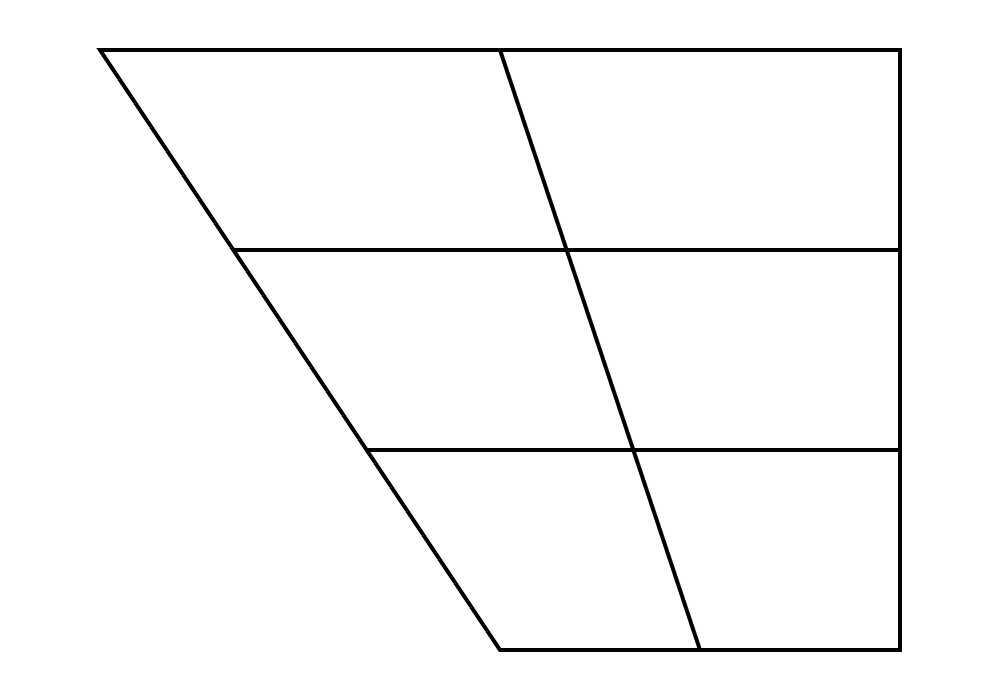
| |||||
| Near-close | ||||||
| Close-mid | ||||||
| Mid | ||||||
| Open-mid | ||||||
| Near-open | ||||||
| Open | ||||||
Grammar
Nouns
Gender
Like Minhast, Nahónda has a four-way gender distinction: masculine, feminine, neuter animate, and neuter inanimate. Just as in Minhast, Nahónda does not attach gender markers on nouns, but rather agreement affixes in the verb complex take up this role, each affix indicating the gender of its cross-indexed nominal argument. The verb's agreement affixes cross-index core roles, i.e. the agent and patient. If non-core nouns have been previously marked with deictic markers, a total of two additional markers can occupy the Extended slot of the verb template to cross-index the marked nouns.
Regardless, all nouns have inherent gender which must be memorized individually in order to select the proper verbal agreement affixes, or correctly identify the gender of a peripheral noun.
Number
Unlike Minhast and Nankôre, Nahónda explicitly marks number on nouns with the affix -pi. This affix is a borrowing from Lakota. To indicate collectives, particularly of animals, reduplication is employed, e.g. dagozloba1 "elk" → dagogozloba "a herd of elk". Collectives can be further pluralized, e.g. dagogozloba → dagogozlobapi "elk herds".
Case
Nahónda distinguishes two core cases, agent and patient, and one oblique case, the genitive. The Patient case is unmarked and serves as the direct object of most transitive verbs, and the subject of stative verbs. The Genitive serves not only to mark possessors, but as the recipient with donor verbs, e.g. wíkha Džalo-da nitsátačeyo "Give Dzhalo the rope", the hearer of speech verbs, e.g. Enane-da kelómatačeyelo "Speak to Mother!", as well as the direct or indirect object of transitive verbs belonging to other semantic types, e.g. Goal, Experiencer, etc.
| Suffix | Sample Paradigm | |||
|---|---|---|---|---|
| Singular | Plural | Singular | Plural | |
| Agent | -hi | -hipi | šúnkawakáne-hi | šúnkawakáne-hipi |
| Patient | -∅ | -pi | šúnkawakáne | šúnkawakáne-pi |
| Genitive | -da | -dapi | šúnkawakáneda | šúnkawakáne-dapi |
Pronominal Forms
| Number | Person | Agent | Patient | ||
|---|---|---|---|---|---|
| Independent | Bound | Independant | Bound | ||
| Singular | 1st | yate | -ya- | ya | -ya- |
| 2nd | itá | -ta- | ta | -ta- | |
| 3rd Masc. | kane | -ka- | ka | -na- | |
| 3rd Fem. | kicela | -kice- | la | -la- | |
| 3rd Neut. Anim. | séha | -se- | se | -se- | |
| 3rd Neut. Inanim. | ma | -ma- | tsila | -tsi- | |
| Plural | |||||
| Plural | 1st Incl | akene | -ake- | ake | -ke- |
| 1st Excl | nene | -ne- | ne | -ne- | |
| 2nd | tahene | -tahe- | ta | -ta- | |
| 3rd Common | kene | -ke- | ke | -ke- | |
| 3rd Neut. Anim. | setse | -se- | se | -se- | |
| 3rd Neut. Inanim. | mate | -ma- | ma | -ma- | |
Minhast:
| Person - Number - Gender | Independant Forms | Bound Forms | ||
|---|---|---|---|---|
| Ergative | Absolutive | Oblique | Attributive | |
| 1st Sg. | yakte | yak | yak- | -ek |
| 2nd Sg. | tahte | taħ | tah- taħ- |
-taħ |
| 3rd Masculine - Common Sg. | kūde | kua | kū- | -na |
| 3rd Feminine Sg. | lēde- | lea | lē- ley- |
-lea |
| 3rd Neuter Animate Sg. | šemet | šea | šē- šey- |
-šea |
| 3rd Neuter Inanimate Sg. | mēde | mea | mē- mey- |
-mea |
| Plural | ||||
| 1st Plural Inclusive | hakemt(e) | hak | hak- | -(h)akkem |
| 1st Pl Exclusive | nemt(e) | nem | nem- | -nem |
| 2nd Pl. | taħtemt(e) tahemt(e) |
taħtem tahem |
taħtem- tahem- taħm- |
-taħtem -tahem -taħm |
| 3rd Masc./Common Pl | kemt(e) | kem | kem- | -kem |
| 3rd Neut. Anim. Pl. | sešt(e) | seš | sešš(i)- | -sseš |
| 3rd Neut. Inanim Pl. | maħt(e) | maħ | mah- maħ- |
-maħ |
Demonstratives
Like its relatives Minhast and Nankôre, Nahónda makes a four-way distinction in its demonstratives. Some forms, such as the Proximal and Medio-proximal demonstratives, show in the Agent forms an etymological relationship with Minhast. The Medio-proximal patient and Distal agent forms appear to be derived from the same source as in the corresponding Nankôre form. A common etymology for the Invisible form among all the sister languages has yet to be found. The Nahónda demonstratives are listed in the following table:
| Independent | Clitic | Meaning | Nahenic Cognates | |||
|---|---|---|---|---|---|---|
| Agent | Patient | Agent | Patient | |||
| Proximal | saka | ko | =sa | =ko | This one, near the speaker |
|
| Medio-proximal | na | ho | =na | =ho | This/that one near the listener "that" |
|
| Distal | wanko wanku |
wo | =wa | =wo | Far from both speaker and listener |
|
| Invisible | yanko yanku |
yo | =ya | =yo | Used for objects beyond sight or obstructed by another object. It may also be used for a person or thing being referred to within a narrative or other discourse, and sometimes as a decessive. |
|
When used as attributives, they appear directly before the noun phrase. Unlike Minhast, which requires a connective particle to join the demonstrative to its head, in Nahónda the demonstrative is simply juxtaposed before its head, e.g.:
- Wanko šúnkawakaninéhi owožutkopi kasukakatsané.
wanko šúnkawakáne-ne-hi owožu-tko-pi ka-suka~ka-tsa-né
DIST horse-DET.cylindrical.object-AGT grass-DET.flat.prone.object-PL 3MS.AGT-run~INT-EVID.VIS-INTR.ACT
That horse is always racing across the plains.
The demonstratives may also be used as substantives, acquiring full noun status. Additional suffixes, such as determiners and case markers, may then attach to them, e.g.:
- Wankonéhi owožutkopi kasukakatsané.
wanko-ne-hi owožu-tko-pi ka-suka~ka-tsa-né
DIST-DET.cylindrical.object-AGT grass-DET.flat.prone.object-PL 3MS.AGT-run~INT-EVID.VIS-INTR.ACT
That (cylindrical-shaped) one is always racing across the plains.
Determiners
Like many languages that fall in the Siouan Sprachbund, Nahónda uses determiners to mark size and shape information on nouns. These determiners occur as a set of suffixes that attach to the noun preceding any case markers. These suffixes, descended from postural and motion verbs, reflect an evolutionary pathway similar to the non-Siouan languages. The verbs from which these suffixes developed originate from Nahenic roots.
| Type | Affix | Source and Cognates | Examples |
|---|---|---|---|
| Squat/Bulky object, moving |
-ksa- |
|
|
| Flat object, stationary | -tko- |
| |
| Cylindrical object, moving | -ne- |
|
|
| Thin upright object, stationary | -lo- |
|
|
| Sharp or tapering object, stationary | -tso- |
|
|
Numbers
Nahónda employs a base-10 system, although remnants of a base-20 system exist, as in tsentsatsa "twenty" (c.f. Minhast šentāz "twenty") and tsatsentatse "forty" (c.f. Minhast saššentāz "forty"). Siouan influence manifests again, from the numbers eleven through nineteen in the form of the prefix ak-, e.g. aktsunó "eleven" and aktsané "twelve". The prefix is derived from the Lakota prefix aké- found in the numbers eleven and up, as in the Lakota numbers akéwaŋži "eleven", and akénuŋpa "twelve", both literally meaning "ten and one" and "ten and two", respectively.
The accent shifted to ultimate position in virtually all numbers with the exceptions tsentsatsa and tsatsentatse. These exceptions usually occur where the base-20 system of the proto-language surface. Ironically, in their Minhast cognates the last syllable is stressed due to vowel lengthening of the final closed syllables, i.e. šentāz /ʃɛn'ta:z/ and saššentāz /saʃ:ɛn'ta:z/.
| Number | Cardinal | Ordinal | Verbal |
|---|---|---|---|
| one | tsunó | ||
| two | tsané | ||
| three | dutsá | ||
| four | maná | ||
| five | gdané | ||
| six | tsihá | ||
| seven | glihá | ||
| eight | nuná | ||
| nine | galó | ||
| ten | tatsnó | ||
| eleven | aktsunó | (ak- is derived from Lakota aké-, used for the 10's unit) | |
| twelve | aktsané | ||
| thirteen | aktutsé | ||
| fourteen | agmaná | ||
| fifteen | akatsé | ||
| sixteen | aktsihé | ||
| seventeen | aglihé | ||
| eighteen | agnuné | ||
| nineteen | agdalé | ||
| twenty | tsentsatsa | ||
| twenty-one | tsanke tsunó | ||
| twenty-two | tsanke tsané | ||
| twenty-three | šentāz-u-duxt | <-- | |
| thirty | šentāz-u-tazem | ||
| forty | tsatsentatse | ||
| fifty | saššentāz-u-tazem | ||
| sixty | duššentāz | ||
| seventy | duššentāz-u-tazem | ||
| eighty | meneštazem | ||
| ninety | meneštazem-u-tazem | ||
| one hundred | gādi | ||
| one thousand | gaggādi |
Verbs
Verb Template
The polysynthetic Nahónda verb follows a templatic paradigm (c.f. Northern Iroquioan languages). A comparison of the Nahónda verb template with the verb template of its Minhast relative reveals major differences in their verbal structures. Simultaneously, certain components of each language's template reveal a common heritage with their Proto-Nahenic progenitor.
The Nahónda verb is divided into three major segments: the initials, the verb core, and the finals. These roughly correspond with the Minhast preverb, verb core, and the terminative. The Nahónda verb template is illustrated in the following table:
| Initials | |||||||
|---|---|---|---|---|---|---|---|
| Conjunctives | Scalars | Causative | Pronominals | ||||
| Active | Patient | Extensions | |||||
| Verb Core | |||||||
| Reflexive/Reciprocal | Verb Root | Incorporated Noun | Tense/Aspect | Transitivity | |||
| Finals | |||||||
| Adverbials | Deictics | Precatives | Clitics | ||||
| Evidentials | |||||||
The most noticeable difference between Nahónda and Minhast is the order and number of slots in their respective verb templates. The position of the pronominal elements particularly stand out; the Nahónda pronominal affixes appear before the verb root, while in Minhast the pronominals appear after the verb root. Adverbial affixes in Nahónda appear after the verb root, while in Minhast they appear in preverbal position, in the Mood-Tense-Manner slot. Additionally, the adverbial affixes in Nahónda are circumscribed: only some adverbial affixes may co-occur with each other, and when they do, they appear in rigid order, otherwise only one affix may occur at a time; while in Minhast, any number of adverbial affixes may appear and their ordering is highly variable, based on discourse considerations. Certain slot categories appear in one language and are absent in the other; Nahónda has a category for Conjunctives which are lacking in Minhast, while in Minhast the Applicatives slot does not appear in the Nahónda verb template. There are more slot categories in Minhast, which give the appearance that Minhast is more polysynthetic than Nahónda. For comparison, the Minhast verb template is presented below:
| Preverb | ||||||||
|---|---|---|---|---|---|---|---|---|
| Scalar Operators | Locationals | Mood-Aspect-Manner | Control | Applicatives | ||||
| Verb Core | ||||||||
| Verb Root | Incorporated Noun | Prepronominals | Pronominals | Tense-Aspect | Participials | Transitivity | ||
| Terminatives | ||||||||
| Evidentials | Miratives | Deictics | Imperative | Subordinators | Irrealis | Nominalizer | ||
Nevertheless, there are certain patterns shared by both languages. In both languages, the scalar operators appear before the verb root in both languages. The position of the incorporated noun appears directly after the verb in both languages also, which is otherwise a rare phenomenon in polysynthetic languages. The causative is in preverbal position in both languages, occupying a single slot within the Nahónda verb template, and Slot 3 of the Preverbal affixes in the Minhast template. Moreover, the tense/aspect and transitivity markers appear postverbally and in the same order in both languages. The placement of these slots relative to the verb root is not coincidental but is the result from a shared ancestry.
Interestingly, their non-polysynthetic relative, Nankôre, employs a similar process called quasi-incorporation. And just as in Nahónda and Minhast, the quasi-incorporated noun appears post-verbally before the auxiliary itá':
- Nankôre Default SOV1V2 Order:
- Makse rihat tayôreno ta'itá
/'makʃɛ̯ ɾi'hat ta'yo:reno taʔɪt'aʔ/
makse rihat ta=yôre=no ta-itá-ʔ
mouse.LA falcon.HA INV=bite=SEM INV-HS.COP-LS
The mouse bit the falcon.
- Nankôre Quasi-Noun Incorporation, SV1OV2 Order:
- Makse yôreno rihat 'itá'
/'makʃɛ̯ 'yo:reno ɾi'hat ɪt'aʔ/
makse yôre=no rihat ∅-itá-ʔ
mouse.LA bite=SEM falcon DIR-COP-LS
The mouse falcon-bit.
The postverbal position of the incorporated or quasi-incorporated noun is a shared feature among the three languages, apparently inherited from the Nahenic protolanguage.
There are three principal types of transitivity markers in Nahónda, transitive active, intransitive active, and intransitive stative. A minor fourth type of marker exists, a zero-valent intransitive impersonal marker, which is used principally for describing meteorological and supernatural events.
| Affix | Cognates | |
|---|---|---|
| Transitive Active | -čé | Minhast hittu "to give" |
| Intransitive Active | -né | Minhast -an (?) (verbal intransitive marker) Nankóre iná' (?) (copula) Neina -nani (?) (verbal intransitive marker) |
| Intransitive Stative | -ná | Minhast -an (?) (verbal intransitive marker) Nankóre iná' (?) (copula) |
| Intransitive Impersonal | -ká |
Male/Female Speech Marking
Nahónda verbs use special clitics to differentiate whether the speaker is male or female. These clitics have no cognates in any of the Nahenic languages, but were adopted from their immediate Siouan-speaking neighbors, specifically, the Lakota. They are apparently a recent borrowing, as the forms and functions are the same as in Lakota, albeit having undergone a few trivial sound changes to accommodate the Nahónda phonemic inventory.
| Male | Female | |
|---|---|---|
| Mild Assertive | =yeló | =ye |
| Emphatic Assertive | n/a | =kšó |
| Request | =ye | =na |
| Informal Interrogative | =he | |
| Formal Interrogative | =huwo | |
| Dubitative | =so | =se |
Postural and Locomotive Verbs
Nahónda lacks adpositions and verbal applicative markers to indicate the locational or directional relationship of a noun phrase. Instead, postural and locomotive verbs are used to indicate oblique case relations:
| Verb | Meaning | Cognates | Examples | |
|---|---|---|---|---|
| Ablative | amané | to approach | Minhast hān "to come" | |
| Comitative | tsakané | to accompany | Minhast saħpan "to walk" | |
| Instrumental | tsipilače | to use | Minhast sespir "hand" |
|
| Locative | tsatsené | to sit down | Minhast saššian "to sit" |
|
| Perlative | iláyaná | to ford a river, stream, or other body of water |
|
|
The words listed as possible cognates for the Perlative from the other Nahenic languages are highly speculative, as most scholars agree that Nahónda preserved Proto-Nahenic */d/. A sound shift from /d/ -> /l/ lacks supporting evidence; the /d/ -> /l/ alternation found in the Lakota dialects is insufficient to explain the phonological realization of the Perlative, as sound changes in Nahenic roots have by and large resulted from internal processes within Nahónda itself.
Particles
Syntax
Footnotes
1) Tatselo is cognate with Minhast kaslub "dog", and Nankóre kospor "fox".