Nahónda: Difference between revisions
| Line 532: | Line 532: | ||
| =sa | | =sa | ||
| =ko | | =ko | ||
| This one, near the speaker | | This one, near the speaker | ||
| | | | ||
* Proto-Nahenic: | * Proto-Nahenic: | ||
* Neina: | * Neina: | ||
* Common Minhast: | * Common Minhast: ''sap'' (ABS) | ||
* Nankôre: | * Nankôre: | ||
|- | |- | ||
| Line 544: | Line 544: | ||
| =na | | =na | ||
| =ho | | =ho | ||
| This/that one near the listener | | This/that one near the listener "that" | ||
| | | | ||
* Proto-Nahenic: | |||
* Neina: | |||
* Common Minhast: ''nax'' (ABS) | |||
* Nankôre: ''=hori'' | |||
|- | |- | ||
! Distal | ! Distal | ||
| Line 552: | Line 556: | ||
| =wa | | =wa | ||
| =wo | | =wo | ||
| Far from both speaker and listener | | Far from both speaker and listener | ||
| | | | ||
* Proto-Nahenic: | |||
* Neina: =vaš | |||
* Common Minhast: ''waššī'' (ABS) | |||
* Nankôre: ''=nko'' | |||
|- | |- | ||
! Invisible | ! Invisible | ||
| Line 560: | Line 568: | ||
| =ya | | =ya | ||
| =yo | | =yo | ||
| Used for objects beyond sight or obstructed by another object. It may also be used for a person or thing being referred to within a narrative or other discourse, and sometimes as a decessive | | Used for objects beyond sight or obstructed by another object. It may also be used for a person or thing being referred to within a narrative or other discourse, and sometimes as a decessive. | ||
| | | | ||
* Proto-Nahenic: | |||
* Neina: | |||
* Common Minhast: ''waššī'' (?) (Distal) | |||
* Nankôre: ''=nko'' (Distal) | |||
|} | |} | ||
The independent forms may serve as attributives, in which case they appear before the noun phrase. Unlike Minhast, which requires a connective particle to join the demonstrative to its head, in Nahónda the demonstrative is simply juxtaposed before its head, e.g.: | The independent forms may serve as attributives, in which case they appear before the noun phrase. Unlike Minhast, which requires a connective particle to join the demonstrative to its head, in Nahónda the demonstrative is simply juxtaposed before its head, e.g.: | ||
Revision as of 18:35, 14 November 2020
Nahónda
Introduction
Nahónda, also known as Nónda and referred to by its own speakers as Nahónda keloma (lit. "Nahónda speak"), is a language centered in Northwestern Montana. It is bordered by the Lakota Nation to the east, by the Cheyenne to the south, and the Blackfeet and Crow Nations to the north. Along its western border lies the Nez Percé Nation. Long considered a language isolate, new analyses has demonstrated it shares a common lineage with Minhast and Nankôre. It has now been classified as a member of the Nahenic language family, a small family that includes Minhast and Nankóre, as well as the recently discovered Neina or Na'ena language in northeast Siberia. Nahónda is the second largest member of this family, around 60,450 members in the First Nations Confederation, with a few expatriate communities the largest of which exists in southern Manitoba at around nine hundred members. Minhast remains the population juggernaut, at 26 million members in the Minhast homeland, and around 3 million more scattered in expatriate communities throughout the rest of the world.
Nahónda is an agglutinative and fusional language which is most apparent in its complex verb forms. It is a split-intransitive language of the Fluid-S subtype. Agents are explicitly marked while patients receive null marking. Nahónda canonical word order is SOV, as in both Minhast and Nankóre, but word order is quite flexible and may deviate from SOV word order for pragmatics or other discourse considerations. Like Minhast, it is considered a polysynthetic language as it exhibits polypersonal agreement, noun incorporation, head marking, holophrasis, and adverbial, modal, and evidential markers inside the verb complex. The evolution of Nahónda polysynthesis is complex, reflecting both developments from its Nahenic ancestry, and influences from outside sources, especially the Siouan languages and a substrate Iroquoian layer.
The influence of other Native North American languages cannot be overstated, as many had a major impact on the phonology, morphology, and lexicon of the Nahónda language. These influences caused it to diverge from it sister languages to the point that earlier linguists considered it to be a member of the Siouan languages, although the Iroquoian language family was also a main contender.
Phonology
Nahónda Consonantal Inventory
| Bilabial | Alveolar | Palatal | Velar | Glottal | Laryngeal | |||||
|---|---|---|---|---|---|---|---|---|---|---|
| Plain | Ejective | Plain | Ejective | Plain | Ejective | Plain | Ejective | |||
| Nasal | m | n | ||||||||
| Plosive | p b | t d | k g | ʔ | ||||||
| Fricative | s | ʃ | h | |||||||
| Affricates | t͡s | t͡ʃ | ||||||||
| Approximants | w | j | ||||||||
| Lateral | l | |||||||||
Nahónda Vowel Inventory
| Front | Near- front | Central | Near- back | Back | ||
| Close | 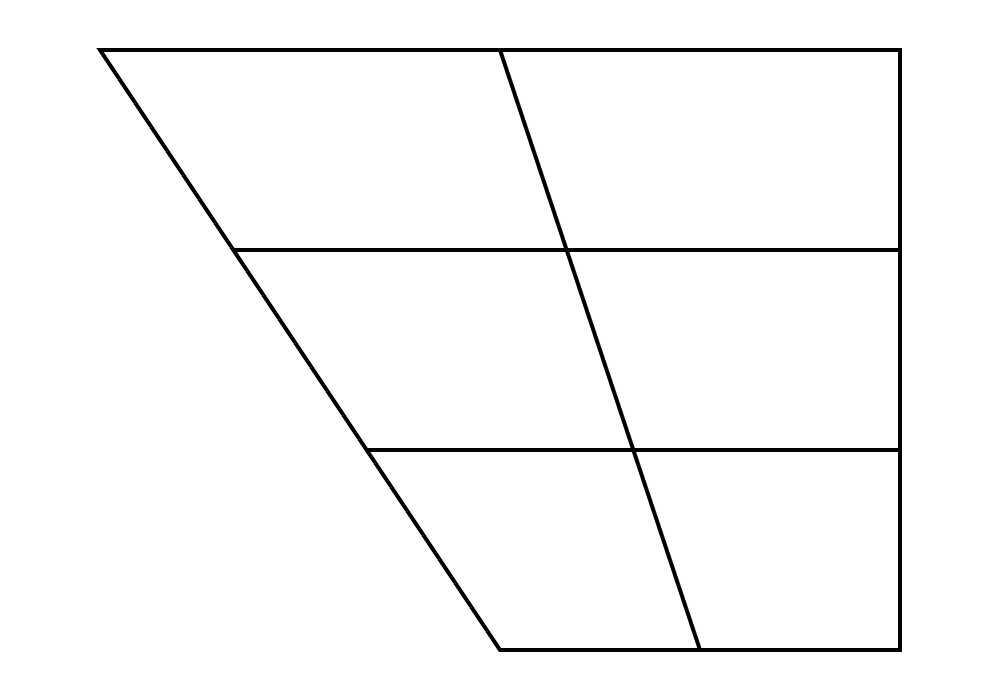
| |||||
| Near-close | ||||||
| Close-mid | ||||||
| Mid | ||||||
| Open-mid | ||||||
| Near-open | ||||||
| Open | ||||||
Nouns
Gender
Like Minhast, Nahónda has a four-way gender distinction: masculine, feminine, neuter animate, and neuter inanimate. Just as in Minhast, Nahónda does not attach gender markers on nouns, but rather agreement affixes in the verb complex take up this role, each affix indicating the gender of its cross-indexed nominal argument. The verb's agreement affixes cross-index core roles only, i.e. the agent and patient; nouns that serve in a peripheral role are unmarked. Regardless, all nouns have inherent gender which must be memorized individually in order to select the proper verbal agreement affixes, or correctly identify the gender of a peripheral noun.
Number
Case
Independent and Bound Pronominal Forms
Nankôre
| Singular | Plural | |||
|---|---|---|---|---|
| Independent | Clitic | Long Form | Short Form | |
| 1S | ak | =ák | akôs | aóy yoy |
| 2S | kā ka |
=ká | kakôs | koy |
| 3S | tā ta |
=tá | takôs | toy |
Minhast:
| Person - Number - Gender | Independant Forms | Bound Forms | ||
|---|---|---|---|---|
| Ergative | Absolutive | Oblique | Attributive | |
| 1st Sg. | yakte | yak | yak- | -ek |
| 2nd Sg. | tahte | taħ | tah- taħ- |
-taħ |
| 3rd Masculine - Common Sg. | kūde | kua | kū- | -na |
| 3rd Feminine Sg. | lēde- | lea | lē- ley- |
-lea |
| 3rd Neuter Animate Sg. | šemet | šea | šē- šey- |
-šea |
| 3rd Neuter Inanimate Sg. | mēde | mea | mē- mey- |
-mea |
| Plural | ||||
| 1st Plural Inclusive | hakemt(e) | hak | hak- | -(h)akkem |
| 1st Pl Exclusive | nemt(e) | nem | nem- | -nem |
| 2nd Pl. | taħtemt(e) tahemt(e) |
taħtem tahem |
taħtem- tahem- taħm- |
-taħtem -tahem -taħm |
| 3rd Masc./Common Pl | kemt(e) | kem | kem- | -kem |
| 3rd Neut. Anim. Pl. | sešt(e) | seš | sešš(i)- | -sseš |
| 3rd Neut. Inanim Pl. | maħt(e) | maħ | mah- maħ- |
-maħ |
| Agent | Patient | |||
| Person | Independent | Bound | Independant | Bound |
| 1st sg. | yat | -t- | ya | -ya- |
| 2nd sg. | intá | -nt- | ta | -n- |
| 3rd masc.sg. | kun | -k- | ka | -Ø- |
| 3rd fem.sg | kcela | -kc- | la | -la- |
| 3rd neut.anim.sg | séha | -s- | seh | -s- |
| 3rd neut.inanim.sg | ma | -m- | tsila | -ts- |
| 4th sg. | wahán | -han- | wa | -w- |
| Agent | Patient | |||
| Person | Independent | Bound | Independant | Bound |
| 1st du.excl | tsatem | tsat | tsak | at |
| 1st du.incl | tsiháka | tsak | tsihák | ak (an) |
| 2nd dual | tsitá | tsit | tsitá | |
| 3rd masc.du | tsakàl | tskál | tsakáhal | tsak |
| 3rd fem.du | tsakìl | tskál | tsakíhil | tsak |
| 3rd mixed.du | tsacé | tsac | tsac | tsac |
| 3rd anim.du | tsamá | tsam | tsam | tsam |
| 3rd inanim.du | tsakìl | tskil | tsašl | tsaš |
| 4th du. | tsákce | tsakc | tsack | tsašk |
| Agent | Patient | |||
| Person | Independent | Bound | Independant | Bound |
| 1st pl.excl | hakém | km | hak | ak |
| 1st pl.incl. | cayácu | cac | acù | ac |
| 2nd pl | catáha | ctah | táha | ta |
| 3rd masc.pl | ciláha | clah | cíla | cīlà |
| 3rd fem.pl | ciláhe | cláhē | la | la |
| 3rd mixed.pl | cilána | clan | lan | lan |
| 3rd anim.pl | cikíla | cklíha | kíla | kīlá |
| 3rd inanim.pl | ci?áca | cyac | áca | áca |
| 3rd High Public | cihòtape | cotape | hotápe | tapè |
| 4th pl. | cī?áca | cīyac | áca | acà |
Demonstratives
Like its relatives Minhast and Nankôre, Nahónda makes a four-way distinction in its demonstratives. Some forms, such as the Proximal and Medio-proximal demonstratives, show in the Agent forms an etymological relationship with Minhast. The Medio-proximal patient and Distal agent forms appear to be derived from the same source as in the corresponding Nankôre form. A common etymology for the Invisible form among all the sister languages has yet to be found. The Nahónda demonstratives are listed in the following table:
| Independent | Clitic | Meaning | Nahenic Cognates | |||
|---|---|---|---|---|---|---|
| Agent | Patient | Agent | Patient | |||
| Proximal | saka | ko | =sa | =ko | This one, near the speaker |
|
| Medio-proximal | na | ho | =na | =ho | This/that one near the listener "that" |
|
| Distal | wanko wanku |
wo | =wa | =wo | Far from both speaker and listener |
|
| Invisible | yanko yanku |
yo | =ya | =yo | Used for objects beyond sight or obstructed by another object. It may also be used for a person or thing being referred to within a narrative or other discourse, and sometimes as a decessive. |
|
The independent forms may serve as attributives, in which case they appear before the noun phrase. Unlike Minhast, which requires a connective particle to join the demonstrative to its head, in Nahónda the demonstrative is simply juxtaposed before its head, e.g.:
- Wanko šúnkawakaninéhi owožutkopi sukakatsa1
wanko šúnkawakán-ne-hi owožu-tko-pi suka~ka-tsa
DIST DET.moving.object-horse-AGT grass-DET.flat.prone.object-PL run~INT-EVID.VIS
That horse is always racing across the plains.
Determiners
Like many languages that fall in the Siouan Sprachbund, Nahónda developed a set of determiners that convey size and shape information of their noun heads. These determiners are descended from postural and motion verbs, reflecting an evolutionary pathway like the non-Siouan languages that developed similar determiners. The verbs from which these articles developed from come from Nahenic roots.
| Type | Determiner Suffix | Source and Cognates | Examples |
|---|---|---|---|
| Bulky object |
-ksa |
|
|
| Flat object | -to |
| |
| Thin upright object | -lo |
|
|
Numbers
Nahónda employs a base-10 system, although remnants of a base-20 system exist, as in tsentsatsa "twenty" (c.f. Minhast šentāz "twenty") and tsatsentatse "forty" (c.f. Minhast saššentāz "forty"). Siouan influence manifests again, from the numbers eleven through nineteen in the form of the prefix ak-, e.g. aktsunó "eleven" and aktsané "twelve". The prefix is derived from the Lakota prefix aké- found in the numbers eleven and up, as in the Lakota numbers akéwaŋži "eleven", and akénuŋpa "twelve", both literally meaning "ten and one" and "ten and two", respectively.
The accent shifted to ultimate position in virtually all numbers with the exceptions tsentsatsa and tsatsentatse. These exceptions usually occur where the base-20 system of the proto-language surface. Ironically, in their Minhast cognates the last syllable is stressed due to vowel lengthening of the final closed syllables, i.e. šentāz /ʃɛn'ta:z/ and saššentāz /saʃ:ɛn'ta:z/.
| Number | Cardinal | Ordinal | Verbal |
|---|---|---|---|
| one | tsunó | ||
| two | tsané | ||
| three | dutsá | ||
| four | maná | ||
| five | gdané | ||
| six | tsihá | ||
| seven | glihá | ||
| eight | nuná | ||
| nine | galó | ||
| ten | tatsnó | ||
| eleven | aktsunó | (ak- is derived from Lakota aké-, used for the 10's unit) | |
| twelve | aktsané | ||
| thirteen | aktutsé | ||
| fourteen | agmaná | ||
| fifteen | akatsé | ||
| sixteen | aktsihé | ||
| seventeen | aglihé | ||
| eighteen | agnuné | ||
| nineteen | agdalé | ||
| twenty | tsentsatsa | ||
| twenty-one | tsanke tsunó | ||
| twenty-two | tsanke tsané | ||
| twenty-three | šentāz-u-duxt | <-- | |
| thirty | šentāz-u-tazem | ||
| forty | tsatsentatse | ||
| fifty | saššentāz-u-tazem | ||
| sixty | duššentāz | ||
| seventy | duššentāz-u-tazem | ||
| eighty | meneštazem | ||
| ninety | meneštazem-u-tazem | ||
| one hundred | gādi | ||
| one thousand | gaggādi |
Verbs
The polysynthetic Nohandaráy verb follows a templatic paradigm (c.f. Northern Iroquioan languages, Ainu, Minhast, etc).
| Category | Affix | Additional Notes |
|---|---|---|
| Temporal Adverbials | [placeholder] | |
| Precative | [placeholder] | |
| Negator | [placeholder] | |
| Irealis (condittional, Optative, etc) | [placeholder] | |
| Manner Adverbials | [placeholder] |
Morphosyntactic Alignment
Nahónda morphosyntactic alignment is classified as the Split Intransitive type, also known as an Active-Stative alignment. Transitive clauses by definition take two core arguments, an Agent, and a Patient. Intransitive clauses take only one core argument. That the verb that core argument takes may denote either a state, e.g. "He is sick", or it may designate an action instigated by the the core argument, e.g. "He jumps". In the first case, the core argument takes marking which indicates it experiences or is affected by the state, while in the second the argument takes another marker which indicates that it instigates an action or event.
Languages of the Split Intransitive type may be further divided into one of two subtype. One type, the Split-S type, divides its verbs into two lexical division: one division is restricted to states; its NP argument is an experiencer or undergoer of the state, and hence takes one type of case marking. The other verbal division expresses events which indicate its core argument functions as an agent; the core argument thus takes marking distinct from that of an experiencer or undergoer. The other Split Intransitive subtype, the Fluid-S type, does not exhibit this verbal distinction: all verbs may serve to indicate state or events; case marking of the core argument depends on its semantic role, it is not preselected based on the verbal class, as Fluid-S type languages do not have distinct verbal classes.
Nahónda belongs to the Fluid-S type of languages. When the core argument of an Intransitive verb functions as a semantic Agent, it takes the marker =yo, whereas it takes the marker =ka when it is an Experiencer or Undergoer.
Footnotes
1) The Siouan languages, particularly Lakota, had a major impact on the Nahónda lexicon. We see this influence in this sample sentence Wanko šúnkawakánhi owožupi sukakatsa. Nahónda šúnkawakán "horse" is borrowed directly from Lakota šúŋkawakȟáŋ, as is owožu "grass". Even the plural marker -pi is borrowed from the Lakota plural marker -pi. The verb sukaka-tsa comes from Nahenic roots, c.f. Minhast sukkan "to be quick" and saru "to see".