Vadi: Difference between revisions
| Line 804: | Line 804: | ||
Modifiers in Vadi typically precede their heads, and this observation holds for adjectives. In terms of morphology, there are no special affixes that distinguish them from either nouns or verbs. Iyyaħmi believes they may trigger mutation, but admits that further analysis is needed. | Modifiers in Vadi typically precede their heads, and this observation holds for adjectives. In terms of morphology, there are no special affixes that distinguish them from either nouns or verbs. Iyyaħmi believes they may trigger mutation, but admits that further analysis is needed. | ||
===Verbs=== | ===Verbs=== | ||
Vadi has several deverbal affixes to derive instrumental, location, and occupational nouns. Other deverbal affixes derive abstract nouns, or infinitives. Examples with the verb ''kora'' "to cut" and the most common deverbals include: | Vadi has several deverbal affixes to derive instrumental, location, and occupational nouns. Other deverbal affixes derive abstract nouns, or infinitives. Examples with the verb ''kora'' "to cut" and the most common deverbals include: | ||
*''-vir'': instrumental deverbal, e.g. ''kora-vir'' "knife" | *''-vir'': instrumental deverbal, e.g. ''kora-vir'' "knife" | ||
| Line 855: | Line 818: | ||
The language has a variety of converbs which appear after their head. These converbs encode modality, aspect, manner, and various adverbial meanings. The converbs may be separated from their head by other elements, such as illocutionary particles, discourse markers, etc. Common converbs include: | The language has a variety of converbs which appear after their head. These converbs encode modality, aspect, manner, and various adverbial meanings. The converbs may be separated from their head by other elements, such as illocutionary particles, discourse markers, etc. Common converbs include: | ||
* ''sutu, sútu, -sut'' : "and; additionally; to add"; <br/> a direct loan from Minhast ''suttu'' "and" | |||
* ''hen'' | |||
* ''ura'', -ra : "again; to repeat" | |||
* ''jor-'' | |||
*''koni'': "to start, begin" | *''koni'': "to start, begin" | ||
*''kila'': "to stop, cease" | *''kila'': "to stop, cease" | ||
| Line 916: | Line 837: | ||
In most instances, converbs can stand alone as bona-fide verbs, e.g. ''Úla ókapi hai hen!'' "You did lie!" | In most instances, converbs can stand alone as bona-fide verbs, e.g. ''Úla ókapi hai hen!'' "You did lie!" | ||
As the language's canonical word order is SOV, the verb | As the language's canonical word order is SOV, the verb occupies the final position of the clause. | ||
===Particles=== | ===Particles=== | ||
Revision as of 18:00, 10 November 2020
Introduction
Vadi is an extinct language once spoken in Minhay. A small parchment fragment was discovered in April 1963 in a cave outside of Peħħat, a small township in Sakkeb Prefecture. More fragments were discovered in subsequent years in the vicinity of the cave, named Aħħur, where the first texts were discovered. Finally, in the late 90's, the wonderfully preserved Kalapái Scriptum were discovered in an isolated hut approximately ten kilometres north of Peħħat. These texts were dated from the mid to late 1800's CE. The Kalapái Scriptum is a collection of letters between two farmers, Éro and Sorvin, who were embroiled in an ongoing feud regarding the property lines between their lands. The letters were written in Vadi intermixed with words from the unrelated Peshpeg, Ín Duári, and Minhast languages. A few letters were written entirely in the the extinct Minhast Knife Speaker dialect. Also found among the letters are legal papers drawn from the Prefect of Dog Speaker Country. The farmers' letters contained several texts clearly indicating code-switching between Vadi and the Knife Speaker dialect. The portions containing the intermixed Knife Speaker and Peshpeg words were used to decipher the Vadi texts. The Dog Speaker papers did not contribute directly to the decipherment of the language, but as an external source it provided a great deal of context of the nature of the feud between the litigants. This external contextual source clarified the translation of otherwise ambiguous passages. The Kalapái Scriptum is thus popularly referred to as the "Minhast Rosetta Stone".
Today, two linguists, Dr. Iyyaħmi min Ruššur of the University of Aškuan, and Dr. Napayshni Tashunka of the University of the Lakota Nation at Three Pipes, are the two leading Vadists of the the Šibbūru1 School. A third Vadist, Dr. J.F. Schumann of Universidad Autónoma de Madrid1, is the pre-eminent leader of the Traditionalist school. The two schools are sharply divided on a single issue, that of mutations, whose affects would not be simply restricted to phonology, but would also impact all aspects of Vadi morphology. The Traditionalists hold that Vadi does not have a mutation system, whereas the Šibbūru School argue that Vadi has an elaborate mutation system comparable to that of the modern Celtic languages.
This article presents the findings and analyses of both schools, the Šibbūru school as represented by Iyyaħmi and Tashunka, as well as the opposing viewpoint of the Traditionalists, as represented by Schumann's.
Phonology
The excellent condition of the texts from the Scriptum were a veritable gold mine for understanding Vadi phonology and phonotactics and led to the conclusion that the phonemic inventory was underestimated. The texts from the Scriptum also eventually dispelled earlier views that Vadi phonotactics were simple. Rather, Vadi phonotactics were far more complex than earlier thought.
The texts were written entirely in the indigenous Minhast Širkattarnaft. While the Širkattarnaft, an abugida, works quite well for the Minhast language, it has presented a major challenge to Vadists in determining the phonology and phonotactics of Vadi. It became immediately apparent that there were several spelling variants and inconsistencies, and numerous occurrences of digraphs appear in both litigants' texts. Many of the digraphs also utilized some of the few surviving ideograms in the Širkattarnaft (e.g. the <MIN> ideogram).
Tashunka, who was working on Minhast dialectology at the time of the discovery of the Scriptum, was among the first scholars to examine the texts. He immediately realized, based on the aforementioned anomalies, that there were phonemes not accounted for in previous Vadists' works. Based on these anomalies, he posited additional phonemes in Vadi. From his analyses, he proposed that either the phoneme /β/ or /v/ was part of the phonemic inventory of Vadi, based on the digraph <bi> + <f> found in the Scriptum's texts. These digraphs coincided with the alternation of <ba> and <wa> in the Aħħur texts. So while the Aħħur texts' spelling for "Vadi" alternated erratically between <ba> + <di> or <wa> + <di>, the texts from the Scriptum consistently spelled "Vadi" as <bi> + <f> + <'a><di>. Similar correlations of the anomalies the Scriptum with the Aħħur materials led him to conclude there was also a /ð/, and another albeit indeterminate sibilant, perhaps /ɕ/. Several years after Tashunka returned to his work on Minhast dialectology, Iyyaħmi took up where Tashunka left off and determined that the sibilant was the apico-alveolar fricative /s̺/.
Iyyaħmi, inspired by Tashunka's earlier work, later discovered previously unknown mutations and other sandhi processes in the language. He developed a new romanization scheme show the complex sandhi processes that were represented by the litigants' unorthodox use of the indigenous Minhast Širkattarnaft script.
Before turning to the actual phonemic inventory and phonotactics of Vadi, a knowledge of the three principal orthographies is essential, as these orthographies illustrate how the Vadi mutation system was eventually reconstructed by the Šibbūru school. Their findings remain a hotly contested issue beyond Vadi's phonological system, as it poses major implications in other areas of the Vadi language, especially morphology and morphosyntax.
Consonants
Traditionalist:
| Bilabial | Alveolar | Palatal | Velar | Glottal | |
|---|---|---|---|---|---|
| Nasal | m | n | |||
| Plosive | p b | t d | k g | ʔ | |
| Fricative | v | s | ʃ* | h | |
| Affricates | d͡ʒ | x* | ħ* | ||
| Approximants | j | ||||
| Flap | ɾ | ||||
| Lateral | l |
*The phonemes /ʃ x ħ/ were not originally part of the native phonology. They appear mostly in words of Minhast origin, although some texts from the Scriptum suggest that /ʃ/ has replaced /s̺/ in some native Vadi words.
Šibbūru:
| Bilabial | Alveolar | Palatal | Velar | Glottal | |
|---|---|---|---|---|---|
| Nasal | m | n | |||
| Plosive | p b | t d | k g | ʔ | |
| Fricative | v | θ* ð* s s̺* |
ʃ* ʒ* | h | |
| Affricates | d͡ʒ | x** | ħ** | ||
| Approximants | j | ||||
| Flap | ɾ | ||||
| Lateral | l ɬ* |
* Not reflected in Traditionalist phonemic inventory. Additionally, /ʒ/ starts to appear in later texts, sometimes alternating with /ʃ/ in Minhast borrowings, and other times alternating with /s̺/ or even /d͡ʒ/ in apparently native Vadi words.
** Phonemes restricted to loanwords borrowed directly from Minhast.
Vowels
| Front | Near- front | Central | Near- back | Back | ||
| Close | 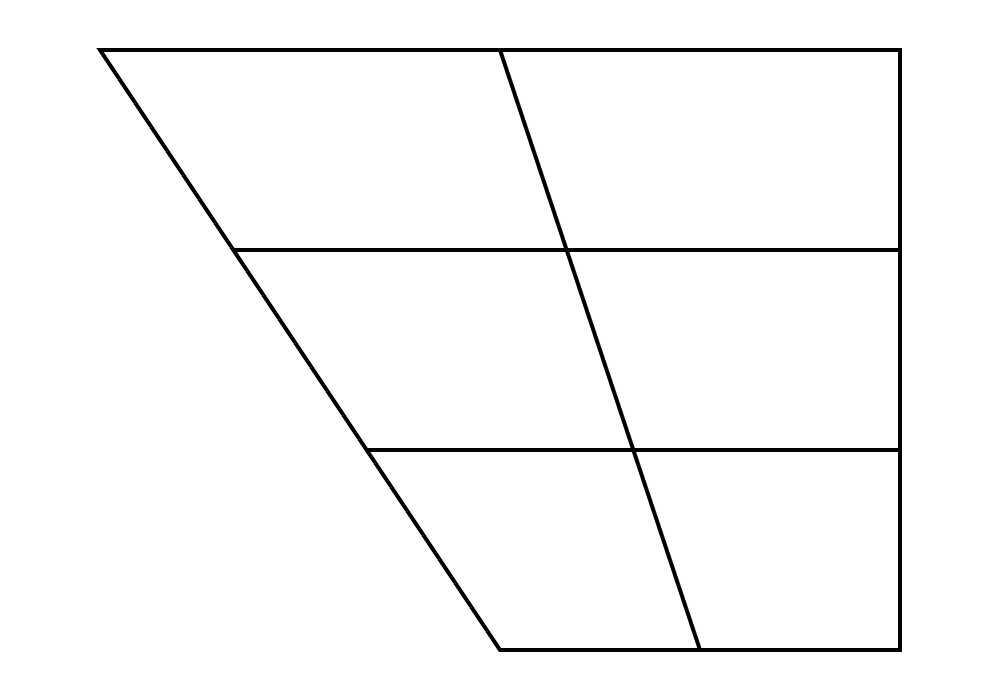
| |||||
| Near-close | ||||||
| Close-mid | ||||||
| Mid | ||||||
| Open-mid | ||||||
| Near-open | ||||||
| Open | ||||||
Prosody
Stress
The issue of stress, as in most areas of Vadi phonology and grammar, is another area of contentious dispute between the Traditionalist and Šibbūru school. The texts discovered at Aħħur showed various marks adjacent to the Širkattarnaft characters, which early Vadists interpreted as diacritics indicating stress. This conclusion was based on the observation that a vertical slash would appear either on the ultimate or penultimate syllables, with more than half appearing on the final syllable. On about five percent of words in the entire Aħħur corpora, both the ultimate and penultimate syllables bore the slash mark.
The corpora of the Kalapái Scriptum, provided evidence that vowel length was also a significant feature of the Vadi phonological system and affected word stress. Although the writers of the material from the Scriptum used the Širkattarnaft very differently from those found in Aħħur, the Scriptum provided a richer dataset for researchers to demonstrate that word stress in Vadi was more complex than earlier thought. Rather than being simply a fixed lexical feature, word stress could shift from various factors, especially when morphophonatactic interactions triggered mutations and word-internal sandhi processes.
Intonation
Phonotactics
Mutations
Syncope
Ablaut
Metathesis
Morphophonology
Orthographic Systems
Širkattarnaft - The Native Minhast Orthography
Like the Aħħur materials, the Scriptum corpora were written entirely in the indigenous Minhast Širkattarnaft.

Unlike the Aħħur materials, the Scriptum is replete by numerous digraphs.
While the Širkattarnaft, an abugida, works quite well for the Minhast language, it has presented a major challenge to Vadists in determining the phonology and phonotactics of Vadi. Several spelling variants and inconsistencies in the earliest dated texts are wildly aberrant from both within the texts and that of later documents.
Traditionalist Romanized System
| Traditionalist Romanization System |
|---|
| a, á, e, é, i, í, o, ó, u, ú, b, p, f, v, d, t, g, k, j, n, m, l, r, z, s, h, w, y |
Morphology
Vadi is a mildly fusional language with some agglutinative characteristics. Cliticization is a prominent feature of the language.
Nouns
Gender
The issue of gender marking in Vadi is a topic of heated debate between the schools. The Traditionalists believe that Vadi lacks gender as there is no apparent gender-marking morphology. The Šibbūru argue that the mutation system (a feature the Traditionalists deny existing) does indeed indicate gender.
Body Parts
At least in the case of body parts, there does appear to be some sort of gender marking on special singulative forms, -ri and -ka for the singulative, and -(h)a on plural forms. These nouns also demonstrate an interesting split on the number system, since Vadi, which otherwise exhibits no plural pattern in other nouns, has an explicit plural for body parts that normally are singular e.g. the head, nose, mouth, etc.
The Šibbūru School believes these divergent forms belong to a special noun class, whereas the Traditionalists believe Vadi had lost its gender or noun class system in its prehistory, and these differentiated forms are simply fossil remnants of that system.
| Body Part | Singulative | Unmarked | Plural |
|---|---|---|---|
| Head | -- | jidár | jidárha |
| Eye | kulúri | kulun | -- |
| Ear | támika | taka | -- |
| Nose | -- | uvaz | uváza |
| Heart | -- | gilay | gilaya |
| Hair | varláka (Schumann) vajlák (Tashunka) |
varlat (Schumann) vajlat (Tashunka) |
-- |
| Lips | túnturi | tuntu | -- |
| Tongue | -- | nipáz | nipáza |
| Finger | patáka, patári | pata | -- |
| Hand | uzáka | uzap | -- |
| Testicle | vúlari/vúluka | vula | -- |
| Penis | niátari/niátak(a) | niat | niata |
Number distinction in body part nouns displays an unusual split, one being the typical singulative-unmarked distinction, and the other being a plural-unmarked distinction. Body parts that usually come in pairs (e.g. hands), mass/collective (e.g. hair), or multiple instances (e.g. fingers) follow the singulative/non-singulative distinction. Those that occur (usually) as a single instance on the human body, such as the head, tongue, and nose follow a singular/plural distinction, with the singular being the unmarked condition. The last body part in the table follows a singulative-plural-unmarked distinction, a highly divergent pattern combined with possessing both an animate/inanimate distinction in the singulative form. How these forms arose remains speculative, but if the texts between the litigants is any guide, the form chosen was employed to intensify some of their more vitriolic correspondence, the animate singulative or plural form serving as the proxy noun of the speech transmitter, and the inanimate singulative or simple unmarked form serving as the proxy noun of the speech recipient. Regardless, the usual singulative determiner han/ha does not co-occur with singular body part nouns in any of the texts of the Scriptum, suggesting that double-marking with the determiner is ungrammatical.
The singulative determiner ha/han (Traditionalist) or ha=/han= (Šibbūru) does not surface before a singular body part noun; double-marking is barred. The singulative forms of body parts seem to roughly correspond with animacy. The -(r)i forms seem associated with animate nouns, whereas the -ka forms appear to have originally descended inananimates. However, exceptions do appear, as in uzáka instead of expected uzap(r)i "hand"; others have more than one form, as in the case of patáka, patári, the singulative forms for "finger". The plural forms, consisting of the sole affix -a, shows no animacy distinction.
Unfortunately, these body parts are the only ones attested from the Scriptum. The last two body parts listed were extracted from letters that became especially laced with various vulgar ad hominems between the two litigants. Note also that the two last terms have both the presumptive animate and inanimate forms. The inanimate forms appear to be used as proxy pronouns for the addressee (implying impotence), while the animate forms appear to be proxy pronouns for the addresser, especially in passages threatening physical violence.
Other Nouns
Evidence that Vadi has a more elaborate gender system can be observed by the effects of mutations triggered by nominal and verbal inflections, according to the Šibbūru School. Case suffixes may trigger lenition or fortition, depending on the target noun.
Number
Number exhibits a two-way distinction in nouns: singular and non-singular. Singular number, or more accurately the Singulative, is explicitly marked with the determiner han/ha (Traditionalist view) or han=/ha= (Šibbūru view). Plural and collective number are unmarked. Singular nouns beginning with a vowel are preceded by han/han=, while ha/ha= appears before nouns beginning with a consonant.
Case
Six case morphemes have been identified. They were originally classified by Schumann as postpositional clitics, whereas Iyyaħmi has convincingly argued for their status as affixes, based on his work on Vadi mutations. Nevertheless, whether they are clitics or affixes, most Vadists agree the shape of the actual markers follow the basic forms listed in the table below:
| Case | Clitic or Affix |
|---|---|
| Genitive | -na |
| Dative-Benefactive | -li |
| Ablative | -ta |
| Locative | -éva |
| Instrumental | -eta |
| Comitative | -kalí |
Body part nouns may precede a head noun already marked with one of the case clitics to add more locational, directional, or positional precision. The singulative determiner does not surface before a singular body part noun, as would be expected. The following example illustrates this type of structure. Here, the noun kilái "heart", often combines with a noun marked with the locative clitic -eva to convey an inessive sense.
(Schumann)
- julanáina gu kilái ha kileva mana, ukan hen!
/d͡zula'naɪna gu kɪ'laɪ ha kɪlɛva mana 'ukan hɛn/
ji-úla-nai-na gu kilái ha kil-eva mana ukan hen (Schumann)
1S.NOM-2S.ACC-FUT-GEN soon heart SGV house-LOC still go wreak.havok EMPH
I will enter your soon house and still ruin you!
(Tashunka, Iyyaħmi)
- Junyé:ne gláy hagléva mana, ukanyen!
/d͡zu'ɲ:eɪnɛ glaɪ ha'glɛva mana u'kãɲɛn/
ji-ula-nai-na kilái ha=kil-éva man ukan=hen (Tashunka, Iyyaħmi)
1S.NOM-2S.ACC-FUT-GEN heart SGV=house-LOC go-EMPH (Tashunka, Iyyaħmi)
I will enter your house and still ruin you! (Tashunka, Iyyaħmi)
With the exception of the portmanteau pronouns, core arguments take no marking in transitive clauses. When an explicit noun appears in transitive clauses, strict SOV order is followed:
- 1) Jiné: gzare yafts̺ / Jinái gu kusare a yaviti (Schumann)3
/d͡zɪ'neɪ: gzarʌ jafts̺/ (Tashunka, Iyyaħmi), /d͡zɪ'naɪ: gu kusare a 'javɪti/ (Schumann)
ji-nai gzare yafts̺ (Tashunka, Iyyaħmi), ji-nai gu kusare a yaviti (Schumann)
1S-FUT meat buy (Tashunka, Iyyaħmi), 1S-FUT soon meat soon buy (Schumann)
I shall buy meat. (Tashunka, Iyyaħmi), I shall buy meat very soon. (Schumann)
Tense markers, when they cliticize, do so only with pronominal patient arguments. As this explicitly marks the direct object, word order can vary without ambiguity. In sentences 2b and 2c, the past tense marker hai has cliticized to the first person singular ji. As the patient is now explicitly marked, it can now appear after the subject (its default position), or it may precede it. Compare these to 2a where no cliticization has taken place:
- 2a) Ávaron jiɬe / Ávaron ji vasáli hai
/'avaɾon 'd͡ʒɪɬɛɪ/ (Tashunka, Iyyaħmi) /'avaɾon d͡ʒi va'sali haɪ/ (Schumann)
ávaron ji-vasáli=hai / ávaron ji vasáli hai
PN 1S-visit=PST / PN 1S visit PST /
Ávaron has visited me.
- 2b) Ávaron jai vasáɫ / Ávaron jai vasáli
'avaron d͡ʒaɪ va'saɬ / 'avaron d͡ʒaɪ va'sali
ávaron ji-hai vasáɫ /ávaron ji-hai vasáli
PN 1S.DO-PST visit
Ávaron has visited me.
- 2c) Jai Ávaron vasáɫ/ Jai Ávaron vasáli
d͡ʒaɪ 'avaron va'saɫ / d͡ʒaɪ 'avaron va'sali
ji-hai ávaron vasáɫ / ji-hai ávaron vasáli
1S.DO-PST PN visit
Ávaron has visited me.
An object may also come before the subject if the object is topicalized by the particle ipan, which is also followed by an audible pause:
- Ku-sa-r fi-s-li pa-n, ya-b-fi-ti si-š nai (Iyyaħmi) / Kusara visil ipán, ji yaviti nai (Schumann)
Kusar iɫpan, yavitš nai / [NA]
kusar ɪɬ'pan jafts̺ naɪ (Iyyaħmi) / kusara visil i:'pan d͡ʒi ja'vi:ti siš naɪ (Schumann)
kusar iɬpan yafts̺ nai (Iyyaħmi) / kusara visil ipán ji yaviti siš nai (Schumann)
meat TOP 1S buy FUT (Iyyaħmi) / meat PART TOP 1S buy soon FUT (Schumann)
Meat, I shall buy (some) / Meat [?], I will buy (some) soon.
Case Chaining
A specific form of agglugination seen in Vadi nouns is case chaining, whereby two or more markers become conjoined to each other. This process is used to convey more granular theta-role information of the host noun. This is seen most often in possessive phrases, whereby the possessor noun undergoes clitic/affix chaining to specify the semantic role of its head, and oftentimes to indicate tense, as in the third sentence:
- Jilina valin bi pela udiyahadi en hai, jutavárana gu iskuvana (Schumann)
Jinne val ippela ujãdé, jutavárana zguvan (Tashunka)
di-yi-l-ne bi-f fa-l-in[sic] bi pe-la u-d-yi-ya-ha-di ʔe-n hai, di-yu-ta-b-fā-ra-na gu i-s-ku-b-fa-na
→ Jinne val ippela ujáde, jutavárana zguvan (Iyyaħmi)
ji-li-na valin bi pela ujiyahadi en hai jutavara-na gu iskuvan (Schumann)
ji-li-na val ippela ujãdi=hai jutavara=na zguvan (Tashunka)
1S-DAT-GEN family [bi-PART] cloth buy [en-PART] PST winter.clothing-GEN recently PURP (Schumann)
For my family I recently bought cloth to make winter clothing (Schumann).
- di-yi-bi-f-da-n gu ki-la-y ha-n-du-wa-ri-m ʔē-sa-y, ku-ni-ri-ʔa-ha-li-n ʔa-di-yu-l <HAMBIN>i-su-ku-bi-fi-b-ʔa-n (Iyyaħmi) / Jevdan glai handorim essai, kundiri-ahalin ajul skuvan (Tashunka) / Jinaevata kilái han odorim hesa hai, kuniri-ahalin ajul [?] isúkuvan (Schumann)
ji-eva-ta-na kilái han=odorim hesa=hai kuniri-ahalin ajul iskuvan
1S-ABL-LOC-GEN heart SGV house coin.PL bring=PST disk-payment iron PURP
From inside my house I brought out money to pay for the iron ingot.
Pronouns
Vadi pronouns do not mark for gender. Case marking on core arguments for transitive clauses do exhibit a nominative-accusative distinction, but only when both arguments are singular in number.
Personal Pronouns
Plurality in the independent personal pronouns are indicated by the suffix -ta. This contrasts with number marking on nouns, where plurals are unmarked but singulars are preceded by the determiner han/ha.
| Singular | Plural | |
|---|---|---|
| First | ji | jita |
| Second | úla | ulta |
| Third | ka | kata |
The nominative-accusative distinction occurs in the portmanteau forms, which are etymologically transparent. The first segment of the portmanteau affix marks the nominative argument, while the second marks the accusative argument:
| Agent | Patient | |||||||
|---|---|---|---|---|---|---|---|---|
| Singular | ||||||||
| Person | Singular | Plural | ||||||
| First | Second | Third | First | Second | Third | |||
| First | -- | júla | jíka | -- | julta | jikata | ||
| Second | uláji | -- | uláka | ulajta | -- | ulkata | ||
| Third | kaji | kúla | káka | katáji | kulta | katá | ||
| Plural | ||||||||
| First | -- | jitúla | jitakta | -- | jitulta | jitkata | ||
| Second | ultaji | -- | ultakta | ultajta | -- | ultakta | ||
| Third | kataji | katúla | katáta | katajta | katulta | kakta | ||
Affix/clitic chaining can occur with all pronominal forms, as in one of the sample sentences in the previous section, demonstrated again here:
- /Dyulnheyne gu~kilay ha~gu~klebfe man ukan~hen (Iyyaħmi) / Junyé:na glay haglev man ukɑ̃ny (Tashunka) / Julanáina gu kilái ha kileva mana, ukan hen! (Schumann)
/d͡zu'ɲeɪnɛ glaɪ 'haglɛv man u'kãɲ/ (Iyyaħmi, Tashunka), /d͡zula'naɪna gu kɪ'laɪ ha kɪlɛva mana 'ukan hɛn/ Schumann
ji-ula-nai-na kilái ha=kilevá man ukan-hen / ji-úla-nai-na gu kilái ha kil-eva mana ukan hen
1S.NOM-2S.ACC-FUT-GEN heart SGV house-LOC still go wreak.havok EMPH/1S.NOM-2S.ACC-FUT-GEN soon house SGV=house-LOC go-EMPH
I will enter your house and still ruin you! / I will soon enter your house and still ruin you!
Interrogative Pronouns
The interrogative pronouns consist of the interrogative affix -rín which is attached to a nominal root:
| Root | Interrogative Form |
Meaning |
|---|---|---|
| pa- | parín | who |
| ki- | kirín | what |
| ai- | airín | when |
| ko- | korín | where |
| to- | torín | why |
Nouns formed from the same roots include pavan "person", kini "thing", ai "daytime", kon "place", and toji "source".
Interrogatives appear at the end of the sentence and do not exhibit WH-movement. When the emphatic hen co-occurs, it cliticizes to the interrogative and triggers palatalization its final consonant:
- Mek ulájne vinári mek, airinye?
/mek u'lad͡ʒnɛ vɪ'na:ɾi mɛk aɪɾɪɲɛ
mek ulá-ji-nai vinári mek, airin=hen
HON 1S.NOM-2S.ACC-FUT help HON when=EMPH
Please my lord, when will you give me aid?
The independent form of the interrogative suffix, rin, is used to form yes-no questions. Again, it undergoes palatalization before hen, which itself is deleted, as demonstrated by the next two examples provided by Tashunka:
- Úla pe:θan gaθran rin?
'u:la 'pe:θan 'gaθran rɪn
úla pe:θan gaθran rin
2S.NOM think prevail Q
Do you think you will prevail?
- Úla pe:θan gaθran riny?
'u:la 'pe:θan 'gaθran rɪɲ
úla pe:θan gaθran rin=hen
2S.NOM think prevail Q=EMPH
Do you really think you will prevail?
The verb útani "to choose" also has a suffixal form, -tani, which can attach to either a noun or a verb, deriving the meaning "which/whichever":
- Rantani pelak odan pelak nyen
'ɾantani 'pɛlak 'odan 'pɛlak 'ɲɛ:n
ran-tani pelak odan pelak nai=hen
man-choose lose utterly lose FUT=EMPH
Whichever man loses shall lose everything.
Numbers
Language contact with Minhast has drastically changed the original Vadi number system. Of the original cardinal numbers, only the numbers for the three through nine retained their original forms; the numbers one, two, and ten are whole-scale borrowings from Minhast. The original ordinal numbers were better preserved, with only the ordinals for eight and ten replaced by Minhast-derived numerals. From eleven through nineteen for both cardinals and ordinals, a hybrid Minhast-Vadi system evolved. For some numbers, tazem became truncated to a prefix taz- joined to the unit number and triggers various sandhi processes.
The Vadi system was originally a base-ten system, as can be seen from numbers 1-20. Numbers beyond twenty have been replaced by the Minhast system in its entirety; it transformed into a base-20 system, and the original Minhast phonemes, such as /x/, have also been preserved.
One important observation about the Vadi number system bears mentioning. Vadi numbers are never used with Minhast measurements involving currency, distance or other officially recognized legal units.
| Number | Cardinal | Ordinal | Comments |
|---|---|---|---|
| One | šūmi | anúri / annyú:ri va- |
Šūmi is a borrowing from Minhast. The ordinals anúri / annyú:ri are the most often used forms Va- is prefixed to roots, e.g. Vadi "First Language", and Varan "First People" |
| Two | šānī | velá | |
| Three | ðirna | ðirnaya / ðirny | |
| Four | valí / vaɫɫi | valíya / vaɫ | |
| Five | koron | korona / korony | |
| Six | θera | θera / θeɫ | |
| Seven | nivái / nivé:h | niváya / nivaɫ | |
| Eight | nivési | munás | Ordinal munás borrowed from Minhast munāx |
| Nine | nivéna | nivénaya / niveny | |
| Ten | tazem | tazmás | Ordinal tazmás borrowed from Minhast tazmāx |
| Eleven | tazem vaní | tazem vaníri / tavyuri | |
| Twelve | tazem ré:ði / tazen je:di | tazem re:ðíri / tanði | |
| Thirteen | tazem ðirnia / tazen dirné: | tazem ðirniari / tandiɫni | |
| Fourteen | tazem valí / tazennaɫɫi | ||
| Fifteen | tazem koron / tazgoron | ||
| Sixteen | tazem θéra / tazdera | ||
| Seventeen | tazem nivái / tazem mivé:h | tazem niváya / taznivaɫ | |
| Eighteen | tazem nivési / taznivési | ||
| Nineteen | tazem nivéna / tazmivén | ||
| Twenty | šentāz | šentāz-u-manāx |
Adjectives
Modifiers in Vadi typically precede their heads, and this observation holds for adjectives. In terms of morphology, there are no special affixes that distinguish them from either nouns or verbs. Iyyaħmi believes they may trigger mutation, but admits that further analysis is needed.
Verbs
Vadi has several deverbal affixes to derive instrumental, location, and occupational nouns. Other deverbal affixes derive abstract nouns, or infinitives. Examples with the verb kora "to cut" and the most common deverbals include:
- -vir: instrumental deverbal, e.g. kora-vir "knife"
- -ðai: locational deverbal, e.g. kor-ðai "butcher shop"
- -ji: occupational deverbal, e.g. kor-ji "butcher"
The language has a variety of converbs which appear after their head. These converbs encode modality, aspect, manner, and various adverbial meanings. The converbs may be separated from their head by other elements, such as illocutionary particles, discourse markers, etc. Common converbs include:
- sutu, sútu, -sut : "and; additionally; to add";
a direct loan from Minhast suttu "and" - hen
- ura, -ra : "again; to repeat"
- jor-
- koni: "to start, begin"
- kila: "to stop, cease"
- helas: "to attempt, to try to do something"
- ila: "immediately; to do quickly"
- ókapi: "suspiciously; to do with malfeasence; to be deceptive"
- kitál: assertive particle, usually translated as "You did do it!"
- yoawíka/yawikâ /jo'ka:ʔ/ (Iyyaħmi): presentational particle, usually translated as "Look here (at the evidence I present you)"; possibly a loan from Minhast wahēk "behold; thus; and then"
- oan: evidential, lit. "It is said", but what the speaker really means is "He (the other litigant) falsely claims"
- peliár: "to be wrong"; used for repudiation, disputation, e.g. "What he (the other litigant) says is a lie/falsehood"
- oni: "to be empty", in the context of the lawsuit, "There is no evidence that..."
- neko: "to continue; still", in the context of the lawsuit, re-establishes a statement the litigant said that has been agreed by the Prefect to be true, setting up support for the next statement the litigant is going to say next, e.g. Neko Ápan jibái Yéso jibáitane!, i.e. "Just as was established (by the Prefect earlier) that Ápan is mine, so is Yéso!"
- penór: privative, "to undo; to wash away", e.g. Penór ójokan "to dismiss, disregard" (lit. "to un-hear"); in the context of the lawsuit, "to dismiss the charges (against me)", e.g. Neko hino jikátahai sonda, Ikúni mek Sorvinna penór mek piláhi!, i.e. "Just as this lowly one has presented thee evidence and thou dost agree, I beseech thee, Lord, that thou dismissest Sorvin's accusations (against me)!" Piláhi means "to accuse", so in this sentence, the litigant Éro is literally saying, "...un-accuse me!"
In most instances, converbs can stand alone as bona-fide verbs, e.g. Úla ókapi hai hen! "You did lie!"
As the language's canonical word order is SOV, the verb occupies the final position of the clause.
Particles
| Disputed Item | Source Text Transcriptions with Translation | Traditionalist | Šibbūru | |||
|---|---|---|---|---|---|---|
| Meaning | Supporting Arguments | Mutation Type | Supporting Arguments | |||
| 1 | gu |
|
Durative marker | Gloss: ji-úla-nai-na gu kilái ha kil-eva mana ukan hen | Fortition + Syncope |
An underlying morpheme -∅- suffixed to the genitive triggers fortition of the initial consonant of neuter nouns. |
| 2 | diyi | 2 | 2 | 2 | Lenition | 2 |
[Particles with consensus btw Traditionalist and Šibbūru schools]
- hai: past tense particle
- nai: future tense particle
- hen: emphatic particle
- ipan: topic particle
- ani: "yes"
- yal: "no"
- ka: "if"
- ki: "well then, so"
- mi: hortative particle
- bia: "behold"
- kunet: interrogative particle
- vali: conjecture particle, "perhaps"
- puni: resultative particle, "therefore"
- imu: "until"
- korlí (Traditionalist), gorlí (Šibbūru): possibly "unless", based on the fact that 80% of occurrences precede ultimatums
- gu (Traditionalist)6: consequence, "or else"
- mek : "please; my lord" (borrowed from Minhast mek, a particle that softens not just commands, but statements, or simply to convey deference)
Derivation
Derivational affixes occur in greater frequency, but the texts from the Scriptum suggest the overwhelming number of these affixes are no longer productive. For this reason, the general consensus among Vadists is that these affixes have been fossilized. A prefix pesa- occurs among some verbs that tends to give them causative meaning. For this reason some have speculated this is a borrowing from the Minhast causative prefix -šp-. This view is problematic however, because this prefix sometimes appears to intensify the meaning of the root. Moreover, it is also found attached to some nouns, but its addition does not appear to affect the semantics of the noun.
Causative pesa-:
- Anu úla pesadíka nai, hen. /Annu úla pesátkanen.
Anu úla pesa-díka nai hen
PN 2P CAUS-run.off FUT EMPH
(Prefect) Annu will drive you out!
Intensive pesa-:
- Ji pesakúna, kaman uláta, ji nokan pesakúdi. / Ji pesakúna, kamallúta, jonkan peskúd.
ji pesa-kúna nai, kaman uláta ji nokan pesa-akúdi.
1P CAUS-go FUT head úla=ABL 2S rock CAUS-throw.
I will climb (that mountain) above you (so that) I can rain down rocks (upon you).
Nominal pesa-:
- Pesarona hokun.
pesa-rona hokun
CAUS-snake eat.
Snakes will eat (you).
Contrast this with the use of the actual Minhast causative -šp-, by Prefect Annu (Minhast, Dog Speaker Dialect):
- Tašpintaknataheknessuš, tašpintaknaknessuš. Marentaħmankilmakš, yattax! Ikšitamaškidustitaħmāš!
ta-šp-nt-ikna-tahek-ness-u=š ta-šp-nt-ikna-k-ness-u=š maren-tahem-an-kilmakš yattax kš-tamašk-dust-tahem-an=š
NEG-CAUS-INT-go-2S.ACC+1S.NOM-FUT-TRNS=IRR NEG-CAUS-go-FUT-TRNS=IRR pest-2P.NOM-MIR.NEG DEPR CESS-stalk.while.hunting-REC.ADVS-2P.NOM-INTR=IRR
I don't plan on throwing you off your land, and I'm not planning on throwing him off his land. You two pests should leave each other alone!
Syntax
Vadi's canonical SOV word order is used to indicate the case roles of the core arguments of a clause, to delineate the constituents of a noun phrase, and to indicate the pivot in multiclausal sentences. Although the language is primarily SOV, the verb phrase may occur in different locations in the clause for pragmatic purposes. However, if both the subject and object arguments are expressed as overt nouns, the S-argument invariably precedes the O-argument in transitive clauses. Tense particles typically occur in clause-final position, but as discussed previously, in transitive clauses they can and often move from clause-final position to cliticize to an object pronoun.
Constituent order
Noun phrase
Possessums follow their heads, which serve as host to the genitive affix, and any other affixes that indicate the head noun's theta role and/or tense-marking clitics.
Adjectives typically follow their head nouns. However, in possessive constructions, whenever an adjective modifies the possessor, it must come immediately before the possessor, otherwise its default position means it is modifying the possessum. As for adverbs, they appear after the adjectival phrase they have scope over. These features of adjectives following their head nouns and adverbs following the adjectival phrase are more typical of VSO languages. It is thus hypothesized by some linguists that Vadi went through a stage in its evolution as a VSO language, but this remains speculative among most Vadists.
Verb phrase
Example texts
Text Catalogue and Comparisons
| Text ID | Schumann | Iyyaħmi |
|---|---|---|
| KS.2015.08.10-S01.02.03.04.a1 |
|
|
|
|
Ad-Hominems and Other Insults
The majority of the materials found in the Scriptum are known as the Waškixrapmakirimērumbustikmaban lit. "All they do is insult each other incessantly", a Minhast term that describes the nature of these letters accurately, i.e. correspondence containing mostly ad-hominems, threats, taunts, and other insults. Many descend to the level of childishness, but this characteristic is probably the most valuable part of the collection, as the style appears to be in vernacular Vadi, with fewer intrusions from the dominant Minhast language found in the legal correspondence.
The following samples come primarily from Schumann. Texts from Simon, another Traditionalist, are immediately identifiable by the <ş> grapheme to represent /s̺/ which he concedes is likely a member of the Vadi phonemic inventory. The last sample comes from Tashunka, where mutation and assimilation has occurred with the cliticization of =hen to the the interrogative clitic =rin.
(Schumann)
- Ulájina hai tábila nikku osar, petta ulátane
/u:'lad͡ʒina haɪ 'ta:bɪla nɪk:u osaɾ pet:a u'la:tane/
úlaji-na hai tábila nikku osar petta úla-tane
2S.NOM-1S.ACC-GEN PST land.PL seize try, thief 2S-EMP
You tried to seize my lands, you are a thief indeed!
- Ka mai naha úlajnaina tábila nikku é, júlanai puni mérkeva!
/ka maɪ 'naha 'u:lad͡ʒnaɪna 'ta:bɪla nikku e 'd͡ʒu:lanaɪ 'pu:ni 'mɛɾkɛva/
ka mai naha úla-ji=nai-na tábila nikku é ji-úla-nai puni mérkeva
if come here 2S.NOM-1S.ACC=FUT-GEN land.PL seize SJV 1S.NOM-2S.ACC-FUT RSLT kill
If you come here to seize my land, I will kill you! (lit. If come here you-me-my-land to seize it, I-you will kill)
- Ka mai naha úlajnaina tábila é, júlanai puni mérkeva!
/ka maɪ 'naha 'u:lad͡ʒnaɪna 'ta:bɪla e 'd͡ʒu:lanaɪ 'pu:ni 'mɛɾkɛva/
ka mai naha úla-ji=nai-na tábila nikku é ji-úla-nai puni mérkeva
if come here 2S.NOM-1S.ACC=FUT-GEN land.PL seize SJV, 1S.NOM-2S.ACC-FUT RSLT kill
If you come here to seize my land, I will kill you! (lit. If come here you-me-my-land to seize it, I-you will kill)
- Valí ulaki úla píhala nai.
/va'li u'laki 'u:la 'pihala naɪ/
valí ulaki úla píhala nai
perhaps authorities 2S seize FUT
Perhaps the authorities shall arrest you.
- Dávan biri ulájai kunet? Dumúla rani ikkúni siráha ji?
/'da:van biɾi ul'a:d͡ʒaɪ kunet du'mu:la ɾani ik:'u:ni siɾ'a:ha d͡ʒi/
dávan biri ulá-ji-hai kunet dum-úla rani ikkúni siráha ji
why thus 2S.NOM-1S.ACC-PST commit.wrong Q-2S know prefect stand.behind 1S
Why have you wronged me thus? Do you not know the Prefect has given me his support?
- Súnagun jibáitane! Ji súharak kanéneka, báti úla kimúdi, bia!
/'su:nagun d͡ʒi'baɪtane d͡ʒi 'su:haɾak ka'ne:neka 'ba:ti 'u:la: ki'm:udi bija/
súnagun ji-bai-tane ji súharak kanéneka báti ulá kimúdi bia
place.name 1S-ownership-EMP 1S papers hold.in.hand PART 2S read behold
Súnagun is mine! I have the (legal) papers, [?] here, take them and read!
- Éro, úla peho te. Júlanai kanarídi. Ikkúni jili Súnagun parati nai.
/'e:ɾo 'u:la pɛho te 'd͡ʒu:lanaɪ kana'ɾidi ɪ'k:u:ni 'd͡ʒili 'sunagun pa'rati naɪ/
éro úla peho te ji-úla-nai kanarídi ikkúni ji-li Súnagun parati nai
PN 2S fool truth 1S.NOM-2S.ACC win FUT prefect 1S=DAT place.name reward FUT
Éro, you indeed are a fool. I will prevail over you. The Prefect shall award me Súnagun.
- Óşi jínai kanárato bihók şilmá. (Simon)
/'o:s̺i 'd͡ʒɪnaɪ kana:ɾato bɪhok 's̺ɪl'ma/
Ósi jí-nai kanárato bihók şilmá
yes 1S.NOM-2S.ACC succeed indeed today
Of course I shall prevail (over you) today
- Manetór ki pida dáşelek mi, mánjate nihálave yal. (Simon)
/manɛ'toɾ ki 'pida 'das̺ɛlɛk mi 'mand͡ʒate ni'halavɛ yal/
manetór ki pida dáşelek mi mánjate nihálave yal
fire well.then fall.down heaven HORT anyone care NEG
Well then, let fire fall down (upon you), no one will care.
- Isáro ka munek ki bára jikalí, júla emtol. Ulánai paho yal.
/ɪs'aɾo ka 'munɛk ki 'baɾa d͡ʒɪka'li 'd͡ʒu:la 'ɛmtol u'la:naɪ 'paho yal/
isáro ka munek ki bára ji-kalí ji-úla emtol úla-nai paho yal
choose COND call.upon well.then fist 1S-INST 1S.NOM-2S.ACC thwart 2S-FUT win NEG
If you choose to call up (the townspeople) against me as I expect you will, I will stop you. You will fail.
- Sorvin, vúluka korín? (Tashunka)
/'sorvin 'vuluka ko'riɲ/
sorvin vúluka ko=rin=hen
PN testicle.SGV location=Q=EMPH
Do you have the ba***, Sorvin? (lit. Sorvin, where indeed is your single testicle?)
Legal Claims
In contrast, the Legal Claims parchments (Upper Minhast: Yukan Mukan, c.f. Gull Speaker Yuk sut Muk, lit. "Complaint and Judgment") use more formal language and lack the colourful language of the Waškixrapmakirimērumbustikmaban. Minhast words, particularly legal terminology, units of measurement, and other terms requiring precision especially found in lawsuits involving land disputes, are found here. Especially prevalent is the formulaic Minhast phrase: Mek wa [proper noun]-behet širkattartahannamā, "Please write to (my lord X) these words".
It is believed that each litigant wrote these letters carefully in order to have them translated to the Prefect, the surveyors, or to ingratiate themselves to other Dog Speakers who could serve as witnesses in the lawsuit. In at least one case one of the litigants even tried to petition the powerful Salmon Speaker Prefect, Nattaxxawan.
- From Éro to Wasiškila for translating to Ruxparan min Ayyurmi, the headman of Niyyurpi Township (Schumann):
- Mek wa Ruxparan-behet širkattartahannamā: Ulá: hano tšmáka jileykandá. Anuna beiólika pisap ey. Hano tšalt han Garbaratana kalaví Íkavalina menehim sentum ohira julór, ja han zitturum Sarpahé:va rwani duxtim sentum julór. Kon, havvá:ta jóri, ha Bikuévana kippi kaħtam min sentum avóro alo ngad. Bari, han Ikúni hajjina pétetaité: hadábla laváké:, hajjina tširosi umukálé:.
{Mek wa Ruxparan-behet širkattartahannamā} úla han-o temáka jilái-kanda Anu-na beiólika pisap hai han-o talta ha Karbara-ta-na kalaví han Íkava-li-na menehim sentum ohira julór, hi-ya han síturum Sarpahei-eva oroani duxtim sentum julór kon ha bihata jóri ha Piku-éva-na kippi kaħtam min sentum alo-k nad bari han Ikkúni han ji-na pétetaiti hai ha tábila lavák hai han jina tirosi umukál hai
{Embedded Minhast text: [deferential.particle CONN=PN=title.of.respect write to him thus]} 2S SGV-PROX map look-IMP PN-GEN surveyor.PL draw PST SGV-PROX line SGV place.name-ABL-GEN rock-GEN river.name-ALL-GEN shore 4 sentum stretch then-EPEN SGV beaver.dam place.name-LOC 3 sentum cross.over stretch from.that.place.there SGV ridge climb 5 sentum again SGV PN-ABL-GEN farmhouse burn-DVB NMZ thus SGV prefect SGV 1S-GEN viewpoint SGV agree PS SGV land recognize SGV 1S-GEN control give PST
Please write to Wise Elder Ruxparan thus: Look at this map. This is what Prefect Annu's surveyors have drawn. This line from Karbaram Rock stretches to the shoreline of River Íkava for 4 sentum (~6 miles), then extends across the old beaver dam at Sarpahey Spring for another 3 sentum (~5 miles). Thence it curves upwards for another 5 sentum (~9 miles) along the ridge where old Piku's farmhouse was before it burnt down. Thus the Prefect has recognized my territorial claim as the sole legitimate one.
The next letter, from Sorvin to Prefect Nattaxxawan, is a rare find, as it contained many archaisms not found in any of the Waškixrapmakirimērumbustikmaban or the majority of the Yukan Mukan for that matter.
- From Sorvin to Ittahampar for translating to Prefect Nattaxxawan, of Salmon Speaker Country:
- Mek wa Ikkūne Nattaxxawan-behet širkattartahannamā: Tódimtana galua jinda pattuk.
{Mek wa Ikkūne Nattaxxawan-behet širkattartahannamā}
Please write to Wise Lord Nattaxxawan: This lowly one places himself before the Great Hero's feet and kisses the ground upon which he steps. This lowly one is not worthy, for thou art the most high and esteemed Lord of all of Salmon Speaker Country. Yet this lowly one beseeches thee and ask thee but only give a light word to the most respected Prefect of all of Dog Speaker Country, the great Prefect Ruxparan under which this lowly one places himself under the Great Lord's feet.
OVS -> matrix clause
SC -> dependent clause
SVO -> matrix clause, COND SOV -> dependent clause, RSLT
OSV
Other resources
Footnotes
1) Šibbūru is an Irish Gaelic borrowing into Minhast, derived from Irish séimhiú "lenition", and urú "eclipsis". This loanword was imported by Minhast Vadists to represent their view that mutations were a major feature of Vadi affecting both phonology and morphology. This is in diametrical opposition of the Traditionalist school, which maintains that Vadi phonology and phonotactics do not exhibit "exotic pseudo-Celtic" characteristics.
An alternative name to Šibbūru, also used often, is the indigenous Upper Minhast term, Saxtakyattīluan Saxtidammaftīluan, lit. "The tongue becomes both hard and soft", i.e. fortition and lenition.
2) Much of Schumann's objections to Iyyaħmi's findings is that the spelling anomaly categories the latter assembled were based on conjecture and that Iyyaħmi fitted his conclusions to the sample. A major counter-criticism to Schumann's objections, notably from Dr. Tashunka, is that although Schumann is "competent" in the Širkattarnaft, he lacks a full understanding of its development and evolution, and how it was historically used by other non-Minhast minority speakers, namely the Peshpeg and Ín Duári, to transcribe their respective languages; the Širkattarnaft in the two speech communities also show the use of digraphs, unorthodox usage of the characters, and other anomalies in spelling. It has been argued that Schumann remains committed to the traditional model of Vadi phonology and phonotactics, and that he has failed to provide an alternate model that would explain the discrepancies more effectively than Iyyaħmi. While it can be argued that Schumann has an interest in maintaining the traditional model because an alternative model would invalidate his previous work, it must also be recognized that Iyyaħmi studied under Tashunka, who would understandably side with his prodigy.
3) Schumann argues that gemination outside of Minhast loanwords does not occur in Vadi, as the authors' Širkattarnaft does not show any gemination. This argument, as Tashunka notes, is problematic in that most Minhast writings, both past and present, rarely indicate gemination. Evidence of gemination in Vadi surfaces in the orthography between morpheme boundaries where the vowel of the syllable preceding the geminate consonant is lengthened, and the following syllable or an inserted "dummy syllable" starts with a voiced consonant to indicate fortition. Schumann argues this is partial reduplication used for derivation, but Iyyaħmi concurs with Tashunka's analysis.
4) This particular gloss is an excellent example of how the divergence between the Traditionalist and Sibbūru orthographic systems can lead to different conclusions of underlying grammatical structures.
In the original Širkattarnaft of this sample, Iyyaħmi has indicated, per his system employing tildes, the mutations that occurred between the standalone characters and the word in which they trigger sandhi changes. In this case, the word <diy>ney triggers kusarʌ to undergo voicing of the initial consonant as indicated by the tilde in gu~ joined to kusarʌ. Syncope also cooccurs with the elision of the /i/ of kilay. Iyyaħmi's gloss yields the actual phonemic realization /gzarʌ/.
In contrast, Schumann has glossed the original Širkattarnaft grapheme <gu> as a bona fide word, which has led his final morphemic gloss of <gu> as gu, a particle whose meaning is not entirely clear, translated as "soon", "still", "lest", or "later". Iyyaħmi's representation however conveys the sandhi process kusarʌ undergoes. As a result, Iyyaħmi's transcription yields two fewer words than Schumann's, the very two that Schumann has glossed as independent words. Iyyaħmi's gloss ultimately avoids the problematic translation issues that an independent gu particle would involve.
As expected, the first line of Tashunka's gloss indicates none of the underlying mutations, only the pronunciation of the final textual realization. Mutations and other sandhi changes can be gleaned only via his morphemic breakdowns, which again closely follow Iyyaħmi's analysis.
5) Iyyaħmi's reconstruction of erva yulka is based on a sentence from one of Éro's texts:
- Ikúni behet mek, yawikâ ha <yu> ~ <bif>ita mek hen
/i'ku:ni bɛhɛt mɛk jo'ka: ha'jita mɛkjɛn/
Ikúni behet mek, yawikâ ha=yita mek hen
lord VOC.DEFR please here SGV paper please EMPH
My lord, I beseech thee, behold the (legal) documents (in my hand).
Here, the singulative clitic ha= triggers palatalization of the noun vita to yita "paper" (from <yu> ~ <bif>ita). It is from this example that Iyyaħmi extrapolates the mutation of the adjective phrase (AP).
6) The Šibbūru School argue that gu triggers fortition and should not be analyzed as a word.