Luthic: Difference between revisions
Lëtzelúcia (talk | contribs) |
Lëtzelúcia (talk | contribs) |
||
| Line 7,124: | Line 7,124: | ||
| 12 || breast || brostu “breast” || 𐌱𐍂𐌿𐍃𐍄𐍃 (brusts) “breast” || frū̆stum “piece; bit; crumb; morsel; scrap of food” || *bʰrews- “to break (up); to cut” | | 12 || breast || brostu “breast” || 𐌱𐍂𐌿𐍃𐍄𐍃 (brusts) “breast” || frū̆stum “piece; bit; crumb; morsel; scrap of food” || *bʰrews- “to break (up); to cut” | ||
|- | |- | ||
| 13 || rain || | | 13 || rain || pioggia “rain” || *𐍆𐌻𐌰𐌿𐌼𐍃 (flaums) “stream; flow; flood”, compare 𐍆𐌻𐍉𐌳𐌿𐍃 (flōdus) “river” for the same root < *pleh₃(w)-, often considered a lengthened *ō-grade of *plew- || pluvia “rain” || *plew- “to fly; to flow; to run” | ||
|- | |- | ||
| 14 || I || ic “I” || 𐌹𐌺 (ik) “I” || egō̆ “I” || *eǵóH < *éǵ ~ *h₁eǵ(H) “I” | | 14 || I || ic “I” || 𐌹𐌺 (ik) “I” || egō̆ “I” || *eǵóH < *éǵ ~ *h₁eǵ(H) “I” | ||
| Line 7,130: | Line 7,130: | ||
| 15 || name || namno “name” || 𐌽𐌰𐌼𐍉 (namō) “name” || nōmen “name” || *h₃néh₃mn̥ ~ *h₃nh₃méns “name” | | 15 || name || namno “name” || 𐌽𐌰𐌼𐍉 (namō) “name” || nōmen “name” || *h₃néh₃mn̥ ~ *h₃nh₃méns “name” | ||
|- | |- | ||
| 16 || louse || | | 16 || louse || pidocchiu “louse” || ∅ || pēdis “louse” || *pesdis < *pesd- “annoying insect?”. Ultimately IE, cognates include: Avestan 𐬞𐬀𐬰𐬛𐬎- (pazdu-) “beetle; maggot” and Sanskrit पेदु- (pedú-) “proper noun of a man, protected by the Asvins, by whom he was presented with white snake-killing honey”, पैद्व (paidvá-) “the snake-killing horse of Pedu; an insect harming horses” | ||
|- | |- | ||
| 17 || wing || ala “wing” || *𐌰𐌷𐍃𐌻𐌰 (ahsla) “shoulder” || āla “wing” || *h₂eḱs(i)leh₂ < *h₂eḱs- “axle; axis” | | 17 || wing || ala “wing” || *𐌰𐌷𐍃𐌻𐌰 (ahsla) “shoulder” || āla “wing” || *h₂eḱs(i)leh₂ < *h₂eḱs- “axle; axis” | ||
| Line 7,138: | Line 7,138: | ||
| 19 || arm || bracchio “arm” || *𐌼𐌰𐌿𐍂𐌲𐌿𐍃 (maurgus) “short” || bracchium “arm” || *mréǵʰus < *mreǵʰ- “short; brief” | | 19 || arm || bracchio “arm” || *𐌼𐌰𐌿𐍂𐌲𐌿𐍃 (maurgus) “short” || bracchium “arm” || *mréǵʰus < *mreǵʰ- “short; brief” | ||
|- | |- | ||
| 20 || fly || | | 20 || fly || þliugnio “fly” || *𐌸𐌻𐌹𐌿𐌲𐍉 (þliugō) “fly” || plūma “feather; plume” || *plewk- “to fly; to flow; to run” | ||
|- | |- | ||
| 21 || night || nattu “night” || 𐌽𐌰𐌷𐍄𐍃 (nahts) “night” || nōx “night” || *nókʷts “night” | | 21 || night || nattu “night” || 𐌽𐌰𐌷𐍄𐍃 (nahts) “night” || nōx “night” || *nókʷts “night” | ||
|- | |- | ||
| 22 || ear || | | 22 || ear || orecchia “ear” || 𐌰𐌿𐍃𐍉 (ausō) “ear” || auris “ear” || *h₂ṓws, *h₂éwsos “ear” | ||
|- | |- | ||
| 23 || neck || collo “neck” || 𐌷𐌰𐌻𐍃 (hals) “neck” || collum “neck” || *kʷolso- < *kʷel- “to turn (end-over-end)” | | 23 || neck || collo “neck” || 𐌷𐌰𐌻𐍃 (hals) “neck” || collum “neck” || *kʷolso- < *kʷel- “to turn (end-over-end)” | ||
| Line 7,170: | Line 7,170: | ||
| 35 || he, she, it|| is, ia, ata “he, she, it” || 𐌹𐍃, 𐍃𐌹, 𐌹𐍄𐌰 (is, si, ita) “he, she, it” || is, ea, id “he, she, it” || *h₁e, *ih₂, *id “he, she, it” | | 35 || he, she, it|| is, ia, ata “he, she, it” || 𐌹𐍃, 𐍃𐌹, 𐌹𐍄𐌰 (is, si, ita) “he, she, it” || is, ea, id “he, she, it” || *h₁e, *ih₂, *id “he, she, it” | ||
|- | |- | ||
| 36 || to hit || | | 36 || to hit || biegguare “to hit” || 𐌱𐌻𐌹𐌲𐌲𐍅𐌰𐌽 (bliggwan) “to beat; to scourge; to cut; to kill” || ∅ || *mléwe- < *mlew- “weak?”. Ultimately Indo-European, related to Ancient Greek ἀμβλύς (amblús) “blunt; dim; faint” and Avestan 𐬨𐬭𐬎𐬙𐬀 (mruta) “crushed; weak”, also related to Old Norse blauðr (soft; meek; coward(ly)). | ||
|- | |- | ||
| 37 || foot || piê “foot” || 𐍆𐍉𐍄𐌿𐍃 (fōtus) “foot” || pēs “foot” || *pṓds, *ped- “foot” | | 37 || foot || piê “foot” || 𐍆𐍉𐍄𐌿𐍃 (fōtus) “foot” || pēs “foot” || *pṓds, *ped- “foot” | ||
Revision as of 22:40, 18 July 2024
 | This article is private. The author requests that you do not make changes to this project without approval. By all means, please help fix spelling, grammar and organisation problems, thank you. |
| Luthic | |
|---|---|
| Lûthica | |
 Flag of the Luthic-speaking Ravenna | |
| Pronunciation | [ˈlu.ti.xɐ] |
| Created by | Lëtzelúcia |
| Date | 2023 |
| Setting | Alternative history Italy |
| Native to | Ravenna; Ferrara and Bologna |
| Ethnicity | Luths |
| Native speakers | 149,500 (2020) |
Indo-European
| |
Early forms | Proto-Luthic
|
Standard form | Standard Ravennese Luthic (Lûthica)
|
Dialects |
|
| Official status | |
Recognised minority language in | |
| Regulated by | Council for the Luthic Language |
 The areas where Luthic (red and orange) is spoken. | |
Luthic (/ˈluːθ.ɪk/ LOOTH-ik, less often /ˈlʌθ.ɪk/ LUTH-ik, also Luthish; endonym: Lûthica [ˈlu.ti.xɐ] or Rasda Lûthica [ˈraz.dɐ ˈlu.ti.xɐ]) is an Italic language that is spoken by the Luths, with strong East Germanic influence. Unlike other Romance languages, such as Portuguese, Spanish, Catalan, Occitan and French, Luthic has a large inherited vocabulary from East Germanic, instead of only proper names that survived in historical accounts, and loanwords. About 250,000 people speak Luthic worldwide.
Luthic is the result of a prolonged contact among members of both regions after the Gothic raids towards the Roman Empire began, together with the later West Germanic merchants’ travels to and from the Western Roman Empire. These connections, the interactions between the Papal States and the conquest by the Germanic dynasties of the Roman Empire slowly formed a creole as a lingua franca for mutual communication.
As a standard form of the Gotho-Romance language, Luthic has similarities with other Italo-Dalmatian languages, Western Romance languages and Sardinian. The status of Luthic as the regional language of Ravenna and the existence there of a regulatory body have removed Luthic, at least in part, from the domain of Standard Italian, its traditional Dachsprache. It is also related to the Florentine dialect spoken by the Italians in the Italian city of Florence and its immediate surroundings.
Luthic is an inflected fusional language, with four cases for nouns, pronouns, and adjectives (nominative, accusative, genitive, dative); three genders (masculine, feminine, neuter); and two numbers (singular, plural).
Classification

Luthic is an Indo-European language that belongs to the Gotho-Romance group of the Italic languages, however Luthic has great Germanic influence; where the Germanic languages are traditionally subdivided into three branches: North Germanic, East Germanic, and West Germanic. The first of these branches survives in modern Danish, Swedish, Norwegian, Elfdalian, Faroese, and Icelandic, all of which are descended from Old Norse. The East Germanic languages are now extinct, and Gothic is the only language in this branch which survives in written texts; Luthic is the only surviving Indo-European language with extensive East Germanic derived vocabulary. The West Germanic languages, however, have undergone extensive dialectal subdivision and are now represented in modern languages such as English, German, Dutch, Yiddish, Afrikaans, and others.
Among the Romance languages, its classification has always been controversial, for example, it is one of the Italo-Dalmatian languages and most closely related to Istriot on the one hand and Tuscan-Italian on the other. Some authors include it among the Gallo-Italic languages, and according to others, it is not related to either one. Although both Ethnologue and Glottolog group Luthic into a new language group, the Gotho-Romance (opere citato) family is still somewhat dubious.
Luthic has been influenced by Italian, Frankish, Gothic and Langobardic since its first attestation, the great influence of these languages on the vocabulary and grammar of Modern Luthic is widely acknowledged. Most specialists in language contact do consider Luthic to be a true mixed language. Luthic is classified as a Romance langauge because it shares innovations with other Romance languages such as Italian, French and Spanish.
| Biblical Gothic | Crimean Gothic¹ | Luthic | English |
|---|---|---|---|
| 𐌰𐌷𐍄𐌰𐌿 (ahtau) /ˈax.tɔː/ | athe /ˈa.te/ | attau [ˈat.tɔ] | eight |
| 𐌱𐌰𐌿𐍂 (baur) /bɔr/ 𐌱𐌰𐍂𐌽 (barn) /barn/ |
baar /bar/ *ba(a)rn /barn/? |
baure [ˈbɔ.re] barno [ˈbar.no] |
child |
| 𐌱𐍂𐍉𐌸𐌰𐍂 (brōþar) /ˈbroː.θar/ | bruder /'bru.der/ | broþar [ˈbro.θɐr] | brother |
| 𐍅𐌰𐌹𐍂 (wair) /wɛr/ | fers /fers/ | vaere [ˈvɛ.re] | were- (as in werewolf) |
| 𐌷𐌰𐌽𐌳𐌿𐍃 (handus) /ˈhan.dus/ | handa /ˈan.da/ | handu [ˈan.du] (archaic, dialectal or obsolete) | hand |
| 𐌷𐌰𐌿𐌱𐌹𐌸 (haubiþ) /ˈhɔː.βiθ/ | hoef (for *hoeft) /oft/ | hauviþo [ˈɔ.βi.θo] (archaic, dialectal or obsolete) | head |
| 𐌵𐌹𐌼𐌰𐌽 (qiman) /ˈkʷi.man/ | kommen /'ko.men/ | qemare [kᶣeˈma.re] | to come |
| 𐌷𐌻𐌰𐌷𐌾𐌰𐌽 (hlahjan) /'hlax.jan/ | lachen /'la.xen/ (/'la.ɣen/?) | chiaire [ˈkjaj.re] | to laugh |
| 𐌰𐌿𐌲𐍉 (augō) /ˈɔː.ɣoː/ | oeghene /ˈo.ɣe.ne/ | augnio [ˈɔɲ.ɲo] | eye |
- ¹ Discussions cover the different versions of Busbecq’s report, including scribal emendation and errors in printing and subsequent corrections. It seems that Busbecq’s understanding and documentation of Crimean Gothic were influenced by his Flemish background and possibly by German. He obtained his information from a Crimean Greek source who was knowledgeable in Crimean Gothic. The individual from Crimea who supplied the language information was either originally Greek or fluent in Crimean Gothic but more proficient in Greek than their own native language. In both cases, it’s likely that the pronunciation of Crimean Gothic words was influenced to some extent by the phonetics of the Greek language spoken in that area and time.
History
The Luthic philologist Aþalphonsu Silva divided the history of Luthic into a period from 500 AD to 1740 to be “Mediaeval Luthic”, which he subdivided into “Gothic Luthic” (500–1100), “Mediaeval Luthic” (1100–1600) and “late Mediaeval Luthic” (1600–1740).
An additional period was later created by Lucia Giamane, from c. 325 AD to 500 AD to be called “Proto-Luthic”, which she believes to be an Vulgar Latin ethnolect, spoken by the early Goths during its period of co-existence with the Roman Empire, no written records from such an early period survive, and if any ever existed, it was fully lost during the Gothic War (376–382) and during the Sack of Rome (410). Proto-Luthic ultimately is the result of the Romano-Germanic culture.

The term Romano-Germanic describes the conflation of Roman culture with that of various Germanic peoples in areas successively ruled by the Roman Empire and Germanic “barbarian monarchies”. These include the kingdoms of the Visigoths (in Hispania and Gallia Narbonensis), the Ostrogoths (in Italia, Sicilia, Raetia, Noricum, Pannonia, Dalmatia and Dacia), the Anglo-Saxon kingdoms in Sub-Roman Britain, and finally the Franks who established the nucleus of the later “Holy Roman Empire” in Gallia Aquitania, Gallia Lugdunensis, Gallia Belgica, Germania Superior and Inferior, and parts of the previously unconquered Germania Magna. Additionally, minor Germanic tribes – the Vandals, the Suebi, the Burgundians, the Alemanni, and later the Lombards − also established their kingdoms in Roman territory in the West.
Romano-Germanic cultural contact begins as early as the first Roman accounts of the Germanic peoples. Roman influence is perceptible beyond the boundaries of the empire, in the Northern European Roman Iron Age of the first centuries AD. The nature of this cultural contact changes with the decline of the Roman Empire and the beginning Migration period in the wake of the crisis of the third century: the “barbarian” peoples of Germania Magna formerly known as mercenaries and traders now came as invaders and eventually as a new ruling elite, even in Italy itself, beginning with Odoacer’s rise to the rank of Dux Italiae in 476 AD.
The cultural syncretism was most pronounced in Francia. In West Francia, the nucleus of what was to become France, the Frankish language was eventually extinct, but not without leaving significant traces in the emerging Romance language. In East Francia on the other hand, the nucleus of what was to become the kingdom of Germany and ultimately German-speaking Europe, the syncretism was less pronounced since only its southernmost portion had ever been part of the Roman Empire, as Germania Superior: all territories on the right hand side of the Rhine remain Germanic-speaking. Those parts of the Germanic sphere extends along the left of the Rhine, including the Swiss plateau, the Alsace, the Rhineland and Flanders, are the parts where Romano-Germanic cultural contact remains most evident.
Early Germanic law reflects the coexistence of Roman and Germanic cultures during the Migration period in applying separate laws to Roman and Germanic individuals, notably the Lex Romana Visigothorum (506), the Lex Romana Curiensis and the Lex Romana Burgundionum. The separate cultures amalgamated after Christianisation, and by the Carolingian period the distinction of Roman vs. Germanic subjects had been replaced by the feudal system of the Three Estates of the Realm.
With a renewed close attention to the history and literature of ancient Rome in the 12th century, the mediaeval aristocracy saw itself mirrored in the accounts of ancient Roman nobility. Some made doubtful claims to direct descent from Roman aristocracy. In the 19th century, German, Luth and French mediaevalists worried about the origins of the great mediaeval families. Did the great families descend from the aristocracy of the Roman Empire or from the barbarian chieftains who invaded the Roman Empire between 400 and 600? Did the families originate in the Latin or Germanic world? Both, it seems. Mediaeval Western Europe was an amalgam of Roman and ‘Barbarian’ bloodlines. The cultural and genetic influence of the Visigoths, Franks, et al. is readily apparent in the socio-cultural and political framework of Mediaeval Europe. In spite of this, the legacy of Rome, both social-cultural and genetic pervaded every aspect of Mediaeval society – this was of course greatly assisted by the mediaeval Church.
The initial trouble for the later Roman Empire came from East Germanic speakers, with various tribal groups such as the Vandals and Burgundians traversing Europe. However, it was the Goths who notably contributed to the linguistic record of the East Germanic languages. Originating from the lower Vistula, they migrated to present-day Ukraine. Later, facing pressure from the Huns, they moved into the Balkans and eventually into Western Europe. Among them, the Visigoths settled in Spain, shaping its post-Roman state, while the Ostrogoths became custodians of the last Roman emperors in Italy. By the eighth century, linguistic assimilation into Romance-speaking populations had largely absorbed the Goths of Spain and Italy. Ulfilas, a prominent Christian missionary and later bishop of the Visigoths, translated the Bible into Gothic while they resided in the northeast Balkans, providing a significant linguistic record of Gothic and East Germanic. A small group of Ostrogoths left in Crimea resurfaced in the sixteenth century through a wordlist compiled by Ogier de Busbecq, the Holy Roman Emperor’s ambassador to the Sublime Porte. However, these Crimean Gothic speakers disappeared linguistically shortly after Busbecq documented their vocabulary.
Gothic Luthic
The earliest varieties of a Luthic language, collectively known as Gothic Luthic or “Gotho-Luthic”, evolved from the contact of Latin dialects and East Germanic languages. A considerable amount of East Germanic vocabulary was incorporated into Luthic over some five centuries. Approximately 1,200 uncompounded Luthic words are derived from Gothic and ultimately from Proto-Indo-European. Of these 1,200, 700 are nouns, 300 are verbs and 200 are adjectives. Luthic has also absorbed many loanwords, most of which were borrowed from West Germanic languages of the Early Middle Ages.
Only a few documents in Gothic Luthic have survived – not enough for a complete reconstruction of the language. Most Gothic Luthic-language sources are translations or glosses of other languages (namely, Greek and Latin), so foreign linguistic elements most certainly influenced the texts. Nevertheless, Gothic Luthic was probably very close to Gothic (it is known primarily from the Codex Argenteus, a 6th-century copy of a 4th-century Bible translation, and is the only East Germanic language with a sizeable text corpus). These are the primary sources:
- Codex Luthicus (Ravenna), two parts: 87 leaves
- It contains scattered passages from the New Testament (including parts of the gospels and the Epistles), from the Old Testament (Nehemiah), and some commentaries. The text likely had been somewhat modified by copyists. It was written using the Gothic alphabet, an alphabet used for writing the Gothic language. It was developed in the 4th century AD by Ulfilas (or *𐍅𐌿𐌻𐍆𐌹𐌻𐌰 (Wulfila)), a Gothic preacher of Cappadocian Greek descent, for the purpose of translating the Bible.

- Codex Ravennas (Ravenna), four parts: 140 leaves
- A civil code enacted under Theodoric the Great. The code covered the Ostrogothic Kingdom of Italy, but mainly Ravenna, as Theodoric devoted most of his architectural attention to his capital, Ravenna. Codex Ravennas was also written using the Gothic alphabet. The text likely had been somewhat modified by copyists. Together with four leaves, fragments of Romans 11–15 (a Luthic–Latin diglot).
Mediaeval Luthic

English: “Luthic is our language, and we must defend our right to use it freely, Italian will never be our language, as the Italians don’t respect us”
In the mediaeval period, Luthic emerged as a separate language from Latin and Gothic. The main written language was Latin, and the few Luthic-language texts preserved from this period are written in the Latin alphabet. From the 7th to the 16th centuries, Mediaeval Luthic gradually transformed through language contact with Old Italian, Langobardic and Frankish. During the Carolingian Empire (773–774), Charles conquered the Lombards and thus included northern Italy in his sphere of influence. He renewed the Vatican donation and the promise to the papacy of continued Frankish protection. Frankish was very strong, until Louis’ eldest surviving son Lothair I became Emperor in name but de facto only the ruler of the Middle Frankish Kingdom.
After the fall of Middle Francia and the rise of Holy Roman Empire, Louis II conquered Bari in 871 led to poor relations with the Eastern Roman Empire, which led to a lesser degree of the Greek influence present in Luthic. At this time, Luthic eventually dropped the Gothic alphabet and adopted the Latin alphabet, that still lacked some letters present in the Gothic script, such as ⟨j⟩ and ⟨w⟩, and there was no ⟨v⟩ as distinct from ⟨u⟩. Through the 810s, Luthic eventually borrowed ⟨þ⟩ into its orthography, displacing ⟨θ⟩ and ⟨ψ⟩, that were used in free variation to represent the voiceless dental fricative /θ/, in fact, the modern Luthic orthography still lacks ⟨j⟩, ⟨k⟩ and ⟨w⟩ for those reasons, in some manuscripts, ⟨y⟩ is found representing the voiced labiodental fricative /v/ and the voiced bilabial fricative /β/, probably influenced by the Gothic letter ⟨𐍅⟩.
Late Mediaeval Luthic
Fraugiani e Narri hanno rasda fre.
“Lords and jesters have free speech.”
Following the first Bible translation, the development of Luthic as a written language, as a language of religion, administration, and public discourse accelerated. In the second half of the 17th century, grammarians elaborated grammars of Luthic, first among them Þiudareicu Biagci’s 1657 Latin grammar De studio linguæ luthicæ. Late Mediaevel Luthic saw significant changes to its vocabulary, grammar, pronunciation and orthography. An eventual form of written Standard Luthic emerged c. 1730, and a large number of terms for abstract concepts were adopted directly from Mediaeval Latin (as adapted borrowings, rather than via the native form or Italian). What is known as Standard Ravennese Luthic began in the 1750s after the printing and wide distribution of prayer books and other kinds of liturgical books in Luthic, after the works of Þiudareicu and his essays about the Luthic language and its written form.
De Studio Linguæ Luthicæ

De Studio Linguæ Luthicæ (Luthic: Studia Rasde Lûthice [ˈstu.dja ˈraz.de ˈlu.ti.t͡ʃe]; English: On Study of the Luthic Language) often referred to as simply the Luthicæ (/lʌˈθiˌki, lʌθˈaɪˌki/ lu-THEE-KEE), is a book by Þiudareicu Biagci that expounds Luthic grammar. The Luthicæ is written in Latin (specifically Neo-Latin) and comprises two volumes, it was authorised, imprimatur, by Pope Alexander VII, then head of the Catholic Church on 1956, and was first published on 9 September 1657.
The Luthicæ is considered one of the most importants in the history of Luthic linguistics. In the first book, Þiudareicu discusses the relationship between Latin and the vernacular languages within Italy. His work made new innovations, as it included diglot lemmata, and it was also significant how Þiudareicu approached this theme (a not so common topic at that time), the Luthicæ and the general opinion of Þiudareicu was greatly influenced by Dante Alighieri, as he agreed with Dante, that languages were not something to be considered static, but something that evolves and need historical contextualisation.
Book 1, De grammatica
Book 1, subtitled De grammatica (On grammar) concerns fundamental grammar features present in Luthic and how it changed from Latin, Þiudareicu takes on historical evolution of language, although his opinion was greatly affected by the building of the Tower of Babel, his ideas were not so far off what we know nowadays, however, he classified Uralic languages as Indo-European languages. It opens a collection of examples and Luthic–Latin diglot lemmata.
Book 2, De orthographia
Book 2, subtitled De orthographia (On orthography), is an exposition of the many vernacular orthographies Luthic had, and eventual suggestions for a universal orthography, he took inspiration from rhetorical essays written in Occitan, such as manuals of grammar and writting for troubadour poetry in order to elaborate his orthography, he was also familar with encyclopaedic dictionaries that influenced his work. He also deals with literary genres, and defends that Luthic must be also used as a vernacular for song and verse, in order to displace other vernacular languages, such as Occitan, Sicilian and Italian.
Etymology
The name of the Luths is hugely linked to the name of the Goths, itself one of the most discussed topics in Germanic philology. The autonym is attested as 𐌲𐌿𐍄𐌸𐌹𐌿𐌳𐌰 (gutþiuda) (the status of this word as a Gothic autonym prior to the Ostrogothic period is disputed) on the Gothic calendar (in the Codex Ambrosianus A): þize ana gutþiudai managaize marwtre jah friþareikeikeis. However, on the basis of parallel formations in Germanic (svíþjóð; angelþēod) and non-Germanic (Old Irish cruithen-tuath) indicates that it means “land of the Goths, Gothia”, instead of a more literal translation “Gothpeople”. The first element however may be also the same element attested on the Ring of Pietrossa ᚷᚢᛏᚨᚾᛁ (gutanī). Roman authors of late antiquity did not classify the Goths as Germani. While the Gutones, the Pomeranian precursors of the Goths, and the Vandili, the Silesian ancestors of the Vandals, were still considered part of Tacitean Germania, the later Goths, Vandals, and other East Germanic tribes were differentiated from the Germans and were referred to as Scythians, Goths, or some other special names. The sole exception are the Burgundians, who were considered German because they came to Gaul via Germania. In keeping with this classification, post-Tacitean Scandinavians were also no longer counted among the Germans, even though they were regarded as close relatives. The word for Luthic is first attested as 𐌻𐌿𐌸𐌹𐌺𐍃 (luþiks) on the Codex Luthicus, named after so. The name was probably first recorded via Greco-Roman writers, as *Lūthae, a formation similar to Getae, itself derived from *leuhtą. Ultimately meaning the lighters. 𐌻𐌿𐌸𐌹𐌺𐍃 is probably a corruption *leuhtą, *leuthą, *Lūthae, influenced by gothus, then reborrowed via a Germanic language, where *-th- > -þ-.
Geographical distribution
Flag | |
| Motto: “Semper vigil, nunquam dormiens” Latin “Aeve allerta, nogca dormindo” Luthic “Always aware, never sleeping” | |
 | |
 | |
| Location | 44°24′58″N 12°12′06″E |
| Official languages | Luthic, Emilian, Romagnol, Italian |
| Ethnic groups | Luths, Italians |
| Religion | Christianity |
| Demonyms | Ravennate, Ravennese |
| Population | |
• Estimate | 158,784 (1 January 2014) |
| Currency | Euro (€) |
| Time zone | CET |
| Date format | dd.mm.yyyy |
| Calling code | +39-544 |
Website Official website | |

Luthic is spoken mainly in Emilia-Romagna, Italy, where it is primarily spoken in Ravenna and its adjacent communes. Although Luthic is spoken almost exclusively in Emilia-Romagna, it has also been spoken outside of Italy. Luth and general Italian emigrant communities (the largest of which are to be found in the Americas) sometimes employ Luthic as their primary language. The largest concentrations of Luthic speakers are found in the provinces of Ravenna, Ferrara and Bologna (Metropolitan City of Bologna). The people of Ravenna live in tetraglossia, as Romagnol, Emilian and Italian are spoken in those provinces alongside Luthic.
According to a census by ISTAT (The Italian National Institute of Statistics), Luthic is spoken by an estimated 250,000 people, however only 149,500 are considered de facto natives, and approximately 50,000 are monolinguals.
Status and usage
As in most European countries, the minority languages are defined by legislation or constitutional documents and afforded some form of official support. In 1992, the Council of Europe adopted the European Charter for Regional or Minority Languages to protect and promote historical regional and minority languages in Europe.
Luthic is regulated by the Council for the Luthic Language (Luthic: Gafaurdu faulla Rasda Lûthica [ɡɐˈɸɔr.du fɔl.lɐ ˈraz.dɐ ˈlu.ti.xɐ]) and the Luthic Community of Ravenna (Luthic: Gamaenescape Lûthica Ravenne [ɡɐˌmɛ.neˈska.ɸe ˈlu.ti.xɐ rɐˈβẽ.ne]). The existence of a regulatory body has removed Luthic, at least in part, from the domain of Standard Italian, its traditional Dachsprache, Luthic was considered an Italian dialect like many others until about World War II, but then it underwent ausbau.

Diglossia and code-switching
Luthic is recognised as a minor language in Ravenna. Italy’s official language is Italian, as stated by the framework law no. 482/1999 and Trentino Alto-Adige’s special Statute, which is adopted with a constitutional law. Around the world there are an estimated 64 million native Italian speakers and another 21 million who use it as a second language. Italian is often natively spoken in a regional variety, not to be confused with Italy’s regional and minority languages; however, the establishment of a national education system led to a decrease in variation in the languages spoken across the country during the 20th century. Standardisation was further expanded in the 1950s and 1960s due to economic growth and the rise of mass media and television (the state broadcaster RAI helped set a standard Italian).
Code-switching between Luthic, Emilian dialects and Italian is frequent among Luthic speakers, in both informal and formal settings (such as on television).
Education
Education in Italy is free and mandatory from ages six to sixteen, and consists of five stages: kindergarten (scuola dell’infanzia), primary school (scuola primaria), lower secondary school (scuola secondaria di primo grado), upper secondary school (scuola secondaria di secondo grado), and university (università). Although mostly in Italian, education is Luthic has been implemented in 2018 by Ravenna University. In 2018, the Italian secondary education was evaluated as below the OECD average. Italy scored below the OECD average in reading and science, and near OECD average in mathematics. Mean performance in Italy declined in reading and science, and remained stable in mathematics. Trento and Bolzano scored at an above the national average in reading. Compared to school children in other OECD countries, children in Italy missed out on a greater amount of learning due to absences and indiscipline in classrooms. A wide gap exists between northern schools, which perform near average, and schools in the South, that had much poorer results. The 2018 Progress in International Reading Literacy Study ranks children in Italy 16th for reading. Compared to school children in other OECD countries, children in Italy missed out on a greater amount of learning due to absences and indiscipline in classrooms.

Most of the Luths also speak Italian, this is commoner for Luth elders, and most of the Luth elders may speak only Italian because of the influence from the Fascist period, as the Fascist government endorsed a stringent education policy in Italy aiming at eliminating illiteracy, which was a serious problem in Italy at the time, as well as improving the allegiance of Italians to the state. The Fascist government’s first minister of education from 1922 to 1924 Giovanni Gentile recommended that education policy should focus on indoctrination of students into Fascism and to educate youth to respect and be obedient to authority. In 1929, education policy took a major step towards being completely taken over by the agenda of indoctrination.> In that year, the Fascist government took control of the authorization of all textbooks, all secondary school teachers were required to take an oath of loyalty to Fascism and children began to be taught that they owed the same loyalty to Fascism as they did to God. In 1933, all university teachers were required to be members of the National Fascist Party. From the 1930s to 1940s, Italy’s education focused on the history of Italy displaying Italy as a force of civilization during the Roman era, displaying the rebirth of Italian nationalism and the struggle for Italian independence and unity during the Risorgimento. In the late 1930s, the Fascist government copied Nazi Germany’s education system on the issue of physical fitness and began an agenda that demanded that Italians become physically healthy. Intellectual talent in Italy was rewarded and promoted by the Fascist government through the Royal Academy of Italy which was created in 1926 to promote and coordinate Italy’s intellectual activity.
Films and music
Most films and songs are in vernacular Italian, Luthic is seldom spoken in television and radio. Some educational shows hosted by the Luthic Community of Ravenna and Ravenna University are often in Standard Luthic. Italian folk music is an important part of the country’ musical heritage, and spans a diverse array of regional styles, instruments and dances. Instrumental and vocal classical music is an iconic part of Italian identity, spanning experimental art music and international fusions to symphonic music and opera. Italian music has been held up in high esteem in history and many pieces of Italian music are considered high art. More than other elements of Italian culture, music is generally eclectic, but unique from other nations’ music. The country’s historical contributions to music are also an important part of national pride. The relatively recent history of Italy includes the development of an opera tradition that has spread throughout the world; prior to the development of Italian identity or a unified Italian state, the Italian peninsula contributed to important innovations in music including the development of musical notation and Gregorian chant.
Similar to the Canzone Napoletana, Le Canzoni Lûthice, sometimes referred to as Luthic songs, became a formal institution in the 1990s as Luthic became more researched by Ravenna University, a generic term for a traditional form of music sung in the Luthic language, ordinarily for male and female voice singing solo. An important factor in defining what makes a Luthic song is the matter of language. All these songs are written and performed in the Luthic language. Although the music is sung by a few non-Luthic singers, it is difficult to sing correctly without knowledge of the Luthic continua, which is crucial in obtaining the correct inflection.
Written media

Luthic is mostly found as written media, However newspapers usually use Italian and reserve Luthic for sarcastic commentaries and caricatures. Headlines in Luthic are common. The letter to the editor section often includes entire paragraphs in Luthic. Many newspapers also regularly publish personal columns in Luthic. Most comedies are written in Luthic. Comic books are often written in Luthic instead of Italian. Luthic also has many translated editions of American comic books, specifically the ones published by DC Comics. In novels and short stories, most of the Luth authors, write the dialogues in their Luthic dialects.
Within Luthic poetry, the iambic verse is a very popular choice together with trochaic verses, a very famous Luthic poem, known as Manu ad Amare “ready to love”, by Lucia Giamane, is composed of two iambic quatrains, with a rhyme scheme of ABAB:
|
Manu ad Amare |
English translation |
Poetic translation |
The metric scheme:
|
il CAL-du NAT-tu NON ist SCAU-nu |
il VAR-mu DA-gu TAN vi-CI-nu |
Poetry in Luthic is often governed by decasyllabic verses, but the usage of octosyllabic verses has become commoner in modern and contemporaneous Luthic poetry. Modern Luthic poets often rely on synaloephae for better metrics.
Luthic regarded as an Italian dialect

Luthic lexicon is discrepant from those of other Romance languages, since most of the words present in Modern Luthic are ultimately of Germanic origin. The lexical differentiation was a big factor for the creation of an independent regulatory body. There were many attempts to assimilate Luthic into the Italian dialect continuum, as in recent centuries, the intermediate dialects between the major Romance languages have been moving toward extinction, as their speakers have switched to varieties closer to the more prestigious national standards. That has been most notable in France, owing to the French government’s refusal to recognise minority languages. For many decades since Italy’s unification, the attitude of the French government towards the ethnolinguistic minorities was copied by the Italian government. A movement called “Italianised Luthic Movement” (Luthic: Movimento Lûthice Italianegiate; Italian: Movimento per il Lutico Italianeggiato) tried to italianase Luthic’s vocabulary and reduce the inherited Germanic vocabulary, in order to assimilate Luthic as an Italian derived language; modern Luthic orthography was affected by this movement.
Almost all of the Romance languages spoken in Italy are native to the area in which they are spoken. Apart from Standard Italian, these languages are often referred to as dialetti “dialects”, both colloquially and in scholarly usage; however, the term may coexist with other labels like “minority languages” or “vernaculars” for some of them. Italian was first declared to be Italy's official language during the Fascist period, more specifically through the R.D.l., adopted on 15 October 1925, with the name of Sull'Obbligo della lingua italiana in tutti gli uffici giudiziari del Regno, salvo le eccezioni stabilite nei trattati internazionali per la città di Fiume. According to UNESCO's Atlas of the World's Languages in Danger, there are 31 endangered languages in Italy.
Standard Luthic
The basis of Standard Luthic was developed by the popular language spoken by the Ravennese people, whose was highly influenced by Gothic, together with other East Germanic substrate, such as Vandalic and Burgundian and other ancient West Germanic languages, mainly Frankish and Langobardic. Standard Luthic orthography was further influenced by Italian. Increasing mobility of the population and the dissemination of the language through mass media such as radio and television are leading to a gradual standardisation towards a “Standard Luthic” through the process of koineization.
Alphabet
Luthic has a shallow orthography, meaning very regular spelling with an almost one-to-one correspondence between letters and sounds. In linguistic terms, the writing system is close to being a phonemic orthography. The most important of the few exceptions are the following (see below for more details):
- The letter ⟨c⟩ represents the sound /k/ at the end of words and before the letters ⟨a⟩, ⟨o⟩, and ⟨u⟩ but represents the sound /t͡ʃ/ before the letters ⟨e⟩ and ⟨i⟩.
- The letter ⟨g⟩ represents the sound /ɡ/ at the end of words and before the letters ⟨a⟩, ⟨o⟩, and ⟨u⟩ but represents the sound /d͡ʒ/ before the letters ⟨e⟩ and ⟨i⟩. It also represents the sound /ŋ/ before ⟨c⟩, ⟨q⟩ or ⟨g⟩.
- Velar plosives after /ŋ/ are not further palatalised to /t͡ʃ/ or /d͡ʒ/.
- /ɡʷ/ only happens before a nasal and is spelled as ⟨ggu⟩ /ŋɡʷ/, or inherited from Gothic -ggw- as a regular outcome of Germanic *ww: 𐍄𐍂𐌹𐌲𐌲𐍅𐍃 [triɡʷːs], tregguu [ˈtrɛɡ.ɡʷu]. The spelling ⟨gg⟩ stands for both /ŋɡ/ and /dd͡ʒ/, making it further confunsing.
- The cluster ⟨sc⟩ /sk/ before the letters ⟨e⟩ and ⟨i⟩ represents the sound /ʃ/, geminate if intervocalic.
- The spellings ⟨ci⟩ and ⟨gi⟩ before another vowel represent only /t͡ʃ/ or /d͡ʒ/ with no /i/ ~ /j/ sound.
- Unless ⟨c⟩ or ⟨g⟩ precede stressed /i/ (pharmacia /fɐr.mɐˈtʃi.ɐ/ ‘pharmacy’, biologia /bjo.loˈdʒi.ɐ/ ‘biology’), these may be optionally spelt as ⟨cï⟩ and ⟨gï⟩ (pharmacïa, biologïa).
- The letter ⟨h⟩ is always silent. It is used to form a digraph with ⟨c⟩ or ⟨g⟩ to represent /k/ or /ɡ/ before ⟨e⟩ or ⟨i⟩. It is also used with ⟨p⟩ to represent /ɸ/ and is found in some Greco-Roman words with ⟨t⟩ for /t/ mostly for aesthetics only, however, when spelt as ⟨th⟩, it is never further spirantised to /θ/.
- The spelling ⟨ch⟩ and ⟨gh⟩ always represent the sounds /k/ and /ɡ/.
- The spelling ⟨gli⟩ and ⟨gni⟩ represent the palatals /ʎ/ and /ɲ/ retrospectively; always geminate if intervocalic.
The Luthic alphabet is considered to consist of 24 letters; ⟨j, k, w, x, y⟩ are excluded, and often avoided in loanwords, as tassi vs taxi, cenophobo vs xenofobo, geins vs jeans, Giorche vs York, Valsar vs Walsar.
- The circumflex accent is used over vowels to indicate irregular stress.
- The diaeresis accent is used to distinguish from a digraph or a diphthong.
- The letter ⟨s⟩ can symbolise voiced or voiceless consonants. ⟨s⟩ symbolises /s/ onset before a vowel, when clustered with a voiceless consonant (⟨p, f, c, q⟩), and when doubled (geminate); it symbolises /z/ when between vowels and when clustered with voiced consonants.
- Similarly, the letter ⟨z⟩ can symbolise voiced or voiceless consonants. ⟨z⟩ symbolises /t͡s/ onset before a vowel, when clustered with a voiceless consonant (⟨p, f, c, q⟩), and when doubled (geminate); it symbolises /d͡z/ when between vowels (except in -zione suffixed nouns) and when clustered with voiced consonants. However, ⟨zz⟩ stands for both /tt͡s/ and /dd͡z/.
- The letter ⟨þ⟩ can symbolise voiced or voiceless consonants. ⟨þ⟩ symbolises /θ/ in all cases, except when clustered with a voiced consonant, standing for /ð/.
- The status of the letter ⟨ð⟩ is debatable, and is one of the main reasons for common misspellings in Luthic, however, it is only used for etymological reasons, or when /ð/ is needed in a position where Gorgia tuscana can not affect /d/ (vide § Lenition). Nevertheless, many writers and scholars just ignore the existence of it.
| Letter | Name | Historical name | IPA | Diacritics |
|---|---|---|---|---|
| A, a | a [ˈa] | asga [ˈaz.ɡɐ] | /ɐ/ or /a/ | â |
| B, b | bi [ˈbi] | baerca [ˈbɛr.kɐ] | /b/ or /β/ | — |
| C, c | ci [ˈt͡ʃi] | cauno [ˈk̠ɔ.no] | /k/, /t͡ʃ/ or /x/ | — |
| D, d | di [ˈdi] | dagu [ˈda.ɣu] | /d/ or /ð/ | — |
| Ð, ð | eððe [ˈɛð.ðe] | ∅ | /ð/ | — |
| E, e | e [ˈɛ] | aeqqu [ˈɛk.kʷu] | /e/ or /ɛ/ | ê |
| F, f | effe [ˈɛɸ.ɸe] | faeu [ˈfɛ.u] | /ɸ/ or /f/ | — |
| G, g | gi [ˈd͡ʒi] | geva [ˈd͡ʒe.βɐ] | /ɡ/, /d͡ʒ/, /ɣ/ or /ŋ/ | — |
| H, h | acca [ˈak.kɐ] | hagliu [ˈaʎ.ʎu] | ∅ | — |
| I, i | i [ˈi] | eissu [ˈis.su] | /i/ or /j/ | ï |
| L, l | elle [ˈɛl.le] | lagu [ˈla.ɣu] | /l/ | — |
| M, m | emme [ˈẽ.me] | mannu [ˈmɐ̃.nu] | /m/ | — |
| N, n | enne [ˈẽ.ne] | nauþu [ˈnɔ.θu] | /n/ or /ŋ/ | — |
| O, o | o [ˈɔ] | oþalo [oˈθa.lo] | /o/ or /ɔ/ | ô |
| P, p | pi [ˈpi] | paerþa [ˈpɛr.θɐ] | /p/ or /ɸ/ | — |
| Q, q | qoppa [ˈkʷɔp.pɐ] | qaerþa [ˈkᶣɛr.θɐ] | /kʷ/ | — |
| R, r | erre [ɛrˈre] | raeða [ˈrɛ.ðɐ] | /r/ | — |
| S, s | esse [ɛsˈse] | sauila [ˈsɔj.lɐ] | /s/ or /z/ | — |
| T, t | ti [ˈti] | teivu [ˈti.βu] | /t/ or /θ/ | — |
| Þ, þ | eþþe [ˈɛθ.θe] | þaurnu [ˈθɔr.nu] | /θ/ or /ð/ | — |
| U, u | u [ˈu] | uru [ˈu.ru] | /u/ or /w/ | û, ü |
| V, v | vi [ˈvi] | vignia [ˈviɲ.ɲɐ] | /β/ or /v/ | — |
| Z, z | zi [ˈt͡si] | zetta [ˈt͡sɛt.tɐ] | /t͡s/ or /d͡z/ | — |

Luthic has geminate, or double, consonants, which are distinguished by length and intensity. Length is distinctive for all consonants except for /d͡z/, /ʎ/ and /ɲ/, which are always geminate when between vowels, and /z/, which is always single. Geminate plosive and affricates are realised as lengthened closures. Geminate fricatives, nasals, and /l/ are realised as lengthened continuants. When triggered by Gorgia Toscana, voiceless fricatives are always constrictive, but voiced fricatives are not very constrictive and often closer to approximants.
Phonology
There is a maximum of 8 oral vowels, 5 nasal vowels, 2 semivowels and 31 consonants; though some varieties of the language have fewer phonemes. Gothic, Frankish, northern Suebi, Langobardic, Lepontic and Cisalpine Gaulish (Roman Gaul) influences were highly absorbed into the local Vulgar Latin dialect. An early form of Luthic was already spoken in the Ostrogothic Kingdom during Theodoric’s reign and by the year 600 Luthic had already become the vernacular of Ravenna. Luthic developed in the region of the former Ostrogothic capital of Ravenna, from Late Latin dialects and Vulgar Latin. As Theodoric emerged as the new ruler of Italy, he upheld a Roman legal administration and scholarly culture while promoting a major building program across Italy, his cultural and architectural attention to Ravenna led to a most conserved dialect, resulting in modern Luthic.
Vowels
| Front | Central | Back | ||||
|---|---|---|---|---|---|---|
| oral | nasal | oral | nasal | oral | nasal | |
| Close | i | ĩ | u | ũ | ||
| Close-mid | e | ẽ | o | õ | ||
| Open-mid | ɛ | ɐ | ɐ̃ | ɔ | ||
| Open | a | |||||
Notes


When the mid vowels /ε, ɔ/ precede a nasal, they become close [ẽ] rather than [ε̃] and [õ] rather than [ɔ̃].
- /i/ is close front unrounded [i]. f1 =337 y f2 =2300; f1 =400 y f2 =2600 hz.
- /ĩ/ is close front unrounded [ĩ]. f1 =337 y f2 =2300; f1 =400 y f2 =2600 hz.
- /u/ is close back rounded [u]. f1 =350 y f1 =1185; f1 =400 y f2 =925 hz.
- /ũ/ is close back rounded [ũ]. f1 =350 y f1 =1185; f1 =400 y f2 =925 hz.
- /e/ is close-mid front unrounded [e]. f1 =475 hz y f2 =1700 hz.
- /ẽ/ is close-mid front unrounded [ẽ]. f1 =475 hz y f2 =1700 hz.
- /o/ is close-mid back rounded [o]. f1 =490 y f2 =1015; f1 =500 y f2=1075.
- /õ/ is close-mid back rounded [õ]. f1 =490 y f2 =1015; f1 =500 y f2=1075.
- /ɛ/ has been variously described as mid front unrounded [ɛ̝] and open-mid front unrounded [ɛ]. f1 =700 hz y f2 =1800 hz.
- /ɔ/ is somewhat fronted open-mid back rounded [ɔ̟]. f1 =555 hz y f2 =1100; f1 =600 hz y f2 =1100 hz.
- /ɐ/ is near-open central unrounded [ɐ]. f1 =700 y f2 =1300 hz; f1 =715 hz y f2 =1400 hz.
- /ɐ̃/ is near-open central unrounded [ɐ̃]. f1 =700 y f2 =1300 hz; f1 =715 hz y f2 =1400 hz.
- /a/ has been variously described as open front unrounded [a] and open central unrounded [ä]. f1 =700 y f2 =1350 hz; f1 =750 y f2 =1500 hz.
It has been registered that word-final /i, u/ are raised and end in a voiceless vowel: [ii̥, uu̥]. The voiceless vowels may sound almost like [ç] and [x] retrospectively, mainly around Lugo, it is also transcribed as [ii̥ᶜ̧, uu̥ˣ] or [iᶜ̧, uˣ]. In the same region, it is common to have interconsonantal laxed variants [i̽, u̽] and these laxed forms often have a schwa-like off-glide [i̽ə̯, u̽ə̯], that is further described as an extra short schwa-like off-glide [ə̯̆] ([i̽ə̯̆, u̽ə̯̆] or [i̽ᵊ, u̽ᵊ]). The status of [ɛ] and [ɔ] is up to debate, and it is often believed that the long vowel phonemes that were present in Gothic resulted in schwa-glides [ɛə̯̆, ɔə̯̆], or further fortified to a quasi-diphthong [ɛæ̯̆, ɔɒ̯̆] (henceforth only written ⟨[ɛ, ɔ]⟩ due to its questionable nature and for simplicity).
Diphthongs and triphthongs
|
| ||||||||||||||||||||||||||||||||||||||||||||||||||||
Notes
- Diphthongs starting in /i/ or /u/ such as /iw/ and /uj/ are in free variation with /ju/ and /wi/.
- All vowels are lowered and retracted before /w/: [ɪ, u̞, ë̞, o̞, æ̈, ʌ, ɒ, ɑ].
- All vowels are raised and advanced before /j/: [i, u, e̟, o̟, ɛ̝, ɐ̝, ɔ̝, ä̝].
It has also been registered that vowels may be rounded before /w/: [y, u, ø, o, œ, ɐ͗, ɔ, a͗], resulting in further lowered and retracted rounded vowels [ʏ, u̞, ø̞̈, o̞, æ̹̈, ɔ, ɒ, ɒ]. This mainly occurs where other Gallo-Italic languages are more predominant, such as Lombard and Piedmontese.
Consonants
| Labial | Dental/ Alveolar |
Postalveolar | Palatal | Velar | |||
|---|---|---|---|---|---|---|---|
| plain | labialized | ||||||
| Nasal | m | n | ɲ | ŋ | (ŋʷ) | ||
| Plosive | voiceless | p | t | k | kʷ | ||
| voiced | b | d | ɡ | ɡʷ | |||
| Fricative | voiceless | ɸ (f) | s θ | ʃ | (x) | ||
| voiced | β (v) | z ð | (ɣ) | ||||
| Affricate | voiceless | t͡s | t͡ʃ | ||||
| voiceless | d͡z | d͡ʒ | |||||
| Approximant | semivowel | j | w | ||||
| lateral | l | ʎ | |||||
| Trill | r | ||||||
Notes
- Nasals:
- /n/ is laminal alveolar [n̻].
- /ɲ/ is alveolo-palatal, always geminate when intervocalic.
- /ŋ/ has a labio-velar allophone [ŋʷ] before labio-velar plosives.
- [ŋʷ] may be further palatalised to a palato-labialised velar nasal [ŋᶣ] before /i, e, ɛ, j/.
- /ŋ/ is pre-velar [ŋ˖] before [k̟, ɡ̟].
- /ŋ/ is post-velar [ŋ˗] before [k̠, ɡ˗], it may also be described as an uvular [ɴ].
- Plosives:
- /p/ /b/ are purely bilabial.
- /t/ and /d/ are laminal dentialveolar [t̻, d̻].
- /k/ and /ɡ/ are pre-velar [k̟, ɡ̟] before /i, e, ɛ, j/.
- /k/ and /ɡ/ are post-velar [k̠, ɡ˗] before /o, ɔ, u/, they may also be described as uvulars [q, ɢ].
- /kʷ/ and /ɡʷ/ are palato-labialised [kᶣ, ɡᶣ] before /i, e, ɛ, j/.
- Affricates:
- /t͡s/ and /d͡z/ are dentalised laminal alveolar [t̻͡s̪, d̻͡z̪].
- /t͡ʃ/ and /d͡ʒ/ are strongly labialised palato-alveolar [t͡ʃʷ, d͡ʒʷ].
- Fricatives:
- /ɸ/ and /β/ are bilabial.
- [f] and [v] are labiodental and only happens as an allophone of /ɸ/ and /β/ word-initially and postconsonantal.
- /θ/ and /ð/ are laminal dentialveolar.
- /s/ and /z/ are laminal alveolar [s̻, z̻].
- /ʃ/ is strongly labialised palato-alveolar [ʃʷ].
- /x/ and /ɣ/ are velar, and only found when triggered by Gorgia Toscana.
- Approximants, trill and laterals:
Historical phonology
The phonological system of the Luthic language underwent many changes during the period of its existence. These included the palatalisation of velar consonants in many positions and subsequent lenitions. A number of phonological processes affected Luthic in the period before the earliest documentation. The processes took place chronologically in roughly the order described below (with uncertainty in ordering as noted).
Vowel system
The most sonorous elements of the syllable are vowels, which occupy the nuclear position. They are prototypical mora-bearing elements, with simple vowels monomoraic, and long vowels bimoraic. Latin vowels occurred with one of five qualities and one of two weights, that is short and long /i e a o u/. At first, weight was realised by means of longer or shorter duration, and any articulatory differences were negligible, with the short:long opposition stable. Subtle articulatory differences eventually grow and lead to the abandonment of length, and reanalysis of vocal contrast is shifted solely to quality rather than both quality and quantity; specifically, the manifestation of weight as length came to include differences in tongue height and tenseness, and quite early on, /ī, ū/ began to differ from /ĭ, ŭ/ articulatorily, as did /ē, ō/ from /ĕ, ŏ/. The long vowels were stable, but the short vowels came to be realised lower and laxer, with the result that /ĭ, ŭ/ opened to [ɪ, ʊ], and /ĕ, ŏ/ opened to [ε, ɔ]. The result is the merger of Latin /ĭ, ŭ/ and /ē, ō/, since their contrast is now realised sufficiently be their distinct vowel quality, which would be easier to articulate and perceive than vowel duration.

| Front | Central | Back | |
|---|---|---|---|
| Close | i iː ĩː | u uː ũː | |
| Mid | e eː ẽː | o oː õː | |
| Open | ä äː ä̃ː |
| Front | Central | Back | |
|---|---|---|---|
| Close | ɪ iː ĩː | ʊ uː ũː | |
| Mid | ɛ eː ẽː | ɔ oː õː | |
| Open | ä äː ä̃ː |
Unstressed a resulted in a slightly raised a [ɐ]. In hiatus, unstressed front vowels become /j/, while unstressed back vowels become /w/. Unlike other Romance languages, the Luthic vowel system was not so affected by metaphony, such as /e/ raising to /i/ or /ɛ/ raising to /e/:
- Classical Latin vī̆ndēmia [u̯i(ː)n̪.ˈd̪eː.mi.ä] > Vulgar Latin *[benˈde.mja] > Spanish vendimia [bẽn̪ˈd̪i.mja], but the Luthic cognate vendemia [venˈde.mjɐ]
Luthic also diphthongises ō̆ to /wɔ/ in the following environments:
- mō̆- > muo-
- Latin movēre [mo.ˈu̯eː.re ~ mɔ.ˈu̯eː.rɛ] > Luthic muovere [mwɔˈβe.re]
- Latin mōbilia [ˈmoː.bi.l(ʲ)i.ä ~ ˈmoː.bɪ.l(ʲ)ɪ.ä] > Luthic muobiglia [mwɔˈbiʎ.ʎɐ]
- bō̆- > buo-
- (Ⓒ)ō̆v- > (Ⓒ)uov-
In addition to monophthongs, Luthic has diphthongs, which, however, are both phonemically and phonetically simply combinations of the other vowels. None of the diphthongs are, however, considered to have distinct phonemic status since their constituents do not behave differently from how they occur in isolation, unlike the diphthongs in other languages like English and German. Grammatical tradition distinguishes “falling” from “rising” diphthongs, but since rising diphthongs are composed of one semiconsonantal sound [j] or [w] and one vowel sound, they are not actually diphthongs. The practice of referring to them as “diphthongs” has been criticised by phoneticians like Alareicu Villavolfu.
Cluster smoothing
Clusters such as -p.t- -k.t- -x.t- are always smoothed to -t.t-.
- Latin aptus [ˈäp.t̪us̠ ~ ˈäp.t̪ʊs̠] > Luthic attu [ˈat.tu]
- Latin āctuālis [äːk.t̪uˈäː.lʲis̠ ~ äːk.t̪uˈäː.lʲɪs̠] > Luthic attuale [ɐtˈtwa.le]
- Gothic 𐌰𐌷𐍄𐌰𐌿 (ahtau) [ˈax.tɔː] > Luthic attau [ˈat.tɔ]
- Gothic 𐌽𐌰𐌷𐍄𐍃 (nahts) [naxts] > Luthic nattu [ˈnat.tu]
This is also valid for other CC clusters with similar manner or place.
Absorption of nasals before fricatives
This is the source of such alterations as modern Standard Luthic fimfe [ˈfĩ.ɸe] “five”, monþu [ˈmõ.θu] “mouth” versus Gothic 𐍆𐌹𐌼𐍆 [ˈɸimɸ] “id.”, 𐌼𐌿𐌽𐌸𐍃 [ˈmunθs] “id.” and German fünf [fʏnf] “id.”, Mund [mʊnt] “id.”.
Monophthongization
The diphthongs ⟨au⟩, ⟨ae⟩ and ⟨oe⟩ [au̯, ae̯, oe̯] were monophthongized (smoothed) to [ɔ, ɛ, e] by Gothic influence, as the Germanic diphthongs /ai̯/ and /au̯/ appear as digraphs written ⟨ai⟩ and ⟨au⟩ in Gothic. Researchers have disagreed over whether they were still pronounced as diphthongs /ai̯/ and /au̯/ in Ulfilas' time (4th century) or had become long open-mid vowels: /ɛː/ and /ɔː/: 𐌰𐌹𐌽𐍃 (ains) [ains] / [ɛːns] “one” (German eins, Icelandic einn), 𐌰𐌿𐌲𐍉 (augō) [auɣoː] / [ɔːɣoː] “eye” (German Auge, Icelandic auga). It is most likely that the latter view is correct, as it is indisputable that the digraphs ⟨ai⟩ and ⟨au⟩ represent the sounds /ɛː/ and /ɔː/ in some circumstances (see below), and ⟨aj⟩ and ⟨aw⟩ were available to unambiguously represent the sounds /ai̯/ and /au̯/. The digraph ⟨aw⟩ is in fact used to represent /au/ in foreign words (such as 𐍀𐌰𐍅𐌻𐌿𐍃 (Pawlus) “Paul”), and alternations between ⟨ai⟩/⟨aj⟩ and ⟨au⟩/⟨aw⟩ are scrupulously maintained in paradigms where both variants occur (e.g. 𐍄𐌰𐌿𐌾𐌰𐌽 (taujan) “to do” vs. past tense 𐍄𐌰𐍅𐌹𐌳𐌰 (tawida) “did”). Evidence from transcriptions of Gothic names into Latin suggests that the sound change had occurred very recently when Gothic spelling was standardised: Gothic names with Germanic au are rendered with au in Latin until the 4th century and o later on (Austrogoti > Ostrogoti).
Palatalisation
Early evidence of palatalised pronunciations of /tj kj/ appears as early as the 2nd–3rd centuries AD in the form of spelling mistakes interchanging ⟨ti⟩ and ⟨ci⟩ before a following vowel, as in ⟨tribunitiae⟩ for tribūnīciae. This is assumed to reflect the fronting of Latin /k/ in this environment to [c ~ t͡sʲ]. Palatalisation of the velar consonants /k/ and /ɡ/ occurred in certain environments, mostly involving front vowels; additional palatalisation is also found in dental consonants /t/, /d/, /l/ and /n/, however, these are often not palatalised in word initial environment.
- Latin amīcus [äˈmiː.kus̠ ~ äˈmiː.kʊs̠], amīcī [äˈmiː.kiː] > Luthic amicu [ɐˈmi.xu], amici [ɐˈmi.t͡ʃi].
- Gothic 𐌲𐌹𐌱𐌰 (giba) [ˈɡiβa] > Luthic geva [ˈd͡ʒe.βɐ].
- Latin ratiō [ˈrä.t̪i.oː] > Luthic razione [rɐdˈd͡zjo.ne].
- Latin fīlius [ˈfiː.l(ʲ)i.us̠ ~ ˈfiː.l(ʲ)i.ʊs̠] > Luthic figliu [ˈfiʎ.ʎu].
- Latin līnea [ˈl(ʲ)iː.ne.ä] > Luthic ligna [ˈliɲ.ɲɐ].
- Latin pugnus [ˈpuŋ.nus̠ ~ ˈpʊŋ.nʊs̠] > Luthic pogniu [ˈpoɲ.ɲu].
- Latin ācrimōnia [äː.kriˈmoː.ni.ä ~ äː.krɪˈmoː.ni.ä] > Luthic acremognia [ɐ.kreˈmoɲ.ɲɐ].
Labio-velars remain unpalatalised, except in monosyllabic environment:
- Latin quis [kʷis̠ ~ kʷɪs̠] > Luthic ce [t͡ʃe].
- Gothic 𐌵𐌹𐌼𐌰𐌽 (qiman) [ˈkʷiman] > Luthic qemare [kᶣeˈma.re].
In some cases, palatalisation occurs word initially, mainly if /kn/ is the initial cluster:
- Gothic 𐌺𐌽𐍉𐌸𐍃 (knōþs) [knoːθs] > Luthic gnioðe [ˈɲo.ðe].
- Gothic 𐌺𐌿𐌽𐌽𐌰𐌽 (kunnan) [ˈkunːan], influenced by Latin (co)gnōscere [koŋˈnoːs̠.ke.re ~ kɔŋˈnoːs̠.kɛ.rɛ] and later Langobardic *knājan */ˈknaːjan/ > Luthic gnioscere [ɲoʃˈʃe.re]
- Langobardic *knohha */ˈknoxːa ~ ˈknɔxːa/ > Luthic gnioccu [ˈɲɔk̠.k̠u].
It may not happen if intervocalic:
- Gothic 𐌺𐌴𐌻𐌹𐌺𐌽 (kēlikn) [ˈkeːlikn] > Luthic celecna [t͡ʃeˈlek.nɐ].
- Gothic 𐌰𐌿𐌺𐌽𐌰𐌽 (auknan) [ˈɔːknan] > Luthic aucnare [ɔkˈna.re].
Velar and labial plosive clusters with l are also palatalised, fl is also palatalised:
- Latin pūblicus [ˈpuː.blʲi.kus̠ ~ ˈpuː.blʲɪ.kʊs̠] > *plūbicus > Luthic piuvicu [ˈpju.βi.xu].
- Gothic 𐌱𐌻𐍉𐌼𐌰 (blōma) [ˈbloːma] > Luthic biomna [ˈbjom.nɐ].
- Latin clārus [ˈkɫ̪äː.rus̠ ~ ˈkɫ̪äː.rʊs̠] > Luthic chiaru [ˈk̟ja.ru].
- Latin glaciēs [ˈɡɫ̪ä.ki.eːs̠] > glacia > Luthic ghiaccia [ˈɡ̟jat.t͡ʃɐ.
- Latin flagellum [fɫ̪äˈɡelʲ.lʲũː ~ fɫ̪äˈɡɛlʲ.lʲũː] > Luthic fiagello [fjɐˈd͡ʒɛl.lo].
Lenition
The Gotho-Romance family suffered very few lenitions, but in most cases the stops /p t k/ are lenited to /b d ɡ/ if not in onset position, before or after a sonorant or in intervocalic position as a geminate. A similar process happens with /b/ that is lenited to /v ~ β/ in the same conditions. The unstressed labio-velar /kʷ/ delabialises before hard vowels, as in:
- Gothic 𐍈𐌰𐌽 (ƕan) [ʍan] > *[kʷɐn] > Luthic can [kɐn].
- Latin numquam [ˈnuŋ.kʷä̃ː ~ ˈnʊŋ.kʷä̃ː] > Luthic nogca [ˈnoŋ.kɐ].
Luthic is further affected by the Gorgia Toscana effect, where every plosive is spirantised (or further approximated if voiced). Plosives, however, are not affected if:
- Geminate.
- Labialised.
- Nearby another fricative.
- Nearby a rhotic, a lateral or nasal.
- Stressed and anlaut.
Fortition
In every case, /j/ and /w/ are fortified to /d͡ʒ/ and /v ~ β/, except when triggered by hiatus collapse. The Germanic /xʷ ~ hʷ ~ ʍ/ is also fortified to /kʷ/ in every position; which can be further lenited to /k ~ t͡ʃ/ in the environments given above. The Germanic /h ~ x/ is fortified to /k/ before a rhotic or a lateral, as in:
- Gothic 𐌷𐌻𐌰𐌹𐍆𐍃 (hlaifs) [ˈhlɛːɸs] > *claefu > Luthic chiaefu [ˈk̟jɛ.ɸu].
- Gothic *𐌷𐍂𐌹𐌲𐌲𐍃 (hriggs) [ˈhriŋɡs ~ ˈhriŋks] > Luthic creggu [ˈkreŋ˗.ɡ˗u].
Coda consonants with similar articulations often sandhi, triggering a kind of syntactic gemination, it also happens with oxytones:
- Ed þû, ce taugis? [e.θ‿ˈθu | t͡ʃe ˈtɔ.d͡ʒis].
- La cittâ stâþ sporca [lɐ t͡ʃitˈta.s‿ˈsta.s‿ˈspor.kɐ].
Deletion
In some rare cases, the consonants are fully deleted (elision), as in the verb havere, akin to Italian avere, which followed a very similar paradigm and evolution:
- 1st person indicative present: Latin habeō, Gothic 𐌷𐌰𐌱𐌰 (haba), Luthic hô, Italian ho.
- 2nd person indicative present: Latin habēs, Gothic 𐌷𐌰𐌱𐌰𐌹𐍃 (habais), Luthic hais, Italian hai.
- 3rd person indicative present: Latin habet, Gothic 𐌷𐌰𐌱𐌰𐌹𐌸 (habaiþ), Luthic hâþ, Italian ha.
Vowels other than /ä/ are often syncopated in unstressed word-internal syllables, especially when in contact with liquid consonants:
- Latin angulus [ˈäŋ.ɡu.ɫ̪us̠ ~ ˈäŋ.ɡʊ.ɫ̪ʊs̠] > Luthic agglu [ˈaŋ.ɡlu].
- Latin speculum [ˈs̠pɛ.ku.ɫ̪ũː ~ ˈs̠pɛ.kʊ.ɫ̪ũː] ~ Luthic speclo [ˈspɛ.klo].
- Latin avunculus [äˈu̯uŋ.ku.ɫ̪us̠ ~ äˈu̯ʊŋ.kʊ.ɫ̪ʊs̠] > Luthic avogclu [ɐˈβoŋ.klu].
A similar process happens when vowels (except /ä/) are interconsonantal between /m/ and /n/:
- Latin dominus [ˈd̪o.mi.nus̠ ~ ˈd̪ɔ.mɪ.nʊs̠] > Luthic domnu [ˈdɔm.nu] or [ˈdom.nu] (apophony).
- Latin lāmina [ˈɫ̪äː.mi.nä ~ ˈɫ̪äː.mɪ.nä] > Luthic lamna [ˈlam.nɐ].
- Gothic 𐌲𐌰𐌼𐌿𐌽𐌰𐌽 (gamunan) [ɡaˈmunan] > Luthic gamnare [ɡɐmˈna.re].
In some Gothic an-stem and other general environments, the interconsonantal vowel is deleted between /ɣ/ and /n/, triggering palatalisation:
In vulgar dialects where cases are fully ignored and prepositions are more used instead, it is very common to apocope the last vowel (except /ɐ/) after a sonorant (/m n l r/) in singular forms, this feature is also very used by poets and it is often considered a poetic characteristic of Luthic:
- Luthic mannu [ˈmɐ̃.nu] > mann [ˈmɐ̃n].
- Luthic hemeno [ˈe.me.no] > hemen [ˈe.men].
- Luthic virgine [ˈvir.d͡ʒi.ne] > virgin [ˈvir.d͡ʒin].
This is very common to happen with third-person plural verbal forms and infinitive verbal forms as well. Words ending in -N.CV- may result in apocope of the consonant as well:
Phonotactics
Luthic allows up to three consonants in syllable-initial position, though there are limitations. The syllable structure of Luthic is (C)(C)(C)(G)V(G)(C)(C). As with English, there exist many words that begin with three consonants. Luthic lacks bimoraic (diphthongs and long vowels), as the so-called diphthongs are composed of one semiconsonantal (glide) sound [j] or [w].
| C₁ | C₂ | C₃ |
|---|---|---|
| f ~ ɸ v ~ β p b t d k ɡ | r | j w |
| s | p k | r l |
| s | f ~ ɸ t | r |
| z | b | l |
| z | d ɡ | r |
| z | m n v ~ β d͡ʒ r l | — |
| p b f ~ ɸ v ~ β k ɡ | r l | — |
| ɡ | n l | — |
| p t k d | r | — |
| θ ð | v ~ β r | — |
| t | v ~ β | — |
| kʷ ɡʷ t͡s t͡ʃ d͡ʒ ʃ r ɲ l ʎ | — | — |
CC
- /s/ + any voiceless stop or /f ~ ɸ/;
- /z/ + any voiced stop, /v ~ β d͡ʒ m n l r/;
- /f ~ ɸ v ~ β/, or any stop + /r/;
- /f ~ ɸ v ~ β/, or any stop except /t d/ + /l/;
- f ~ ɸ v ~ β s z/, or any stop or nasal + /j w/;
- In Graeco-Roman words origin which are only partially assimilated, other combinations such as /pn/ (e.g. pneumaticu), /mn/ (e.g. mnemonicu), /tm/ (e.g. tmesi), and /ps/ (e.g. pseudo-) occur.
As an onset, the cluster /s/ + voiceless consonant is inherently unstable. Phonetically, word-internal s+C normally syllabifies as [s.C]. A competing analysis accepts that while the syllabification /s.C/ is accurate historically, modern retreat of i-prosthesis before word initial /s/+C (e.g. miþ isforzȧ “with effort” has generally given way to miþ sforza) suggests that the structure is now underdetermined, with occurrence of /s.C/ or /.sC/ variable “according to the context and the idiosyncratic behaviour of the speakers.”
CCC
- /s/ + voiceless stop or /f ~ ɸ/ + /r/;
- /z/ + voiced stop + /r/;
- /s/ + /p k/ + /l/;
- /z/ + /b/ + /l/;
- /f ~ ɸ v ~ β/ or any stop + /r/ + /j w/.
| V₁ | V₂ | V₃ |
|---|---|---|
| a ɐ e ɛ | i [j] u [w] | — |
| o ɔ | i [j] | — |
| i [j] | e o | — |
| i [j] | ɐ ɛ ɔ | i [j] |
| i [j] | u [w] | o |
| u [w] | ɐ ɛ ɔ | i [j] |
| u [w] | e o | — |
| u [w] | i | — |
The nucleus is the only mandatory part of a syllable and must be a vowel or a diphthong. In a falling diphthong the most common second elements are /i̯/ or /u̯/. Combinations of /j w/ with vowels are often labelled diphthongs, allowing for combinations of /j w/ with falling diphthongs to be called triphthongs. One view holds that it is more accurate to label /j w/ as consonants and /jV wV/ as consonant-vowel sequences rather than rising diphthongs. In that interpretation, Luthic has only falling diphthongs (phonemically at least, cf. synaeresis) and no triphthongs.
| C₁ | C₂ |
|---|---|
| m n l r | Cₓ |
| Cₓ | — |
Luthic permits a small number of coda consonants. Outside of loanwords, the permitted consonants are:
- The first element of any geminate.
- A nasal consonant that is either /n/ (word-finally) or one that is homorganic to a following consonant.
- /r/ and /l/.
- /s/ (though not before fricatives).
Prosody
Luthic is quasi-paroxytonic, meaning that most words receive stress on their penultimate (second-to-last) syllable. Monosyllabic words tend to lack stress in their only syllable, unless emphasised or accentuated. Enclitic and other unstressed personal pronouns do not affect stress patterns. Some monosyllabic words may have natural stress (even if not emphasised), but it is weaker than those in polysyllabic words.
- rasda (ʀᴀ-sda ~ ʀᴀs-da) [ˈra.zdɐ ~ ˈraz.dɐ];
- Italia (i-ᴛᴀ-lia) [iˈta.ljɐ];
- approssimativamente (ap-pros-si-ma-ti-va-ᴍᴇɴ-te) [ɐp.pros.si.mɐ.θi.βɐˈmen.te].
Compound words have secondary stress on their penultimate syllable. Some suffixes also maintain the suffixed word secondary stress.
- panzar + campo + vagniu > panzarcampovagniu (ᴘᴀɴ-zar-ᴄᴀᴍ-po-ᴠᴀ-gniu) [ˌpan.t͡sɐrˌkam.poˈβaɲ.ɲu];
- broþar + -scape > broþarscape (ʙʀᴏ-þar-sᴄᴀ-pe) [ˌbro.θɐrˈska.ɸe].
Secondary stress is however often omitted by Italian influence. Tetrasyllabic (and beyond) words may have a very weak secondary stress in the fourth-to-last syllable (i.e. two syllables before the main or primary stress).
Research

Luthic is a well-studied language, and multiple universities in Italy have departments devoted to Luthic or linguistics with active research projects on the language, mainly in Ravenna, such as the Linguistic Circle of Ravenna (Luthic: Creizzo Rasdavitascapetico Ravenne; Italian: Circolo Linguistico di Ravenna) at Ravenna University, and there are many dictionaries and technological resources on the language. The language council Gafaurdu faul·la Rasda Lûthica also publishes research on the language both nationally and internationally. Academic descriptions of the language are published both in Luthic, Italian and English. The most complete grammar is the Grammatica gli Lûthice Rasde (Grammar of the Luthic Language) by Alessandru Fiscar & Luca Vagnar, and it is written in Luthic and contains over 800 pages. Multiple corpora of Luthic language data are available. The Luthic Online Dictionary project provides a curated corpus of 35,000 words.
History
The Ravenna School of Linguistics evolved around Giuvanni Laggobardi and his developing theory of language in linguistic structuralism. Together with Soġnafreþo Rossi he founded the Circle of Linguistics of Ravenna in 1964, a group of linguists based on the model of the Prague Linguistic Circle. From 1970, Ravenna University offered courses in languages and philosophy but the students were unable to finish their studies without going to Accademia della Crusca for their final examinations.
- Ravenna University Circle of Phonological Development (Luthic: Creizzo Sviluppi Phonologici gi’Accademia Ravenna) was developed in 1990, however very little research has been done on the earliest stages of phonological development in Luthic.
- Ravenna University Circle of Theology (Luthic: Creizzo Theologie gi’Accademia Ravenna) was developed in 2000 in association with the Ravenna Cathedral or Metropolitan Cathedral of the Resurrection of Our Lord Jesus Christ (Luthic: Cathedrale metropolitana deï Osstassi Unsari Signiori Giesaus Christi; Italian: Cattedrale metropolitana della Risurrezione di Nostro Signore Gesù Cristo; Duomo di Ravenna).
Phonological development
Phonological development refers to how children learn to organize sounds into meaning or language (phonology) during their stages of growth.
Phoneme inventory and phonotactics
Word-final consonants are rarely produced during the early stages of word production. Consonants are usually found in word-initial position, or in intervocalic position. At 6 months, infants are also able to make use of prosodic features of the ambient language to break the speech stream they are exposed to into meaningful units, e.g., they are better able to distinguish sounds that occur in stressed vs. unstressed syllables. This means that at 6 months infants have some knowledge of the stress patterns in the speech they are exposed and they have learned that these patterns are meaningful.
10 months
Most consonants are word-initial only: They are voiced stops /d/, /b/ and the nasal /m/. A presence of voiceless stops is also found as /t/, /p/ and rarely /k/; who can be allphones of each other. A preference for a front place of articulation is present. Clicks are also present, although mostly for imitative suckling sounds, blowing a raspberry has also a common register between toddlers.
Babbling becomes distinct from previous, less structured vocal play. Initially, syllable structure is limited to CVCV, called reduplicated babbling. Consonant clusters are still absent. Children’s first ten words appear around month 12, and take CVCV format, such as mama “mother”, papa “father” and dada “give me!”.
21 months
More phones now appear: the nasal /n/, the voiceless fricative /t͡ʃ/, who can be an allphone of /t ~ d/; as voice is still not a distinctive feature, and the liquid /l/. The preference for front articulation is still present, triggering palatalisation.
24 months
Fricatives may appear: /f ~ v/ and /s/ (who can be further palatalised to /ʃ/), primarily at intervocalic position. Voice may become a distinctive feature at this stage. Onomatopoeiae are also produced, such as /aw aw/ for dog’s barking; /ow/, or preferably /aj/ for denoting pain. Production of trisyllabic words begins, such as C₁VC₂VC₃V. Consonant clusters are now present and are often subject to consonant harmony, such as -mb-, -nd- and -dr-; however voiced-voiceless clusters are still rare, such as -mp- and -tr-.
30 months
Approximately equal numbers of phones are now produced in word-initial and intervocalic position. Additions to the phonetic inventory are the voiced stop /ɡ/ and a few consonant clusters. Co-articulations are perceived, such as labio-velar plosives. Alveolars and bilabials are the two most common places of articulation. Labiodental and postalveolar production increases throughout development, while velar production decreases. Luthic lenitions also become evident, as more fricatives and approximants are produced. Children develop syllabic segmentation awareness earlier than phonemic segmentation awareness.
Word processes
These phonological processes may happen within a range of 3 to 6 years.
- Nasal assimilation: non-nasal sounds often become nasal sound due to a nasal sound in the word [ˈrɛn.dɐ] > [ˈnen.nɐ];
- Weak syllable deletion: word-initial and word-terminal unstressed syllables are often omitted [bɐˈna.nɐ] > [ˈna.nɐ];
- Coda deletion: omission of general coda consonant and the final consonant in the word [kɐr] > [kɐ], [ˈbro.θɐr] > [ˈbro.θɐ] ([ˈbro]);
- Consonant harmony: a target word consonant takes on features of another target word consonant [kɐn] > [kɐŋ], [ˈstɛk.kɐ] > [ˈstɛt.tɐ] ([ˈstɛt ~ ˈstɛ]);
- Coalescence: adjacent consonants are merged into one with similar features [ˈzbaɸ.ɸu] > [ˈβaɸ.ɸu] ([ˈvaɸ.ɸu]);
- Cluster reduction: consonant clusters are often simplifed into a single consonant [oˈrek.klɐ] > [oˈrel.lɐ] ([ˈrel.lɐ]);
- Velar fronting: velar plosives are often replaced by alveolar ones nearby a front vowel [ki] > [ti ~ t͡ʃi];
- Stopping or affrication: fricatives are often fortified nearby a front vowel [si] > [ti ~ t͡ʃi];
- Gliding: taps and liquids are replaced by a glide [ˈka.ru] > [ˈka.wu], [ˈaʎ.ʎo] > [ˈaj.jo].
6 years
Children produce mostly adult-like segments. Their ability to produce complex sound sequences and multisyllabic words continues to improve throughout middle childhood.
Typology

Luthic has right symmetry, as other VO languages (verb before object) like English.
| Correlation | VO language | Examples |
|---|---|---|
| Adposition type | prepositions | of..., than..., on... |
| Order of noun and genitive | noun before genitive | father + of John |
| Order of adjective and standard of comparison | adjective before standard | taller + than Bob |
| Order of verb and adpositional phrase | verb before adpositional phrase | slept + on the floor |
| Order of verb and manner adverb | verb before manner adverb | ran + slowly |
| Order of copula and predicative | copula before predicate | is + a teacher |
| Order of auxiliary verb and content verb | auxiliary before content verb | want + to see Mary |
| Place of adverbial subordinator in clause | clause-initial subordinators | because + Bob has left |
| Order of noun and relative clause | noun before relative clause | movies + that we saw |
WALS
The Atlas of Language Structures (WALS) is a large database of structural (phonological, grammatical, lexical) properties of languages gathered from descriptive materials (such as reference grammars) by a team of 55 authors.
| WALS | Luthic | Italian¹ | Romanian¹ | English | German | Icelandic¹ | |
|---|---|---|---|---|---|---|---|
| Headed | Mixed | Mixed | Mixed | Mixed | Mixed | Mixed | |
| Typology | Analytic (partially) | Analytic (partially) | Analytic (partially) | Analytic (partially) | Analytic (partially) | Analytic (partially) | |
| Isochrony | Syllable | Syllable | Stress | Stress | Stress | Syllable | |
| Pro-drop | Yes | Yes | Yes | No | Mostly (colloquial) | No | |
| Consonant Inventories | 1A | Large | Average | Average | Average | Average | Average |
| Vowel Quality Inventories | 2A | Large (7-14) | Average (5-6) | Large (7-14) | Large (7-14) | Large (7-14) | Large (7-14) |
| Consonant-Vowel Ratio | 3A | Moderately high | Average | Average | Low | Low | Low |
| Voicing in Plosives and Fricatives | 4A | In both plosives and fricatives | In both plosives and fricatives | In both plosives and fricatives | In both plosives and fricatives | In both plosives and fricatives | In both plosives and fricatives |
| Voicing and Gaps in Plosive Systems | 5A | None missing in /p t k b d g/ | None missing in /p t k b d g/ | None missing in /p t k b d g/ | None missing in /p t k b d g/ | None missing in /p t k b d g/ | None missing in /p t k b d g/ |
| Uvular Consonants | 6A | Uvular continuants only | None | None | None | Uvular continuants only | None |
| Glottalised Consonants | 7A | No glottalised consonants | No glottalised consonants | No glottalised consonants | No glottalised consonants | No glottalised consonants | No glottalised consonants |
| Lateral Consonants | 8A | /l/, no obstruent laterals | /l/, no obstruent laterals | /l/, no obstruent laterals | /l/, no obstruent laterals | /l/, no obstruent laterals | /l/, no obstruent laterals |
| The Velar Nasal | 9A | No initial velar nasal | No velar nasal | No velar nasal | No initial velar nasal | No initial velar nasal | No initial velar nasal |
| Vowel Nasalisation | 10A | Contrast present | Contrast absent | Contrast absent | Contrast absent | Contrast absent | Contrast absent |
| Front Rounded Vowels | 11A | None | None | None | None | High and mid | High and mid |
| Syllable Structure | 12A | Complex | Moderately complex | Moderately complex | Complex | Complex | Complex |
| Fixed Stress Locations | 14A | No fixed stress | No fixed stress | No fixed stress | No fixed stress | No fixed stress | Initial |
| Weight-Sensitive Stress | 15A | Right-oriented: One of the last three | Right-edge: Ultimate or penultimate | Right-edge: Ultimate or penultimate | Right-oriented: One of the last three | Right-oriented: One of the last three | Fixed stress (no weight-sensitivity) |
| Weight Factors in Weight-Sensitive Stress Systems | 16A | Lexical stress | Lexical stress | Lexical stress | Long vowel or coda consonant | Coda consonant | No weight |
| Rhythm Types | 17A | Undetermined | Undetermined | Undetermined | Trochaic | Trochaic | Trochaic |
| Absence of Common Consonants | 18A | All present | All present | All present | All present | All present | All present |
| Presence of Uncommon Consonants | 19A | ‘Th’ sounds | None | None | ‘Th’ sounds | None | ‘Th’ sounds |
| Fusion of Selected Inflectional Formatives | 20A | Exclusively concatenative | Exclusively concatenative | Exclusively concatenative | Exclusively concatenative | Exclusively concatenative | Exclusively concatenative |
| Exponence of Tense-Aspect-Mood Inflection | 21B | TAM+agreement | TAM+agreement | TAM+agreement | Monoexponential TAM | Monoexponential TAM | Monoexponential TAM |
| Inflectional Synthesis of the Verb | 22A | 4-5 categories per word | 4-5 categories per word | 4-5 categories per word | 2-3 categories per word | 2-3 categories per word | 2-3 categories per word |
| Locus of Marking in the Clause | 23A | Double marking | Double marking | Double marking | Dependent marking | Dependent marking | Dependent marking |
| Locus of Marking in Possessive Noun Phrases | 24A | Dependent marking | Dependent marking | Dependent marking | Dependent marking | Dependent marking | Dependent marking |
| Locus of Marking: Whole-language Typology | 25A | Inconsistent or other | Inconsistent or other | Inconsistent or other | Dependent-marking | Dependent-marking | Dependent-marking |
| Zero Marking of A and P Arguments | 25B | Non-zero marking | Non-zero marking | Non-zero marking | Non-zero marking | Non-zero marking | Non-zero marking |
| Prefixing vs. Suffixing in Inflectional Morphology | 26A | Strongly suffixing | Strongly suffixing | Strongly suffixing | Strongly suffixing | Strongly suffixing | Strongly suffixing |
| Reduplication | 27A | No productive reduplication | No productive reduplication | No productive reduplication | No productive reduplication | No productive reduplication | No productive reduplication |
| Case Syncretism | 28A | Core and non-core | Core and non-core | Core and non-core | Core cases only | Core and non-core | Core and non-core |
| Syncretism in Verbal Person/Number Marking | 29A | Syncretic | Syncretic | Syncretic | Syncretic | Syncretic | Syncretic |
- ¹ Some features and values are stipulated due to lack of resources.
Information rate
The concept of “information density” relates to how languages convey semantic information within the speech signal. Essentially, a language is considered dense if it uses fewer speech elements to convey a given amount of semantic meaning compared to a sparser language. Units such as features or articulatory gestures involve complex multidimensional patterns (such as gestural scores or feature matrices) that are unsuitable for computing average information density during speech communication. In contrast, each speech sample can be described in terms of discrete sequences of segments or syllables, which are potential candidates, although their exact significance and role in communication remain uncertain. Therefore, this study opts to utilise syllables for both methodological and theoretical reasons.
Assuming that for each text Tk, composed of σk(L) syllables in language L, the over-all semantic content Sk is equivalent from one language to another, the average quantity of information per syllable for Tk and for language L is calculated as in 1.

Since Sk is language-independent, it was eliminated by computing a normalised information density (ID) using Vietnamese (VI) as the benchmark. For each text Tk and language L, IDkL resulted from a pairwise comparison of the text lengths (in terms of syllables) in L and VI respectively.

Next, the average information density IDL (in terms of linguistic information per syllable) with reference to VI is defined as the mean of IDkL evaluated for the K texts.

| Language | IDL | Syllabic rate | Information rate |
|---|---|---|---|
| English | 0.91 | 6.19 | 1.08 |
| French | 0.74 | 7.18 | 0.99 |
| Italian | 0.72 | 6.99 | 0.96 |
| Spanish | 0.63 | 7.82 | 0.98 |
| German | 0.79 | 5.67 | 0.90 |
| Luthic | 0.81 | 6.45 | 0.97 |
| Vietnamese | 1 (reference) | 5.22 | 1 (reference) |
Another factor is the syllabic complexity index, being measured in two ways: type and token.
- Type complexity: considers each unique syllable only once when calculating the average complexity.
- Token complexity: takes into account the frequency of occurrence of each unique syllable in the corpus by weighting the complexity accordingly.
| Language | Syllable inventory size | Type complexity | Token complexity |
|---|---|---|---|
| English | 7,931 | 3.70 | 2.48 |
| French | 5,646 | 3.50 | 2.21 |
| Italian | 2,719 | 3.50 | 2.30 |
| Spanish | 1,593 | 3.30 | 2.40 |
| German | 4,207 | 3.70 | 2.68 |
| Luthic | 4,129 | 3.60 | 2.40 |
The Handbook of Luthic Linguistics, Culture and Religion
Aena lettura essenziale summa importanza, inu andarogiugga.
“An essential lecture, of the highest importance, without equivalents.”
In 2012, a collaboration of the Circle of Linguistics, the Circle of Phonological Development and the Circle of Theology resulted in The Handbook of Luthic Linguistics, Culture and Religion (Luthic: Il Handobuocu Rasdavitascapetice, Colture e Religioni Lûthice) initiated in 2005 by Lucia Giamane, designed to illuminate an area of knowledge that encompasses both general linguistics and specialised, philologically oriented linguistics as well as those fields of science that have developed in recent decades from the increasingly extensive research into the diverse phenomena of communicative action.
Mnemonics
A mnemonic device (/nɪˈmɒnɪk/ nih-MON-ik) or memory device is any learning technique that aids information retention or retrieval in the human memory, often by associating the information with something that is easier to remember.
A Luthic mnemonic verse or mnemonic rhyme is a mnemonic device for teaching and remembering Luthic grammar. Such mnemonics have been considered by teachers to be an effective technique for schoolchildren to learn the complex rules of Luthic accidence and syntax. Mnemonics may be helpful in learning foreign languages, for example by transposing difficult foreign words with words in a language the learner knows already, also called “cognates” which are very common in Romance languages and other Germanic languages. A useful such technique is to find linkwords, words that have the same pronunciation in a known language as the target word, and associate them visually or auditorially with the target word; such tecniques have been applied into Luthic learning for children, Italian and other dialleti speakers.
A Luthic rhyme for remembering the masculine nominative singular, masculine accusative singular and neuter nominato-accusative singular is given by many teachers during school first years:
buonu: veglio vessare
buono: veglio stare
ac e buono? veglo mangiare!
Translated it into English as follows:
good: I want to be
in a good place: I want to be in
but what about a good food? I want to eat!
The Ravenna University Circle of Phonological Development also found out that mnemonics can be used in aiding children with autism spectrum disorder (ASD) and other neurodevelopmental disorders, patients with memory deficits that could be caused by head injuries, strokes, epilepsy, multiple sclerosis and other neurological conditions, however, in the case of stroke patients, the results did not reach statistical significance.
Grammar
Luthic Grammar is the body of rules describing the properties of the Luthic language. Luthic words can be divided into the following lexical categories: articles, nouns, adjectives, pronouns, verbs, adverbs, prepositions, conjunctions, and interjections.
Nouns
Luthic grammar is almost typical of the grammar of Romance languages in general. Cases exist for personal pronouns (nominative, accusative, dative, genitive), and unlike other Romance languages (except Romanian), they also exist for nouns, but are often ignored in common speech, mainly because of the Italian influence, a language who lacks noun cases. There are three basic classes of nouns in Luthic, referred to as genders, masculine, feminine and neuter. Masculine nouns typically end in -u, with plural marked by -i, feminine nouns typically end in -a, with plural marked by -e, and neuter nouns typically end in -o, with plural marked by -a. Some feminine nouns, together with masculine nouns, the so called u-stems may also typically end in -u, with the plural marked by -us, while neuter u-stems have the plural marked by -ua. A fifth category of nouns is unmarked for gender, ending in -e in the singular and -i in the plural; a variant of the unmarked declension is found ending in -r in the singular and -i in the plural, it lacks neuter nouns:
Examples:
| Definition | Gender | Singular nominative | Plural nominative |
|---|---|---|---|
| Son | Masculine | Figliu | Figli |
| Flower | Feminine | Biomna | Biomne |
| Fruit | Neuter | Acrano | Acrana |
| Port | Masculine | Portu | Portus |
| Hand | Feminine | Manu | Manus |
| Wealth | Neuter | Faeu | Faeua |
| Love | Masculine | Amore | Amori |
| Art | Feminine | Crafte | Crafti |
| Water | Neuter | Vadne | Vadni |
| King | Masculine | Rege | Regi |
| Heart | Neuter | Haertene | Haerteni |
| Father | Masculine | Faðar | Faðari |
| Mother | Feminine | Moðar | Moðari |
Declension paradigm in formal Standard Luthic:
| Number | Case | o-stem m | a-stem f | o-stem n | i-stem unm | r-stem unm |
|---|---|---|---|---|---|---|
| Singular | nom. | dagu | geva | hauviþo | crafte | broþar |
| acc. | dago | geva | hauviþo | crafte | broþare | |
| dat. | daga | geva | hauviþa | crafti | broþari | |
| gen. | dagi | geve | hauviþi | crafti | broþari | |
| Plural | nom. | dagi | geve | hauviþa | crafti | broþari |
| acc. | dagos | gevas | hauviþa | craftes | broþares | |
| dat. | dagom | gevam | hauviþom | craftivo | broþarivo | |
| gen. | dagoro | gevaro | hauviþoro | craftem | broþarem |
The declension paradigm of u-stems nouns is simplier than other nouns, since the nominative is identical to the accusative.
| Number | Case | u-stem m | u-stem f | u-stem n |
|---|---|---|---|---|
| Singular | nom. | portu | manu | faeu |
| acc. | portu | manu | faeu | |
| dat. | portau | manau | faeau | |
| gen. | portaus | manaus | faeaus | |
| Plural | nom. | portus | manus | faeua |
| acc. | portus | manus | faeua | |
| dat. | portum | manum | faeum | |
| gen. | portivo | manivo | faeivo |
A small class of quasi-irregular nouns is found, itself being a variant of the unmarked class. The nominative forms always are oxytones and hide their consonant stem -d-. These are often called d-stem:
| Number | Case | d-stem unm | d-stem unm | d-stem unm |
|---|---|---|---|---|
| Singular | nom. | piê | fê | -tâ |
| acc. | piede | fede | -tade | |
| dat. | piedi | fedi | -tadi | |
| gen. | piedi | fedi | -tadi | |
| Plural | nom. | piedi | fedi | -tadi |
| acc. | piedes | fedes | -tades | |
| dat. | piedivo | fedivo | -tadivo | |
| gen. | piedem | fedem | -tadem |
Pronouns
Luthic, like Latin and Gothic, inherited the full set of Indo-European pronouns: personal pronouns (including reflexive pronouns for each of the three grammatical persons), possessive pronouns, both simple and compound demonstratives, relative pronouns, interrogatives and indefinite pronouns. Each follows a particular pattern of inflection (partially mirroring the noun declension), much like other Indo-European languages. Although Luthic inherited a paradigm extremely close to Gothic (and Common Germanic), the Italic influence is visible in the genitive and plural formations.
| PIE | Latin | Gothic | German | Luthic |
|---|---|---|---|---|
| *u̯ei̯ nom, *n̥s acc | nōs nom/acc | 𐍅𐌴𐌹𐍃 nom, 𐌿𐌽𐍃 acc | wir nom, uns acc | vi nom, unse acc |
| Number | Case | 1st person | 2st person | 3rd person | reflexive | ||
|---|---|---|---|---|---|---|---|
| masculine | feminine | neuter | |||||
| Singular | nom. | ic | þû | is | ia | ata | — |
| acc. | mic | þuc | ino | ina | ata | sic | |
| dat. | mis | þus | ia | ia | ia | sis | |
| dat. | meina | þeina | eis | ise | eis | seina | |
| Singular | nom. | vi | gi | eis | ise | ia | — |
| acc. | unse | isve | eis | isas | ia | sic | |
| dat. | unsis | isvis | eis | eis | eis | sis | |
| gen. | unsara | isvara | eisôro | eisâro | eisôro | seina | |
Pronouns often become a clitic nearby verbs, mainly with imperative or after non-finite forms of verbs (often apocopating the terminal -e of infinitives), being applied as enclitics. A good example is faur þuc “for you” but (ic) dauþo·t “I kill you”. Paradigmata is given below:
| Number | Case | 1st person | 2st person | 3rd person | reflexive | ||
|---|---|---|---|---|---|---|---|
| masculine | feminine | neuter | |||||
| Singular | acc. | mi ·m |
ti ·t |
lo ·l |
la ·l |
lo ·l |
si ·s |
| dat. | mi ·m |
ti ·t |
gli ·gl |
gle ·gl |
gli ·gl |
si ·s | |
| gen. | — | — | ne ·n |
ne ·n |
ne ·n |
ne ·n | |
| Plural | acc. | ci | vi | los ·l |
las ·l |
la ·l |
si ·s |
| dat. | ci | vi | li ·l |
li ·l |
li ·l |
si ·s | |
| gen. | — | — | ne ·n |
ne ·n |
ne ·n |
ne ·n | |
Apocopated forms happen before or after (vide below) a vowel, e.g.:
- (Ic) gevo·t lo chiaefo “I give you the bread”
- (Vi) gevamos·ti lo chiaefo “we give you the bread
- (Þû) gevas·mi lo chiaefo “you give me the bread”
- (Eis) gevanno·m lo chiaefo “they give me the bread”
Luthic has mesoclitic pronouns, which happen in compounded verbs with havere (vide § Verbs), i.e. the present conditionals active and passive and the future indicatives active and passive:
- (Ic) gever·t’ô lo chiaefo “I will give you the bread”
- (Ic) gever·vi·ô lo chiaefo “I will give you the bread”
- (Vi) gever·l’êmos lo chiaefo “We will give him the bread”
Optionally, ti or ·t can be voiced to di or ·d after a voiced sonorant:
- (Ic) gever·d’ô lo chiaefo “I will give you the bread”
Verbs that start with a vowel or ⟨h⟩ call for a proclitic, except for first and second person plural:
| Number | Case | 1st person | 2st person | 3rd person | reflexive | ||
|---|---|---|---|---|---|---|---|
| masculine | feminine | neuter | |||||
| Singular | acc. | m’ | t’ | l’ | l’ | l’ | s’ |
| dat. | m’ | t’ | gl’ | gl’ | gl’ | s’ | |
| gen. | — | — | n’ | n’ | n’ | n’ | |
| Plural | acc. | — | — | l’ | l’ | l’ | s’ |
| dat. | — | — | l’ | l’ | l’ | s’ | |
| gen. | — | — | n’ | n’ | n’ | n’ | |
- (Ic) t’amo “I love you”
- (Ic) t’hazo “I hate you”
- (Eis) t’helpanno “they help you”
Furthermore, Luthic has a set of poetic pronouns, often used to translate Italian poetry or to better fit metre, these are also very common in sociolects influenecd by Italian or other nearby Romance languages.
| Number | Case | 1st person | 2st person | 3rd person | reflexive | ||
|---|---|---|---|---|---|---|---|
| masculine | feminine | neuter | |||||
| Singular | nom. | io | þû | is | ia | ata | — |
| acc. | mi | þi | ino | ina | ata | si | |
| dat. | mi | þi | ia | ia | ia | si | |
| dat. | meina | þeina | eis | ise | eis | seina | |
| Singular | nom. | nôi | vôi | eis | ise | ia | — |
| acc. | nôi | vôi | eis | isas | ia | si | |
| dat. | ci | vi | eis | eis | eis | si | |
| gen. | nosâra | vosâra | eisôro | eisâro | eisôro | seina | |
- These forms are also common in everday speech due to Italian influence. Nevertheless, both declension paradigmata are considered to be correct. Main differences are emphasised.
Some Luthic speakers may have T–V distinction (the contextual use of different pronouns that exists in some languages and serves to convey formality or familiarity).
| Unequal authority | Equal authority | ||
|---|---|---|---|
| Employer | Costumer | Parent | Elder sibling |
| T↓V ↑V | T↓V ↑V | T↓↑V | T↓↑V |
| Employee | Waiter | Child | Younger sibling |
The superior has choice on T–V while the subordinate has not; except if talking to one another, then both subordinates can choice. In Luthic, þû is only used as an informal pronoun. It is only addressed to persons that one knows well, like family members and friends. It is also most commonly used among peers as a sign of equality, especially among young people. In formal situations with strangers and acquaintances, vôi is used instead. The pronoun gi was used in formal situations; this was once the abundant usage, but it has completely fallen out of use. In the plural form, gi is a T pronoun.
| Number | Case | 1st person singular | 2st person singular | 3rd person singular | ||||||
|---|---|---|---|---|---|---|---|---|---|---|
| masculine | feminine | neuter | masculine | feminine | neuter | masculine | feminine | neuter | ||
| Singular | nom. | meinu | meina | meino | þeinu | þeina | þeino | seinu | seina | seina |
| acc. | meino | meina | meino | þeino | þeina | þeino | seino | seina | seino | |
| dat. | meina | meina | meina | þeina | þeina | þeina | seina | seina | seina | |
| gen. | meini | meine | meini | þeini | þeine | þeini | seini | seine | seini | |
| Plural | nom. | meini | meine | meina | þeini | þeine | þeina | seini | seine | seina |
| acc. | meinos | meinas | meina | þeinos | þeinas | þeina | seinos | seinas | seina | |
| dat. | meinom | meinam | meinom | þeinom | þeinam | þeinom | seinom | seinam | seinom | |
| gen. | meinoro | meinaro | meinoro | þeinoro | þeinaro | þeinoro | seinoro | seinaro | seinoro | |
| Number | Case | 1st person plural | 2st person plural | 3rd person plural | ||||||
|---|---|---|---|---|---|---|---|---|---|---|
| masculine | feminine | neuter | masculine | feminine | neuter | masculine | feminine | neuter | ||
| Singular | nom. | unsar | unsara | unsaro | isvar | isvara | isvaro | seinu | seina | seino |
| acc. | unsare | unsara | unsaro | isvare | isvara | isvaro | seino | seina | seino | |
| dat. | unsari | unsara | unsara | isvari | isvara | isvara | seina | seina | seina | |
| gen. | unsari | unsare | unsari | isvari | isvare | isvari | seini | seine | seini | |
| Plural | nom. | unsari | unsare | unsara | isvari | isvare | isvara | seini | seine | seina |
| acc. | unsares | unsaras | unsara | isvares | isvaras | isvara | seinos | seinas | seina | |
| dat. | unsarivo | unsaram | unsarom | isvarivo | isvaram | isvarom | seinom | seinam | seinom | |
| gen. | unsarem | unsararo | unsaroro | isvarem | isvararo | isvaroro | seinoro | seinaro | seinoro | |
The pronouns unsar, isvar have an irregular declension, being declined like an unmarked adjective in the masculine gender and marked in the other genders. Every possessive pronoun is declined like an o-stem adjective for masculine and neuter gender, while its feminine counterpart is declined as an a-stem adjective
| Number | Case | 1st person singular | 2st person singular | 3rd person singular | ||||||
|---|---|---|---|---|---|---|---|---|---|---|
| masculine | feminine | neuter | masculine | feminine | neuter | masculine | feminine | neuter | ||
| Singular | nom. | miu | mia | mio | þou | þua | þuo | sou | sua | suo |
| acc. | mio | mia | mio | þuo | þua | þuo | suo | sua | suo | |
| dat. | mia | mia | mia | þua | þua | þua | sua | sua | sua | |
| gen. | miei | mie | miei | þui | þue | þui | sui | sue | sui | |
| Plural | nom. | miei | mie | mia | þui | þue | þua | sui | sue | sua |
| acc. | mios | mias | mia | þuos | þuas | þua | suos | suas | sua | |
| dat. | miom | miam | miom | þuom | þuam | þuom | suom | suam | suom | |
| gen. | mioro | miaro | mioro | þuoro | þuaro | þuoro | suoro | suaro | suoro | |
| Number | Case | 1st person plural | 2st person plural | 3rd person plural | ||||||
|---|---|---|---|---|---|---|---|---|---|---|
| masculine | feminine | neuter | masculine | feminine | neuter | masculine | feminine | neuter | ||
| Singular | nom. | nostru | nostra | nostro | vostru | vostra | vostro | suu | sua | suo |
| acc. | nostro | nostra | nostro | vostro | vostra | vostro | suo | sua | suo | |
| dat. | nostra | nostra | nostra | vostra | vostra | vostra | sua | sua | sua | |
| gen. | nostri | nostre | nostri | vostri | vostre | vostri | sui | sue | sui | |
| Plural | nom. | nostri | nostre | nostra | vostri | vostre | vostra | sui | sue | sua |
| acc. | nostros | nostras | nostra | vostros | vostras | vostra | suos | suas | sua | |
| dat. | nostrom | nostram | nostrom | vostrom | vostram | vostrom | suom | suam | suom | |
| gen. | nostroro | nostraro | nostroro | vostroro | vostraro | vostroro | suoro | suaro | suoro | |
Interrogative and indefinite pronouns are indeclinable by case and number:
| Interrogative pronouns | Masculine | Feminine | Neuter |
|---|---|---|---|
| What | ce | ce | ce |
| What (archaic or dialectical) | che | che | che |
| Who | qu | qa | qo |
| Whom | ci | ci | ci |
| Which | carge | carge | carge |
| Whose | cogiu | cogia | cogio |
| Indefinite pronouns | Masculine | Feminine | Neuter |
|---|---|---|---|
| Each | casu | casa | caso |
| Every | cargisu | cargisa | cargiso |
| Whoever/Whatever | þecargisu | þecargisa | þecargiso |
The relative pronoun ei is fully indeclinable, it is sometimes called “common relative particle”.
Luthic has a Proximal-Medial-Distal demonstrative system:
| Number | Case | Proximal | Medial | Distal | ||||||
|---|---|---|---|---|---|---|---|---|---|---|
| masculine | feminine | neuter | masculine | feminine | neuter | masculine | feminine | neuter | ||
| Singular | nom. | su | sa | þata | este | esta | esto | giaenu | giaena | giaeno |
| acc. | þo | þa | þata | este | esta | esto | giaeno | giaena | giaeno | |
| dat. | þammo | þise | þammo | esti | esta | esta | giaena | giaena | giaena | |
| gen. | þis | þise | þis | estis | este | esti | giaeni | giaene | giaeni | |
| Plural | nom. | þi | þe | þa | esti | este | esta | giaeni | giaene | giaena |
| acc. | þos | þas | þa | estes | estas | esta | giaenos | giaenas | giaena | |
| dat. | þom | þam | þom | estivo | estam | estom | giaenom | giaenam | giaenom | |
| gen. | þisaro | þisara | þisaro | estem | estaro | estoro | giaenoro | giaenaro | giaenoro | |
Articles
Luthic articles are used similarly to the English articles, a and the. However, they are declined differently according to the number, gender and case of their nouns.
| Number | Case | Indefinite | Definite | ||||
|---|---|---|---|---|---|---|---|
| masculine | feminine | neuter | masculine | feminine | neuter | ||
| Singular | nom. | aenu | aena | aeno | il | la | lata, ata |
| acc. | aeno | aena | aeno | lo | la | lata, ata | |
| dat. | aena | aena | aena | la | la | la | |
| gen. | aeni | aene | aeni | gli, i | gli, i | gli, i | |
| Plural | nom. | aeni | aene | aena | gli, i | le | la |
| acc. | aenos | aenas | aena | los | las | la | |
| dat. | aenom | aenam | aenom | lom | lam | lom | |
| gen. | aenoro | aenaro | aenoro | loro | loro | loro | |
Adjectives
In Luthic, an adjective can be placed before or after the noun. The unmarked placement for most adjectives is after the noun. Placing the adjective after the noun can alter its meaning or indicate restrictiveness of reference.
- Aenu buocu rossu “a red book” (unmarked)
- Aenu rossu buocu “a book that is red” (marked)
Adjectives are inflected for case, gender and number, the paradigmata are identical to the nominal paradigmata.
| Number | Case | o-stem m | a-stem f | o-stem n | i-stem unm | r-stem unm |
|---|---|---|---|---|---|---|
| Singular | nom. | rossu | rossa | rosso | felice | polchar |
| acc. | rosso | rossa | rosso | felice | polchare | |
| dat. | rossa | rossa | rossa | felici | polchari | |
| gen. | rossi | rosse | rossi | felici | polchari | |
| Plural | nom. | rossi | rosse | rossa | felici | polchari |
| acc. | rossos | rossas | rossa | felices | polchares | |
| dat. | rossom | rossam | rossom | felicivo | polcharivo | |
| gen. | rossoro | rossaro | rossoro | felicem | polcharem |
Luthic has two grammatical constructions for expressing comparison: comparative and superlative. The suffixes -izo (the “comparative”) and -issimo (the “superlative”) are of Indo-European origin and are cognate with the Latin suffixes -ior and -issimus and Ancient Greek -ῑ́ων (-īōn) and -ῐστος (-istos). This system also contains a number of irregular forms, mainly because of suppletion.
Regular examples are:
- rossu “red” > rossizu “redder”
- rossu “red” > rossissimu “reddest”
- polchar “beautiful” > polcharizu “more beautiful”
- polchar “beautiful” > polcharissimu “most beautiful”
Irregular examples are:
- buonu “good” > betezu “better”
- buonu “good” > betessimu “best”
- malu “bad” > vaersizu “worse”
- malu “bad” > vaersissimu “worst”
| Number | Case | o-stem m | a-stem f | o-stem n |
|---|---|---|---|---|
| Singular | nom. | -izu | -iza | -izo |
| acc. | -izo | -iza | -izo | |
| dat. | -iza | -iza | -iza | |
| gen. | -izi | -ize | -izi | |
| Plural | nom. | -izi | -ize | -iza |
| acc. | -izos | -izas | -iza | |
| dat. | -izom | -izam | -izom | |
| gen. | -izoro | -izaro | -izoro |
| Number | Case | o-stem m | a-stem f | o-stem n |
|---|---|---|---|---|
| Singular | nom. | -issimu | -issima | -issimo |
| acc. | -issimo | -issima | -issimo | |
| dat. | -issima | -issima | -issima | |
| gen. | -issimi | -issime | -issimi | |
| Plural | nom. | -issimi | -issime | -issima |
| acc. | -issimos | -issimas | -issima | |
| dat. | -issimom | -issimam | -issimom | |
| gen. | -issimoro | -issimaro | -issimoro |
Numerals
| # | Cardinal | Ordinal | ||
|---|---|---|---|---|
| Word | Declension | Word | Declension | |
| 0 | zephero | o-stem adjective, singulare tantum | zepherêsimo | o-stem adjective |
| 1 | aenu | o-stem adjective | fromu | o-stem adjetive |
| 2 | tvi | o-stem adjective, plurale tantum | anþar | r-stem adjetive |
| 3 | þreis | indeclinable | þrigiane | i-stem adjetive |
| 4 | fidvor | indeclinable | fidvorêsimu | o-stem adjective |
| 5 | fimfe | indeclinable | fimfêsimu | o-stem adjective |
| 6 | sê | indeclinable | sestu | o-stem adjective |
| 7 | siu | indeclinable | siudu | o-stem adjective |
| 8 | attau | indeclinable | attudu | o-stem adjective |
| 9 | niu | indeclinable | niudu | o-stem adjective |
| 10 | ziu | indeclinable | ziudu | o-stem adjective |
| 11 | aellefe | indeclinable | aelleftu | o-stem adjective |
| 12 | tvelefe | indeclinable | tveleftu | o-stem adjective |
| 13 | þreiziu | indeclinable | þreiziudu | o-stem adjective |
| 14 | fidvorziu | indeclinable | fidvorziudu | o-stem adjective |
| 15 | fimfeziu | indeclinable | fimfeziudu | o-stem adjective |
| 16 | seziu | indeclinable | seziudu | o-stem adjective |
| 17 | setteziu | indeclinable | setteziudu | o-stem adjective |
| 18 | tvedivinta | indeclinable | tvedivintêsimu | o-stem adjective |
| 19 | aendivinta | indeclinable | aendivintêsimu | o-stem adjective |
| 20 | vinta | indeclinable | vintêsimu | o-stem adjective |
| 28 | tvediþreinta | indeclinable | tvediþreintêsimu | o-stem adjective |
| 29 | aendiþreinta | indeclinable | aendiþreintêsimu | o-stem adjective |
| 30 | þreinta | indeclinable | þreintêsimu | o-stem adjective |
| 38 | tvedifidvorinta | indeclinable | tvedifidvorintêsimu | o-stem adjective |
| 39 | aendifidvorinta | indeclinable | aendifidvorintêsimu | o-stem adjective |
| 40 | fidvorinta | indeclinable | fidvorintêsimu | o-stem adjective |
| 50 | fimfinta | indeclinable | fimfintêsimu | o-stem adjective |
| 60 | sessanta | indeclinable | sessantêsimu | o-stem adjective |
| 70 | siunta | indeclinable | siuntêsimu | o-stem adjective |
| 80 | attanta | indeclinable | attantêsimu | o-stem adjective |
| 90 | niunta | indeclinable | niuntêsimu | o-stem adjective |
| 98 | tvedihondu | o-stem adjective | tvedihondêsimu | o-stem adjective |
| 99 | aendihondu | o-stem adjective | aendihondêsimu | o-stem adjective |
| 100 | hondu | o-stem adjective | hondêsimu | o-stem adjective |
- Adverbial numbers are formed together with the noun vece: aena vece “once”, tve veci “twice”.
- Multiplier numbers are formed together with the noun falþu: aenu falþu “single, onefold”, hondi falþi “centuple, hundredfold”. This noun was originally a suffix, compare Gothic 𐌰𐌹𐌽𐍆𐌰𐌻𐌸𐍃 (aenfalþs), English onefold, Icelandic einfaldur.
- Distributive numbers are formed together with the adjective falþoleicu: þreis falþoleici “triply”.
- Collective numbers are formed together with the adjective somu: tvelefe somi “dozen”.
- Fractional numbers are formed together with the adjective integru: fidvor integri “quarter”.
| # | Cardinal | Ordinal | ||
|---|---|---|---|---|
| Word | Declension | Word | Declension | |
| 200 | tvihondi α | o-stem adjective, plurale tantum | tvihondêsimu β | o-stem adjective |
| 500 | fimfehondi γ | o-stem adjective, plurale tantum | fimfehondêsimu | o-stem adjective |
| 1 000 | mille | i-stem | millêsimu | o-stem adjective |
| 2 000 | tvimilli α | i-stem adjective, plurale tantum | tvimillêsimu β | o-stem adjective |
| 5 000 | fimfemilli γ | i-stem adjective, plurale tantum | fimfemillêsimu | o-stem adjective |
| 10 000 | ziumilli γ | i-stem adjective, plurale tantum | ziumillêsimu | o-stem adjective |
| 20 000 | vintamilli γ | i-stem adjective, plurale tantum | vintamillêsimu | o-stem adjective |
| 50 000 | fimfintamilli γ | i-stem adjective, plurale tantum | fimfintamillêsimu | o-stem adjective |
| 100 000 | hondimilli α | i-stem adjective, plurale tantum | hondimillêsimu β | o-stem adjective |
| 200 000 | tvihondimilli δ | i-stem adjective, plurale tantum | tvihondimillêsimu β | o-stem adjective |
| 500 000 | fimfehondimilli ε | i-stem adjective, plurale tantum | fimfehondimillêsimu β | o-stem adjective |
| 106 | millione | i-stem adjective | millionêsimu | o-stem adjective |
| 2 x 10⁶ | tvimillioni α | i-stem adjective, plurale tantum | tvimillionêsimu β | o-stem adjective |
| 109 | milliarde | i-stem adjective | milliardêsimu | o-stem adjective |
| 1012 | billione | i-stem adjective | billionêsimu | o-stem adjective |
| 1015 | billiarde | i-stem adjective | billiardêsimu | o-stem adjective |
| 1019 | trillione | i-stem adjective | trillionêsimu | o-stem adjective |
- α Both elements are declinable, e.g. tvehonde, tvahonda;
- β Only the last element is declinable, e.g. tvihondêsima, tvihondêsimoro;
- γ The first element is indeclinable;
- δ All the three elements are declinable, e.g. tvarohondaromillem, tvoshondosmilles;
- ε Only the two last elements are declinable, e.g. fimfehondommillivo.
Luthic uses the long scale, unlike English that uses the short scale instead. The long and short scales are two of several naming systems for integer powers of ten which use some of the same terms for different magnitudes. Luthic has a verbal system similar to Italian, German, Dutch and French:

| Luthic | Italian | German | Dutch | French | English | |
|---|---|---|---|---|---|---|
| 106 | millione | milione | Million | miljoen | million | million |
| 109 | milliarde | miliardo | Milliarde | miljard | milliard | billion |
| 1012 | billione | bilione | Billion | biljoen | billion | trillion |
Combinations of a decade and a unit are constructed in a regular way: the decade comes first followed by the unit. No spaces are written between them. Vowel collision triggers an interpunct. For example:
- 28 vinta·attau (lit “twenty eight”)
- 73 siuntaþreis (lit “seventy three”)
- 82 attantatvi (lit “eighty two”)
- 95 niuntafimfe (lit “ninety five”)
Combinations of a hundred and a lower number are expressed by just placing them together, with the hundred coming first.
- 111 honduaellefe
- 164 hondusessantafidvor
- 225 tvihondivintafimfe
- 788 siuhondi·attanta·attau
Combinations of a thousand and a lower number are expressed by placing them together, with the thousand coming first. A space is written between them.
- 1 066 mille sessantasê
- 9 011 niumilli aellefe
- 61 500 sessanta·aenomilli fimfehondi
- 123 456 hondivintaþreismilli fidvorhondifimfintasê
For millions and above, combinations with lower numbers are much the same as with the thousands.
- 123 456 789 hondivintaþreis millioni fidvorhondifimfintasêhondi siuhondiniunta·attau
- 10 987 654 321 ziu milliardi niuhondi·attantasiumillioni sehondifimfintafidvorhondi þreishondivinta·aenu
When alone, numbers are always in the masculine gender, however numbers always agree in gender and in case (if declinable) with the head noun. For example:
- aenu vaere (“one man”)
- aena qena (“one woman”)
- aenu harge hondom vaerivo (“an army [composed] of hundred men”)
- il meinu hareme hâþ tvashondas qenas (“my harem has two hundred women”)
Compound numbers have both elements declined (if possible):
| Number | Case | o-stem m | a-stem f | o-stem n |
|---|---|---|---|---|
| Plural | nom. | tvihondi | tvehonde | tvahonda |
| acc. | tvoshondos | tvashondas | tvahonda | |
| dat. | tvomhondom | tvamhondam | tvomhondom | |
| gen. | tvorohondoro | tvarohondaro | tvorohondoro |
Verbs
Luthic verbs have a high degree of inflection, the majority of which follows one of three common patterns of conjugation. Luthic conjugation is affected by voice, mood, person, tense, number, aspect and occasionally gender.
The four classes of verbs (conjugation’s patterns) are distinguished by the infinitive’s endings form of the verb:
- 1st conjugation: -are (þagcare “to think”);
- 2nd conjugation: -ere (credere “to believe”);
- 3rd conjugation: -ore (holore “to accuse”);
- 4th conjugation: -ire (dormire “to sleep”).
Additionally, Luthic has a number of verbs that do not follow predictable patterns in all conjugation classes, most markedly the present and the past. Often classified together as irregular verbs, their irregularities occur to different degrees, with forms of vessare “to be”, and somewhat less extremely, havere “to have”, the least predictable. Others, such as ganare “to go”, stare “to stay, to stand”, taugiare “to do, to make”, and numerous others, follow various degrees of regularity within paradigms, largely due to suppletion, historical sound change or analogical developments.
Present
The present is used for:
- Events happening in the present;
- Habitual actions;
- Current states of being and conditions;
- Actions planned to occur in the future.
| þagcare | credere | holore | dormire | vessare | havere | ganare | stare | taugiare | |
|---|---|---|---|---|---|---|---|---|---|
| ic | þagco | credo | holo | dormo | im | aggio | gô | stô | taugio |
| þû | þagcis | credis | holis | dormis | is | hais | gâs | stais | taugis |
| is | þagcat | credet | holot | dormit | ist | hâþ | gâþ | stâþ | taugit |
| vi | þagciamos | crediamos | holiamos | dormiamos | ismos | abbiamos | ghiamos | stiamos | taugiamos |
| gi | þagcates | credetes | holotes | dormites | istes | havetes | gates | states | taugiates |
| eis | þagcando | credondo | holondo | dormondo | sondo | hondo | gando | stando | taugiondo |
| þagcare | credere | holore | dormire | vessare | havere | ganare | stare | taugiare | |
|---|---|---|---|---|---|---|---|---|---|
| ic | þagcara | credera | holora | dormira | — | havera | andara | — | taugiara |
| þû | þagcasa | credesa | holosa | dormisa | — | havesa | andasa | — | taugiasa |
| is | þagcaða | credeða | holoða | dormiða | — | haveða | andaða | staða | taugiaða |
| vi | þagcanða | credenða | holonða | dorminða | — | havenða | andanða | — | taugianða |
| gi | þagcanða | credenða | holonða | dorminða | — | havenða | andanða | — | taugianða |
| eis | þagcanða | credenða | holonða | dorminða | — | havenða | andanða | stanða | taugianða |
Present subjunctive
Used for subordinate clauses of the present to express opinion, possibility, desire, or doubt. The Subjunctive is almost always preceded by the common relative particle.
| þagcare | credere | holore | dormire | vessare | havere | ganare | stare | taugiare | |
|---|---|---|---|---|---|---|---|---|---|
| ic | þagci | creda | holuo | dorma | sia | abbia | vada | stia | taugia |
| þû | þagcis | credas | holas | dormas | sias | abbias | vadas | stias | taugias |
| is | þagcit | credat | holuat | dormat | siaþ | abbiat | vadat | stiaþ | taugiat |
| vi | þagciamos | crediamos | holuamos | dormamos | siamos | abbiamos | andiamos | stiamos | taugiaumos |
| gi | þagciates | crediates | holuates | dormates | siates | abbiates | andiates | stiates | taugiautes |
| eis | þagcindo | credando | holando | dormando | siando | abbiando | vadando | stiando | taugiando |
| þagcare | credere | holore | dormire | vessare | havere | ganare | stare | taugiare | |
|---|---|---|---|---|---|---|---|---|---|
| ic | þagcira | credara | holuara | dormara | — | abbiara | vadara | — | taugiaura |
| þû | þagcisa | credasa | holuasa | dormasa | — | abbiasa | vadasa | — | taugiausa |
| is | þagciða | credaða | holuaða | dormaða | — | abbiaða | vadaða | stiaða | taugiauða |
| vi | þagcinða | credianða | holuonða | dormanða | — | abbianða | andianða | — | taugiaunða |
| gi | þagcinða | credianða | holuonða | dormanða | — | abbianða | andianða | — | taugiaunða |
| eis | þagcinða | credianða | holuonða | dormanða | — | abbianða | andianða | stianða | taugiaunða |
Present conditional
Used for events that are dependent upon another event occurring. The conditional is also used for politely asking for something (as in English: “could I please have a glass of water?”)
| þagcare | credere | holore | dormire | vessare | havere | ganare | stare | taugiare | |
|---|---|---|---|---|---|---|---|---|---|
| ic | þagcerebbi | crederebbi | holorebbi | dormirebbi | sarebbi | haverebbi | garebbi | starebbi | tavarebbi |
| þû | þagceresti | crederesti | holoresti | dormiresti | saresti | haveresti | garesti | staresti | tavaresti |
| is | þagcerebbet | crederebbet | holorebbet | dormirebbet | sarebbet | haverebbet | garebbet | starebbet | taverebbet |
| vi | þagceremmos | crederemmos | holoremmos | dormiremmos | saremmos | haveremmos | garemmos | staremmos | tavaremmos |
| gi | þagcerestes | crederestes | holorestes | dormirestes | sarestes | haverestes | garestes | starestes | tavarestes |
| eis | þagcerebbero | crederebbero | holorebbero | dormirebbero | sarebbero | haverebbero | garebbero | starebbero | tavarebbero |
| þagcare | credere | holore | dormire | vessare | havere | ganare | stare | taugiare | |
|---|---|---|---|---|---|---|---|---|---|
| ic | þagcerebbira | crederebbira | holorebbira | dormirebbira | — | haverebbira | garebbira | — | tavarebbira |
| þû | þagceressa | crederessa | holoressa | dormiressa | — | haveressa | garessa | — | tavaressa |
| is | þagcerebbeða | crederebbeða | holorebbeða | dormirebbeða | — | haverebbeða | garebbeða | starebbeða | taverebbeða |
| vi | þagceremma | crederemma | holoremma | dormiremma | — | haveremma | garemma | — | tavaremma |
| gi | þagceremma | crederemma | holoremma | dormiremma | — | haveremma | garemma | — | tavaremma |
| eis | þagceremma | crederemma | holoremma | dormiremma | — | haveremma | garemma | staremma | tavaremma |
- vessare lacks a passive voice form;
- stare passive voice form is only impersonal.
Present perfect
The present perfect is used for single actions or events (sa maurgina im ganatu a scuola “I went to school this morning”), or change in state (sic ist þvaersotu can ata ia aggio rogiatu “he got angry when I told him that”), contrasting with the imperfect which is used for habits (eggiavo bicichietta a scuola alla maurgina “I used to go to school by bike every morning”), or repeated actions, not happening at a specific time (sic þvaersovat alla vece ei, giuveðar can ata ia rogiavat “he got angry every time someone told him that”).
Past participle
The past participle is used to form the compound pasts (e.g. aggio tavitu “I have done”). Regular verbs follow a predictable pattern, but there are many verbs with an irregular past participle.
- 1st conjugation: -atu (þagcatu “thought”);
- 2nd conjugation: -utu (credutu “believed”);
- 3rd conjugation: -otu (holotu “accused”);
- 4th conjugation: -itu (dormitu “slept”);
- vessare and stare have both statu;
- qemare (“to come”) has qemutu;
- havere has havutu;
- taugiare has tavitu.
| Number | Case | o-stem m | a-stem f | o-stem n |
|---|---|---|---|---|
| Singular | nom. | -atu, -utu, -otu, -itu | -ata, -uta, -ota, -ita | -ato, -uto, -oto, -ito |
| acc. | -ato, -uto, -oto, -ito | -ata, -uta, -ota, -ita | -ato, -uto, -oto, -ito | |
| dat. | -ata, -uta, -ota, -ita | -ata, -uta, -ota, -ita | -ata, -uta, -ota, -ita | |
| gen. | -ati, -uti, -oti, -iti | -ate, -ute, -ote, -ite | -ati, -uti, -oti, -iti | |
| Plural | nom. | -ati, -uti, -oti, -iti | -ate, -ute, -ote, -ite | -ata, -uta, -ota, -ita |
| acc. | -atos, -utos, -otos, -itos | -atas, -utas, -otas, -itas | -ata, -uta, -ota, -ita | |
| dat. | -atom, -utom, -otom, -itom | -atam, -utam, -otam, -itam | -atom, -utom, -otom, -itom | |
| gen. | -atoro, -utoro, -otoro, -itoro | -ataro, -utaro, -otaro, -itaro | -atoro, -utoro, -otoro, -itoro |
Except with an immediately preceding third person pronominal direct object, the participle always ends in -u.
All transitive verbs and most intransitive verbs form the present perfect by combining the auxiliary verb havere “to have” in the present tense with the past participle of the transitive verb. A small number of intransitive verbs, namely vessare itself and verbs indicating motion (qemare “to come”, ganare “to go”, affargiare “to arrive”, etc.) use the auxiliary verb vessare instead of havere. The past participle in this agrees with gender and number of the subject. Passive forms always use havere.
Imperfect
The Imperfect fuses past tense with imperfective aspect and is used for:
- Repeated or habitual actions in the past;
- Ongoing actions in the past and ongoing actions in the past that are eventually interrupted;
- States of being and conditions in the past, including weather, time, age.
The difference between imperfective and perfective aspects can be illustrated clearly with the verb vitare “to know”. The Italian imperfect expresses being in possession of knowledge in the past, while the perfective expresses the moment of acquiring the knowledge.
Imperfective: Vitavo la vera. “I knew the truth.” Perfective: Aggio vitatu la vera. “I found out the truth.”
The Imperfect is, in most cases, formed by taking the stem along with the thematic vowel and adding -v- + the ending of the -are verbs in the present tense (with -amos instead of -iamos). There are no irregular conjugations in the Imperfect except for a few forms inherited from Gothic weak verbs, suppletion, and vessare, which uses the stem er- and -v- appears only in 1st and 2nd person plurals.
| þagcare | credere | holore | dormire | vessare | havere | ganare | stare | taugiare | |
|---|---|---|---|---|---|---|---|---|---|
| ic | þagcavo | credevo | holovo | dormivo | ero | havaeðo | eggiavo | stavo | taviðo |
| þû | þagcavas | credevas | holovas | dormivas | eras | havaeðas | eggiavas | stavas | taviðas |
| is | þagcavat | credevat | holovat | dormivat | erat | havaeðat | eggiavat | stavat | taviðat |
| vi | þagcavamos | credevamos | holovamos | dormivamos | eravamos | havaeðamos | eggiavamos | stavamos | taviðamos |
| gi | þagcavates | credevates | holovates | dormivates | eravates | havaeðates | eggiavates | stavates | taviðates |
| eis | þagcavando | credevando | holovando | dormivando | erando | havaeðando | eggiavando | stavando | taviðando |
| þagcare | credere | holore | dormire | vessare | havere | ganare | stare | taugiare | |
|---|---|---|---|---|---|---|---|---|---|
| ic | þagcavara | credevara | holovara | dormivara | — | havaeðara | eggiavara | — | taviðara |
| þû | þagcavasa | credevasa | holovasa | dormivasa | — | havaeðasa | eggiavasa | — | taviðasa |
| is | þagcavaða | credevaða | holovaða | dormivaða | — | havaeðaða | eggiavaða | stavaða | taviðaða |
| vi | þagcavanða | credevanða | holovanða | dormivanða | — | havaeðanða | eggiavanða | — | taviðanða |
| gi | þagcavanða | credevanða | holovanða | dormivanða | — | havaeðanða | eggiavanða | — | taviðanða |
| eis | þagcavanða | credevanða | holovanða | dormivanða | — | havaeðanða | eggiavanða | stavanða | taviðanða |
Subjunctive imperfect
Used for the subordinate clauses of the imperfect indicative or the conditional. For regular verbs, the subjunctive is formed by taking the infinitive and replacing -re with -ssi, -ssis, -ssit, -ssimos, -ssites, -ssero:
| þagcare | credere | holore | dormire | vessare | havere | ganare | stare | taugiare | |
|---|---|---|---|---|---|---|---|---|---|
| ic | þagcassi | credessi | holossi | dormissi | fossi | havessi | eggissi | stessi | tavissi |
| þû | þagcassis | credessis | holossis | dormissis | fossis | havessis | eggissis | stessis | tavissis |
| is | þagcassit | credessit | holossit | dormissit | fossit | havessit | eggissit | stessit | tavissit |
| vi | þagcassimos | credessimos | holossimos | dormissimos | fossimos | havessimos | eggissimos | stessimos | tavissimos |
| gi | þagcassites | credessites | holossites | dormissites | fossites | havessites | eggissites | stessites | tavissites |
| eis | þagcassero | credessero | holossero | dormissero | fossero | havessero | eggissero | stessero | tavissero |
| þagcare | credere | holore | dormire | vessare | havere | ganare | stare | taugiare | |
|---|---|---|---|---|---|---|---|---|---|
| ic | þagcassira | credessira | holossira | dormissira | — | havessira | eggissira | — | tavissira |
| þû | þagcassisa | credessisa | holossisa | dormissisa | — | havessisa | eggissisa | — | tavissisa |
| is | þagcassiða | credessiða | holossiða | dormissiða | — | havessiða | eggissiða | stessiða | tavissiða |
| vi | þagcassinða | credessinða | holossinða | dormissinða | — | havessinða | eggissinða | — | tavissinða |
| gi | þagcassinða | credessinða | holossinða | dormissinða | — | havessinða | eggissinða | — | tavissinða |
| eis | þagcassinða | credessinða | holossinða | dormissinða | — | havessinða | eggissinða | stessinða | tavissinða |
Preterite
The preterite (or perfect) has a function distinct from the present perfect. It is used for events which are distant from the present and no longer directly affect it (e.g. telling a story), whereas the present perfect is used for more recent events which may have a direct impact on the present.
| þagcare | credere | holore | dormire | vessare | havere | ganare | stare | taugiare | |
|---|---|---|---|---|---|---|---|---|---|
| ic | þagcai | credeï | holoi | dormei | fui | ebbi | gai | stetti | tavi |
| þû | þagcasti | credesti | holosti | dormisti | fosti | havesti | gasti | stesti | tavisti |
| is | þagcaut | credaet | holaut | dormeit | fuiþ | ebbet | gauþ | stettet | tavit |
| vi | þagcammos | credemmos | holommos | dormimmos | fomos | havemmos | gammos | stemmos | tavimmos |
| gi | þagcastes | credestes | holostes | dormistes | fostes | havestes | gastes | stestes | tavistes |
| eis | þagcarondo | crederondo | holorondo | dormirondo | furondo | ebbero | garondo | stettero | tavirondo |
| þagcare | credere | holore | dormire | vessare | havere | ganare | stare | taugiare | |
|---|---|---|---|---|---|---|---|---|---|
| ic | þagcaera | credeira | holoira | dormeira | — | ebbira | gaira | — | tavira |
| þû | þagcasa | credessa | holossa | dormissa | — | havessa | gassa | — | tavessa |
| is | þagcauða | credaeða | holauða | dormeiða | — | ebbeða | gauða | stetteða | taveða |
| vi | þagcamma | credemma | holomma | dormimma | — | havemma | gamma | — | tavemma |
| gi | þagcamma | credemma | holomma | dormimma | — | havemma | gamma | — | tavemma |
| eis | þagcamma | credemma | holomma | dormimma | — | havemma | gamma | stettemma | tavemma |
Subjunctive preterite
Used for subordinate clauses of the imperfect indicative or the conditional. The subjunctive preterite is formed the same as the present perfect, but with the auxiliary verb in the subjunctive present.
- Active
- abbia þagcatu;
- sia qemutu;
- sias affargiatu.
- Passive
- abbiara þagcatu;
- abbiara qemutu;
- abbiasa affargiatu.
Conditional preterite
Used for events that would, could or should have occurred or as a prospective past tense. The conditional preterite is formed the same as the present perfect, but with the auxiliary verb in the conditional.
- Active
- haverebbi dormitu;
- sarebbi venutu.
- Passive
- haverebbira dormitu;
- haverebbira venutu.
Future
The future tense is used for events that will happen in the future. It is formed by adding the forms of havere to the infinitive (with abbiamos and havetes contracted to -êmos and -êtes respectively). Sometimes the infinitive undergoes some changes:
- It always loses its final -e;
- Verbs in -are end in -er, not in -ar (stare however retains star-);
- Most irregular verbs lose the vowel before the last r altogether (e.g. havr- for havere and andr- for ganare, suppletion from *andare). Clusters -mr-, -nr- and -lr- are simplified to -rr- (e.g. qerr- for qemare);
- vessare has sar-.
| þagcare | credere | holore | dormire | vessare | havere | ganare | stare | taugiare | |
|---|---|---|---|---|---|---|---|---|---|
| ic | þagceraggio | crederaggio | holoraggio | dormiraggio | saraggio | havraggio | andraggio | staraggio | taugieraggio |
| þû | þagcerais | crederais | holorais | dormirais | sarais | havrais | andrais | starais | taugierais |
| is | þagcerât | crederât | holorât | dormirât | sarât | havrât | andrât | starât | taugierât |
| vi | þagcerêmos | crederêmos | holorêmos | dormirêmos | sarêmos | havrêmos | andrêmos | starêmos | taugierêmos |
| gi | þagcerêtes | crederêtes | holorêtes | dormirêtes | sarêtes | havrêtes | andrêtes | starêtes | taugierêtes |
| eis | þagcerondo | crederondo | holorondo | dormirondo | sarondo | havrondo | androndo | starondo | taugierondo |
| þagcare | credere | holore | dormire | vessare | havere | ganare | stare | taugiare | |
|---|---|---|---|---|---|---|---|---|---|
| ic | þagcerêra | crederêra | holorêra | dormirêra | — | havrêra | andrêra | — | taugierêra |
| þû | þagcerêsa | crederêsa | holorêsa | dormirêsa | — | havrêsa | andrêsa | — | taugierêsa |
| is | þagcerêða | crederêða | holorêða | dormirêða | — | havrêða | andrêða | starêða | taugierêða |
| vi | þagcerênða | crederênða | holorênða | dormirênða | — | havrênða | andrênða | — | taugierênða |
| gi | þagcerênða | crederênða | holorênða | dormirênða | — | havrênða | andrênða | — | taugierênða |
| eis | þagcerênða | crederênða | holorênða | dormirênða | — | havrênða | andrênða | starênða | taugierênða |
Future perfect
Used for events that will have happened when or before something else happens in the future. The future perfect is formed the same as the present perfect, but with the auxiliary verb in the future.
- Active
- havraggio þagcatu;
- sarais holotu.
- Passive
- havrêra þagcatu;
- havrêsa holotu.
Imperative
The imperative is used for giving commands. The imperative is formed by:
- Removing the infinitive -re;
- Adding -te for the plural;
- The word becomes an oxytone in the singular, ending in digraphs for the second, third and fourth conjugation.
| þagcare | credere | holore | dormire | vessare | havere | ganare | stare | taugiare | |
|---|---|---|---|---|---|---|---|---|---|
| þû | þagcâ | credae | holau | dormei | vessâ | havae | ganâ | stâ | taugiâ |
| gi | þagcate | credete | holote | dormite | vessate | havete | ganate | state | taugiate |
| þagcare | credere | holore | dormire | vessare | havere | ganare | stare | taugiare | |
|---|---|---|---|---|---|---|---|---|---|
| þû | non þagcare | non credere | non holore | non dormire | non vessare | non havere | non ganare | non stare | non taugiare |
| gi | non þagcarete | non crederete | non holorete | non dormirete | non vessarete | non haverete | non ganarete | non starete | non taugiarete |
Nominal verb forms
Luthic verbs have three additional forms, known as nominal forms, because they can be used as nouns or adjectives, rather than as verbs.
- The past participle has been discussed above;
- The present participle is used as an adjective or a noun describing someone who is busy doing something. For example, rogiante means “talking” or “someone who is talking”:
- Verbs in -are form the present participle by adding -ante to the stem;
- Verbs in -ere and -ire form the present participle by adding -ente to the stem;
- Verbs in -ore form the present participle by adding -onte to the stem.
- The gerund is the adverbial form of the present participle, and has a very broad use. For example: rogiandu can translate to “talking, while talking, by talking, because of one’s talking, through talking…”:
- The gerund is identical to the present participle, but with final -te replaced by -du;
- Keep in mind that the gerund is an adverb, not an adjective, and so it does not agree in gender and number. The ending is always -u.
vessare, to be
| Tense | Forms | |||||||||||||||||||||||||||||||||||||||||||||
| Infinitive | vessare | |||||||||||||||||||||||||||||||||||||||||||||
|---|---|---|---|---|---|---|---|---|---|---|---|---|---|---|---|---|---|---|---|---|---|---|---|---|---|---|---|---|---|---|---|---|---|---|---|---|---|---|---|---|---|---|---|---|---|---|
| Auxiliary verb | vessare | |||||||||||||||||||||||||||||||||||||||||||||
| Past participle |
| |||||||||||||||||||||||||||||||||||||||||||||
| Present participle | vessante | |||||||||||||||||||||||||||||||||||||||||||||
| Gerund | vessandu | |||||||||||||||||||||||||||||||||||||||||||||
Person Tense
|
first singular ic |
second singular þû |
third singular is, ia, ata |
first plural vi |
second plural gi |
third plural eis, ise, ia | ||||||||||||||||||||||||||||||||||||||||
| Indicative | Present | im | is | ist | ismos | istes | sondo | |||||||||||||||||||||||||||||||||||||||
| Present perfect | im statu | is statu | ist statu | ismos stati | istes stati | sondo stati | ||||||||||||||||||||||||||||||||||||||||
| Imperfect | ero | eras | erat | eravamos | eravates | erando | ||||||||||||||||||||||||||||||||||||||||
| Preterite | fui | fosti | fuiþ | fostes | fomos | furondo | ||||||||||||||||||||||||||||||||||||||||
| Future | saraggio | sarais | sarât | sarêmos | sarêtes | sarondo | ||||||||||||||||||||||||||||||||||||||||
| Future perfect | saraggio statu | sarais statu | sarât statu | sarêmos stati | sarêtes stati | sarondo stati | ||||||||||||||||||||||||||||||||||||||||
| Subjunctive | Present | sia | sias | siaþ | siamos | siates | siando | |||||||||||||||||||||||||||||||||||||||
| Imperfect | fossi | fossis | fossit | fossimos | fossites | fossero | ||||||||||||||||||||||||||||||||||||||||
| Preterite | sia statu | sias statu | siaþ statu | siamos stati | siates stati | siando stati | ||||||||||||||||||||||||||||||||||||||||
| Conditional | Present | sarebbi | saresti | sarebbet | saremmos | sarestes | sarebbero | |||||||||||||||||||||||||||||||||||||||
| Preterite | sarebbi statu | saresti statu | sarebbet statu | saremmos stati | sarestes stati | sarebbero stati | ||||||||||||||||||||||||||||||||||||||||
| Imperative | Positive | vessâ | vessate | |||||||||||||||||||||||||||||||||||||||||||
| Negative | non vessare | non vessarete | ||||||||||||||||||||||||||||||||||||||||||||
havere, to have
| Tense | Forms | |||||||||||||||||||||||||||||||||||||||||||||
| Infinitive | havere | |||||||||||||||||||||||||||||||||||||||||||||
|---|---|---|---|---|---|---|---|---|---|---|---|---|---|---|---|---|---|---|---|---|---|---|---|---|---|---|---|---|---|---|---|---|---|---|---|---|---|---|---|---|---|---|---|---|---|---|
| Auxiliary verb | havere | |||||||||||||||||||||||||||||||||||||||||||||
| Past participle |
| |||||||||||||||||||||||||||||||||||||||||||||
| Present participle | havente | |||||||||||||||||||||||||||||||||||||||||||||
| Gerund | havendu | |||||||||||||||||||||||||||||||||||||||||||||
Person Tense
|
first singular ic |
second singular þû |
third singular is, ia, ata |
first plural vi |
second plural gi |
third plural eis, ise, ia | ||||||||||||||||||||||||||||||||||||||||
| Indicative | Present active | aggio | hais | hâþ | abbiamos | havetes | hondo | |||||||||||||||||||||||||||||||||||||||
| Present passive | havara | havasa | havaða | havanða | havanða | havanða | ||||||||||||||||||||||||||||||||||||||||
| Present perfect active | aggio havutu | hais havutu | hâþ havutu | abbiamos havutu | havetes havutu | hondo havutu | ||||||||||||||||||||||||||||||||||||||||
| Present perfect passive | havara havutu | havasa havutu | havaða havutu | havanða havutu | havanða havutu | havanða havutu | ||||||||||||||||||||||||||||||||||||||||
| Imperfect active | havaeðo | havaeðas | havaeðat | havaeðamos | havaeðates | havaeðanno | ||||||||||||||||||||||||||||||||||||||||
| Imperfect passive | havaeðara | havaeðasa | havaeðaða | havaeðanða | havaeðanða | havaeðanða | ||||||||||||||||||||||||||||||||||||||||
| Preterite active | ebbi | havesti | ebbet | havemmos | havestes | ebbero | ||||||||||||||||||||||||||||||||||||||||
| Preterite passive | ebbira | havessa | ebbeða | havemma | havemma | havemma | ||||||||||||||||||||||||||||||||||||||||
| Future active | havraggio | havrais | havrât | havrêmos | havrêtes | havrondo | ||||||||||||||||||||||||||||||||||||||||
| Future passive | havrêra | havrêsa | havrêða | havrênða | havrênða | havrênða | ||||||||||||||||||||||||||||||||||||||||
| Future perfect active | havraggio havutu | havrais havutu | havrât havutu | havrêmos havutu | havrêtes havutu | havrondo havutu | ||||||||||||||||||||||||||||||||||||||||
| Future perfect passive | havrêra havutu | havrêsa havutu | havrêða havutu | havrênða havutu | havrênða havutu | havrênða havutu | ||||||||||||||||||||||||||||||||||||||||
| Subjunctive | Present active | abbia | abbias | abbiat | abbiamos | abbiates | abbianno | |||||||||||||||||||||||||||||||||||||||
| Present passive | abbiara | abbiasa | abbiaða | abbianða | abbianða | abbianða | ||||||||||||||||||||||||||||||||||||||||
| Imperfect active | havessi | havessis | havessit | havessimos | havessites | havessero | ||||||||||||||||||||||||||||||||||||||||
| Imperfect passive | havessira | havessisa | havessiða | havessinða | havessinða | havessinða | ||||||||||||||||||||||||||||||||||||||||
| Preterite active | abbia havutu | abbias havutu | abbiat havutu | abbiamos havutu | abbiates havutu | abbianno havutu | ||||||||||||||||||||||||||||||||||||||||
| Preterite passive | abbiara havutu | abbiasa havutu | abbiaða havutu | abbianða havutu | abbianða havutu | abbianða havutu | ||||||||||||||||||||||||||||||||||||||||
| Conditional | Present active | haverebbi | haveresti | haverebbet | haveremmos | haverestes | haverebbero | |||||||||||||||||||||||||||||||||||||||
| Present passive | haverebbira | haveressa | haverebbeða | haveremma | haveremma | haveremma | ||||||||||||||||||||||||||||||||||||||||
| Preterite active | haverebbi havutu | haveresti havutu | haverebbet havutu | haveremmos havutu | haverestes havutu | haverebbero havutu | ||||||||||||||||||||||||||||||||||||||||
| Preterite passive | haverebbira havutu | haveressa havutu | haverebbeða havutu | haveremma havutu | haveremma havutu | haveremma havutu | ||||||||||||||||||||||||||||||||||||||||
| Imperative | Positive | havae | havete | |||||||||||||||||||||||||||||||||||||||||||
| Negative | non havere | non haverete | ||||||||||||||||||||||||||||||||||||||||||||
Adverbs
An adjective can be made into a modal adverb by adding -mente (from Latin “mente”, ablative of “mens” (mind), feminine noun) to the ending of the feminine singular form of the adjective. E.g. lenta “slow (feminine)” becomes lentamente “slowly”. Adjectives ending in -re or -le lose their e before adding -mente (facile “easy” becomes facilmente “easily”, particolare “particular” becomes particolarmente “particularly”). Other adjectives become adverbs by adding -e. E.g. solu (alone) becomes sole (only).
These adverbs can also be derived from the absolute superlative form of adjectives, e.g. lentissimamente (“very slowly").
There is also a plethora of temporal, local, modal and interrogative adverbs, mostly derived from Latin.
Prepositions
Luthic has a closed class of basic prepositions, to which a number of adverbs can be added that also double as prepositions.
In modern Luthic, all the basic prepositions have to be combined with an article placed next to them. Prepositions normally require the article before the following noun in a similar way as the English language does. However Latin’s (and to extension, Gothic) lack of articles influenced several cases of prepositions used without article in Luthic. The prepositions tra and fra are interchangeable, and often chosen on the basis of euphony.
| Mandatory contractions | ||||||||
|---|---|---|---|---|---|---|---|---|
| Luthic | English | Preposition + article | ||||||
| m. sg. | f. sg. | n. sg. | l’ | m. pl. | f. pl. | n. pl. | ||
| di | of, from | da | da | da | dal’ | dom | dam | dom |
| du | to | gia | gia | gia | gi’ | giom | giam | giom |
| a | to, at | allo | alla | lata | all’ | allos | allas | alla |
| da | from, by, since | dalla | dalla | dalla | dall’ | dallom | dallam | dallom |
| in | in | nallo | nalla | nallata | nall’ | nallos | nallas | nalla |
| ana | into, on, onto | agnio | agnia | agniata | an’ | agnios | agnias | agnia |
| su + ACC | on, about | sullo | sulla | sullata | sull’ | sullos | sullas | sulla |
| su + DAT | on, about | sulla | sulla | sulla | sull’ | sullom | sullam | sullom |
| Optional contractions | ||||||||
|---|---|---|---|---|---|---|---|---|
| Luthic | English | Preposition + article | ||||||
| m. sg. | f. sg. | n. sg. | l’ | m. pl. | f. pl. | n. pl. | ||
| miþ | with | miþþa | miþþa | miþþa | miþþ’ | miþþom | miþþam | miþþom |
| inu | without | inna | inna | inna | inn’ | innom | innam | innom |
| faur | for, through | faullo | faulla | faullata | faull’ | faullos | faullas | faulla |
| tra | between, among | tralla | tralla | tralla | trall’ | trallom | trallam | trallom |
| fra | between, among | fralla | fralla | fralla | frall’ | frallom | frallam | frallom |
| Preconsonantal apocopated forms | ||
|---|---|---|
| Luthic | English | Preposition + article |
| du | to | gi |
| a | to, at | al |
| da | from, by, since | dal |
| in | in | nal |
| ana | into, on, onto | gnia |
| su + ACC/DAT | on, about | sul |
Demonstrative pronouns contractions
Furthermore, prepositions also have optional contractions with the proximal and medial demonstrative pronouns:
| Contractions with demonstrative pronouns | |||||||||||||||
|---|---|---|---|---|---|---|---|---|---|---|---|---|---|---|---|
| Luthic | English | Preposition + article | |||||||||||||
| m. sg. pro. | f. sg. pro. | n. sg. pro. |
m. pl. pro. | f. pl. pro. | n. pl. pro. | m. sg. med. | f. sg. med. | n. sg. med. | m. pl. med. | f. pl. med. | n. pl. med. | ||||
| di | of, from | daþþammo | daþþise | daþþammo | daþþom | daþþam | daþþom | desti | desta | desta | destivo | destam | destom | ||
| du | to | giaþþammo | giaþþise | giaþþammo | giaþþom | giaþþam | giaþþom | giesti | giesta | giesta | giestivo | giestam | |||
| a | to, at | aþþo | aþþa | aþþata | aþþos | aþþas | aþþa | — | — | — | — | — | — | ||
| da | from, by, since | daþþammo | daþþise | daþþammo | daþþom | daþþam | daþþom | desti | desta | desta | destivo | destam | destom | ||
| in | in | naþþo | naþþa | naþþata | naþþos | naþþas | naþþa | neste | nesta | nestata | nestes | nestas | nesta | ||
| su + ACC | on, about | suþþo | suþþa | suþþata | suþþos | suþþas | suþþa | — | — | — | — | — | — | ||
| su + DAT | on, about | suþþammo | suþþise | suþþammo | suþþom | suþþam | suþþom | — | — | — | — | — | — | ||
| miþ | with | miþþammo | miþþise | miþþammo | miþþom | miþþam | miþþom | miþþesti | miþþesta | miþþesta | miþþestivo | miþþestam | miþþestom | ||
| faur | for | fauþþo | fauþþa | fauþþata | fauþþos | fauþþas | fauþþa | — | — | — | — | — | — | ||
| tra | between, among | traþþammo | traþþise | traþþammo | traþþom | traþþam | traþþom | — | — | — | — | — | — | ||
| fra | between, among | fraþþammo | fraþþise | fraþþammo | fraþþom | fraþþam | fraþþom | — | — | — | — | — | — | ||
Conjunctions
Most of the Luthic monosyllabic conjunctions and prepositions have preconsonantal and prevocalic variations.
- e and ed
- au and aud
- a and ab
- a and ad
Intervocalic conjunctions are often reduced, these reductions are however not mandatory:
- e, ed but ·d if intervocalic
- ac but ·c if intervocalic
Examples:
- Ic e þû (I and you)
- Ic ed is (I and he)
- Þû·d ic (You and I)
- Is ed ic (He and I)
- Ic au þû? (I or you?)
- Ic aud is? (I or he?)
- Þû·d ic? (You or I?)
- Is aud ic? (He or I?)
Romance copula
- Main article: Romance copula
As a Romance language, Luthic shares the complexities of the copula in Romance languages when to its counterparts in other languages. A copula is a word that links the subject of a sentence with a predicate (a subject complement). Whereas English has one main copula verb (and some languages like Russian mostly express the copula implicitly) some Romance languages have more complex forms.
Vessare generally focuses on the essence of the subject, and specifically on qualities that include:
- Nationality
- Possession
- Physical and personality traits
- Material
- Origin
Stare generally focuses on the condition of the subject, and specifically on qualities that include:
- Physical condition
- Feelings, emotions, and states of mind
- Appearance
Vessare is the main copula. Stare refers to state rather than essence, but more narrowly than in Spanish. Vessare is used for almost all cases in which English uses “to be”. It therefore makes sense to concentrate on the few uses of stare.
- Stare means “to be”, “to be feeling”, or “to appear”.
- Stare is used to form continuous forms of tenses.
- Stare’s past participle statu has replaced that of vessare, and so statu is used for “been” in all senses.
- Stare is occasionally “to be located.” This is very common for both transient and durable location.
Sentence structure
Luthic is an OV (Object-Verb) language. Additionally, Luthic, like all Germanic languages except English, uses V2 word order, though only in independent clauses. In dependent clauses, the finite verb is placed last.
Declarative sentences use V2 (verb in the second position) word order: the finite verb is preceded by one and only one constituent (unlike in English, this doesn’t need to be the subject). The subject is usually omitted when it is a pronoun – distinctive verb conjugations make it redundant. Subject pronouns are considered emphatic when used at all. All examples given below ignore possible clitics, reductions or other more complex grammatical features of Luthic, these are often labeled “book phrases” for Luthic students and have a very pure and simplified grammar.
- (Ic) drigco la vadne.
- ic drigc-o l-a vadn-e
- I.NOM drink-PRS.1SG the-ACC.SG.F water-ACC.SG
- “I drink water (lit. I drink the water).”
- La vadne drigco (ic).
- l-a vadn-a drigc-o ic
- the-ACC.SG.F water-ACC.SG drink-PRS.1SG I.NOM
- “The water I drink.”
Non-finite verbs as well as separable particles are placed at the end of the sentence:
- La meina frigionda ist al festa anaqemandu.
- l-a mein-a frigiond-a ist al fest-a ana=qem-andu
- the-ACC.SG.F my-ACC.SG.F friend-ACC.SG.F is at=the-DAT.SG.F party-DAT.SG on=come-GER
- “My friend is arriving (lit. is on-coming) at the party.”
- La meina frigionda qemaut al festa ana.
- l-a mein-a frigion-a qem-aut al fest-a ana
- the-ACC.SG.F my-ACC.SG.F friend-ACC.SG.F come-PRF.3SG at=the-DAT.SG.F party-DAT.SG on
- “My friend arrived (lit. on-came) at the party.”
An inversion is used to emphasise an adverbial phrase, a predicative, an object, or an inner verbal phrase in a sentence. The subject phrase, at the beginning of an indicative unstressed sentence, is moved directly behind the conjugated verb, and the component to be emphasised is moved to the beginning of the sentence. The conjugated verb is always the second sentence element in indicative statements.
Example 1:
- Fliugat snele. “(It) flies fast.” – not emphasised;
- Snele fliugat. “Fast (it) flies.” – emphasised, i.e. “Fast is how it flies.”
Example 2:
- Is liuvaleicu. “(You) are adorable.” – not emphasised;
- Liuvaleicu is. “Adorable (you) are.” – emphasised, i.e. “Adorable is what you are.”
Interrogative and command sentences use the V1 (verb-first) word order: the finite verb occupies the first position in the sentence. However, wh question sentences use the V2 word order. The pronoun subject is never omitted in those cases. Questions are formed by a rising intonation at the end of the sentence (in written form, a question mark).
- Fliugas þû snele?
- fliug-as þû snel-e
- fly-PRS.2SG you.SG fast-ADVR
- “Do you fly fast?”
- Ce taugis þû?
- ce taugis þû
- what do-PRS.2SG you-SG
- “What are you doing?”
- Taugiâ þû svasve rogio!
- taugi-â þû svasve rogi-o
- do-IMP.2SG you.SG as say-PRS.1SG
- “Do as I say!”
Relative and subordinate clauses maintain the same word order.

- Galauvo ei, sariat beteze si þata tavissimos gestradage.
- galauv-o ei sari-at betez-e si þata ta-vi-ssimos gestradag-e
- think-PRS.1SG that be-CND.PRS.3SG better-ADVR if it.ACC.SG do-IMPF-CND.1PL tomorrow-ADVR
- “I think that it would be better if we did it tomorrow.”
- Galauvas þû ei, sariat beteze si þata tavissimos gestradage?
- galauv-as þû ei sari-at betez-e si þata ta-vi-ssimos gestradag-e
- think-PRS.2SG you.SG that be-CND.PRS.3SG better-ADVR if it.ACC.SG do-IMPF-CND.1PL tomorrow-ADVR
- “Do you think that it would be better if we did it tomorrow?”
Case usage
Luthic case usage is very similar to Gothic, itself who calqued Ancient Greek grammar.
- Nominative: (Ic) im lûthicu. “I am Luthic”
- Accusative: (Ic) spraco lo lûthico. “I speak Luthic”
- Dative: (Ic) laso lo lûthico þus. “I teach Luthic to you”
- Genitive: La rasda lûthicoro þiudesca non ist. “The language of the Luths is not Germanic”
- Ablato-locatival accusative:
- Extent of space: (Is) qaervaut þreis chilometros. “He walked three kilometres”
- Duration of time: (Is) non beidaut aeno dago. “He didn’t wait for one day”
- Place when: Þo staþo. “In/on this place”
- Sometimes prepositional: Naþþo staþo. “id.”
- Time when: Giaeno vintru. “In/at/during that winter”
- Within which: Leizelas horas (is) scolat sveltare. “Within a few hours he shall die”
- Sometimes prepositional (dative is used instead): Dentro di leizelam horam (is) scolat sveltare. “Within a few hours he shall die”
- Dative:
- Purpose: Mannesci non ovela, ac gôðana taugianda. “Humans are not made for evil, but for good”
- Action for: Þus scolo helfare los frigiondos þeinos. “I must help your friends for you”
- Purpose for action for: Qenam naseini im. “I am the (cause of) salvation for women”
- Action against: La þeina frescapi scolo gadauþare þuc. “Against/in opposition to your freedom I shall kill you”
- Purpose for action against: Manni dauþam im. “I am the (cause of) death for men” (affects negatively)
- Concerning: Ce þû mis scolas taugiare? “What will you do for me? (expressing the speaker being especially interested in what the other is doing for him or her)”
- Instrumento-dative:
- Instrument: (Ic) reizo penno. “I write with a pen”
- Means: (Ic) saeco augonivo. “I see with the eyes”
- Impersonal agent: Is gadauþada coltella velvi. “He was killed by the knife of the robber”
- Manner: (Ic) fregio þuc managa fregiaþþa. “I love you with many affection”
- Prepositional if with no adjective: (Ic) fregio þuc miþ fregiaþþa. “I love you with affection”
- Accompaniment: (Ic) scoli qemare frigiondom. “I shall come with friends”
- Sometimes prepositional: (Ic) scolo qemare miþ frigiondom. “id.”
- Degree of difference: (Is) alþezo aenom giarivo. “He is older by a few years”
- Quality: Aeno vaere summa honesta. “A man of highest honesty”
- Ablato-dative:
- Separation: (Ic) sculo cofare l’ovelo þus. “I shall keep the evil away from you”
- Motion away (prepositional): Giofa Ravenna du America furondo. “They went from Ravenna to America”
- Personal agent (prepositional): Roma a lom Gôthicom qesciada. “Rome is destroyed by the Goths”
- Comparison (adjectival): Qenam scauneza. “More beautiful than women”
- Cause: (Ic) greto ira ed agi. “I cry with anger and fear” (marks the reason)
- Instrumento-genitive:
- Material: La celecna staene. “The tower made of stone”
- Author/creator: Þa celecna taveða manum meinara. “This tower was built by my hands”
- Behaviour: Molle vadni. “Soft like water”
- Often displaced by the relative adverb: Molle svasve vadne. “Soft like water”
Example text
Schleicher’s fable in Standard Luthic:
- La pecora e gl’aeqqi
- Aena pecora ei, stavat inu volla, saecaut somos aeqqos: aeno eisôro tiravat aeno pesante carro, aeno anþero baeravat aeno mêchelo carico ed aeno anþero transportavat aeno manno snele. La pecora roðit all’aeqqos: “Mic phiagget ata haertene saecandu ce il mannu trattat l’aeqqos”. Gl’aeqqi roðirondo: “Ascoltâ, pecora: faur unse ist penosu saecare ei, il mannu, l’unsar signiore, sic taugit aena veste la volla pecore, mentre le pecore ristondo inu volla”. Dopo ascoltauða þata, la pecora agro fliugat.
- aen-a pecor-a ei st-avat inu voll-a saec-aut som-os aeqq-os aen-o eis-ôro tir-av-at aen-o pesant-e carr-o aen-o anþer-o baer-av-at aen-o mêchel-o caric-o ed aen-o anþer-o transport-av-at aen-o mann-o snel-e l-a pecor-a roð-it al-l=aeqq-os mic phiagg-et ata haerten-e saec-andu ce il mann-u tratt-at l=aeqq-os gl=aeqq-i roð-irondo ascolt-â pecor-a faur uns-e ist penos-u saec-are ei il mann-o l=unsar signior-e sic taug-it aen-a vest-e l-a voll-a pecor-e mentre l-e pecor-e rist-ondo inu voll-a dopo ascolt-au-ða þata l-a pecor-a agr-o fliug-at
- a-NOM.F.SG sheep-NOM.SG that be-IMPF.3SG without wool-DAT.SG see-PRF.3SG some-ACC.M.PL horse-ACC.PL one-ACC.M.SG they-GEN.M.PL pull-IMPF.3SG wagon-ACC.SG one-ACC.M.SG other-ACC.SG bring-IMPF.3SG a-ACC.M.SG big-ACC.M.SG load-ACC.SG and one-ACC.M.SG other-ACC.SG carry-IMPF.3SG a-ACC.M.SG man-ACC.SG fast-ADVR the-NOM.F.SG sheep-NOM.SG say-PRF.3SG to=the-ACC.M.PL horse-ACC.PL I.ACC.SG pain-PRS.3SG the-ACC.N.SG heart-ACC.SG see-GRD how the-NOM.M.SG man-NOM.SG manage-PRS.3SG the-ACC.M.PL=horse-ACC.PL the-NOM.M.PL=horse-NOM.PL say-PRF.3PL hear-IMP.2SG sheep-NOM.SG for us.ACC.PL be-PRS.3SG pitiful see-INF that the-NOM.M.SG man-NOM.SG the-NOM.M.SG=our-NOM.M.SG lord-NOM.SG do-PRS.3R.SG a-ACC.F.SG garnment-ACC.SG the-DAT.F.SG wool-DAT.SG sheep-GEN.SG whereas the-NOM.F.PL sheep-NOM.PL remain-PRS.3PL without wool-DAT.SG after hear-IMPF.PASS.3SG that.ACC.N.SG the-NOM.F.SG sheep-NOM.SG field-ACC.SG flee-PRS.3SG
Dialectology

Luthic has many sociolects, whose differ in phonology and grammar; Standard Ravennese Luthic is the only form who declines noun by cases, other informal sociolects are way closer to other Romance languages in grammar (restrict register). Whereas sociolect refers to a variation in language between different social groups, dialect is a language variation based upon a geographical location, and Luthic has a small geographical area.
Upper Luthic
A major dialect is found nearby Ferrara, who was first mentioned when it was conquered by Germanic tribe the Lombards in 753 CE, and the Byzantine Empire lost its rule over the city. It was gifted to the Holy See by the Franks in either 754 or 756 CE, and was led by the Bishops of Ravenna. Benedictine and Cistercian monasteries started reclaiming Podeltan lands in the 9th century. This contact with West Germanic languages, and the lesser presence of East Germanic influence (unlike Ravenna) modelled some sound changes in discrepancy when compared to Standard Ravennese Luthic. This dialect is often called Ferraresi Luthic (Lûthica Estense) or Upper Luthic (Altalûthica).
- Bilabial and labiodental merging: /ɸ/ and /β/ are merged with /f/ and /v/, a common feature among Luthic dialects.
- soffiare [soɸˈɸja.re] > soffiar [so.fjɐr];
- avvoltu [ɐβˈβol.tu] > avvolt [ɐ.volt].
- Vowel fracture: Luthic strong vowels become diphthongs, ⟨ae⟩ /ɛ/ > ⟨ai⟩ /ɐj/, ⟨au⟩ /ɔ/ > ⟨au⟩ /aw/, ⟨ei⟩ /i/ > ⟨ei⟩ /ɐj/:
- aenu [ˈɛ.nu] > ain [ɐjn];
- hauviþo, hauviþa [ˈɔ.βi.θo ˈɔ.βi.θɐ] > auvit, auvita [ɐw.vit ɐw.vi.tɐ];
- þeinu [ˈθi.nu] > tein [tɐjn].
- The feminine plural form is always realised as /e/.
- Loss of untressed final vowels and terminal devoicing: Every unstressed vowel is dropped, except in plurals and monosyllabic words; terminal consonants are devoiced (except if sonorants):
- geva, geve [ˈd͡ʒe.βɐ ˈd͡ʒe.βe] > gef, geve [ʒef ʒe.ve];
- manago, managi [mɐˈna.ɣu mɐˈna.d͡ʒi] > manac, managi [mɐ.nɐk mɐ.nɐ.ʒi].
- Deaffrication: Affricates are lenited to fricatives:
- Loss of stress: Stress is fully lost, together with Gorgia Toscana:
- qotidianu [kʷo.θiˈdja.nu] > qotidian [ko.ti.djɐn].
- Degemination: Lack of gemination as a distinctive feature:
- grassa [ˈɡras.sɐ] and graso [ˈɡra.zo] > gras [ɡɾɐs];
- oreccla [oˈrek.klɐ] > oreccl [o.ɾekl].
- Loss of coarticulations:
Sample text and comparison
Faðar unsar, þû hemeno, |
Fadar unsar, tû in emen |
[ˈfa.ðɐr ˈũ.sɐr | ˈθu eˈme.no |
[fɐ.dɐɾ ũ.sɐɾ | tu in e.men |
Although general grammar remains very similar, prepositions become more frequent due to a lack of cases. Some sociolects may also lack the neuter gender, fully merging it with the masculine or the feminine (via the plural form). There are also many ethnolects influenced by regional languages, such as the Lutho-Emilian ethnolect, who has its grammar and vocabulary largely affected and influenced by the Emilian dialects. The orthography may also be affected, since Upper Luthic lacks a regulatory body:
- ⟨gi⟩ or ⟨j⟩ for /ʒ/: Standard Ravennese Luthic giâ [ˈd͡ʒa], Upper Luthic gia or ja [ʒɐ];
- ⟨gli⟩ or ⟨lh⟩ for /ʎ/: Standard Ravennese Luthic gli [ʎi], Upper Luthic gli or lhi [ʎi];
- ⟨gni⟩ or ⟨nh⟩ for /ɲ/: Standard Ravennese Luthic signiore [siɲˈɲo.re], Upper Luthic signior or sinhor [si.ɲoɾ];
- ⟨eu⟩, ⟨y⟩ or ⟨ü⟩ for /y/: Standard Ravennese Luthic niu [nju], Upper Luthic neu, ny or nü [ny];
- Disagreement on voiceless terminal consonant spelling: Standard Ravennese Luthic ac [ɐx], Upper Luthic ac or ag [ɐk]; Standard Ravennese Luthic garda [ˈɡar.dɐ], Upper Luthic gart or gard [ɡɐɾt].
Another problem with Upper Luthic lacking a regulatory body is the lack of official statistics:
- Unknown amount of native speakers;
- Unknown status as an endangered language;
- Lack of resources.
Upper Luthic phonology
| Front | Central | Back | ||||
|---|---|---|---|---|---|---|
| oral | nasal | oral | nasal | oral | nasal | |
| Close | i | ĩ | u | ũ | ||
| Close-mid | e | ẽ | o | õ | ||
| Open-mid | ɛ | ɐ | ɐ̃ | ɔ | ||
- Nasal vowels may be realised as velar nasal release [ɐᵑ eᵑ iᵑ oᵑ uᵑ];
- /ɛ/ and /ɔ/ are in free variation with [ɜ] and [ɞ];
- /ɐ/ is in free variation with [ə].
| Labial | Dental/ Alveolar |
Postalveolar | Palatal | Velar | Uvular | ||
|---|---|---|---|---|---|---|---|
| Nasal | m | n | ɲ | ŋ | |||
| Plosive | voiceless | p | t | k | |||
| voiced | b | d | ɡ | ||||
| Fricative | voiceless | f | s | ʃ | |||
| voiced | v | z | ʒ | ||||
| Approximant | semivowel | j | w | ||||
| lateral | l | ʎ | |||||
| Flap | ɾ | ||||||
| Trill | ʀ | ||||||
- /k/ and /ɡ/ are described as pre-velar [k̟] and [ɡ̟] to palatal [c] and [ɟ] before /i, e, ɛ, j/;
- /ʃ/ and /ʒ/ are not labialised and are in free variation with [ʂ] and [ʐ];
- /ʀ/ is in free variation with [r];
- /ʎ/ may be described as a fricative [ʎ̝].
Upper Luthic morphology
| Number | o-stem m | a-stem f | o-stem n | i-stem unm | r-stem unm | d-stem unm |
|---|---|---|---|---|---|---|
| Singular | dac (< dagu) | gef (< geva) | auvit (< hauviþo) | craft (< crafte) | brotar (< broþar) | piet (< pied-) |
| Plural | dagi | geve | auvita | crafti | brotari | piedi |
In general, Upper Luthic has similar, and simpler, nominal declension paradigmata. For u-stems nouns, they are fully merged with o-stems.
| Tense | Forms | ||||||||||||||||||
| Infinitive | aver | ||||||||||||||||||
|---|---|---|---|---|---|---|---|---|---|---|---|---|---|---|---|---|---|---|---|
| Auxiliary verb | aver | ||||||||||||||||||
| Past participle |
| ||||||||||||||||||
| Present participle | avent | ||||||||||||||||||
| Gerund | avent | ||||||||||||||||||
Person Tense
|
first singular ic |
second singular tû |
third singular is, ia, at |
first plural vi |
second plural gi |
third plural eis, ise, ia | |||||||||||||
| Indicative | Present active | o | ais | at | aimos | aites | an | ||||||||||||
| Present passive | avar | avas | avat | avant | avant | avant | |||||||||||||
| Present perfect active | o avut | ais avut | at avut | aimos avut | aites avut | an avut | |||||||||||||
| Present perfect passive | avar avut | avas avut | avat avut | avant avut | avant avut | avant avut | |||||||||||||
| Imperfect active | avait | avaitas | avaitat | avaitamos | avaitates | avaitan | |||||||||||||
| Imperfect passive | avaitar | avaitas | avaitat | avaitant | avaitant | avaitant | |||||||||||||
| Preterite active | ep | avest | ebbet | avemmos | avestes | ebber | |||||||||||||
| Preterite passive | ebbira | aves | ebbet | avem | avem | avem | |||||||||||||
| Future active | avro | avrais | avrat | avremos | avretes | avran | |||||||||||||
| Future passive | avrar | avras | avrat | avrant | avrant | avrant | |||||||||||||
| Future perfect active | avro avut | avrais avut | avrat avut | avremos avut | avrêtes avut | avran avut | |||||||||||||
| Future perfect passive | avrar avut | avras avut | avrat avut | avrant avut | avrant avut | avrant avut | |||||||||||||
| Subjunctive | Present active | abbi | abbias | abbiat | abbiamos | abbiates | abbian | ||||||||||||
| Present passive | abbair | abbais | abbait | abbaint | abbaint | abbaint | |||||||||||||
| Imperfect active | avessi | avessis | avessit | avessimos | avessites | avesser | |||||||||||||
| Imperfect passive | avessir | avessis | avessit | avessint | avessint | avessint | |||||||||||||
| Preterite active | abbi avut | abbias avut | abbiat avut | abbiamos avut | abbiates avut | abbian avut | |||||||||||||
| Preterite passive | abbair avut | abbais avut | abbait avut | abbaint avut | abbaint avut | abbaint avut | |||||||||||||
| Conditional | Present active | averi | averias | averiat | averiamos | averiates | averian | ||||||||||||
| Present passive | averiar | averias | averiat | averiant | averiant | averiant | |||||||||||||
| Preterite active | averi avut | averias avut | averiat avut | averiamos avut | averiates avut | averian avut | |||||||||||||
| Preterite passive | averiar avut | averias avut | averiat avut | averiant avut | averiant avut | averiant avut | |||||||||||||
| Imperative | Positive | ave | avet | ||||||||||||||||
| Negative | non aver | non averet | |||||||||||||||||
Some verbal forms are speculation (by applying and following the common sound changes), as they are not attested.
Standard Bolognese Luthic
- "… I say, then, that perhaps those are not wrong who claim that the Bolognese speak a more beautiful language than most, especially since they take many features of their own speech from that of the people who live around them, in Imola, Ferrara and Modena I believe that everybody does this with respect to his own neighbours.... So the above-mentioned citizens of Bologna take a soft, yielding quality from those of Imola, and from the people of Ferrara and Modena, on the other hand, a certain abruptness which is more typical of the Lombards.... If, then, the Bolognese take from all sides, as I have said, it seems reasonable to suggest that their language, tempered by the combination of opposites mentioned above, should achieve a praiseworthy degree of elegance; and this, in my opinion, is beyond doubt true."
(Dante Alighieri, De vulgari eloquentia - Liber I, xv, 2-5)
Although very similar to Standard Ravennese Luthic, there is noticeable influence from the regional Bolognese dialects, dialects of Emilian, one of the Gallo-Italic languages of the Romance family:
Furthermore, Standard Bolognese Luthic is affected by apophony:
| Unaffected | Mutated |
|---|---|
| /ˈmet.to/ “I put” | /ˈmit.tis/ “you put” |
| /ˈes.to/ “this (neut.)” | /ˈis.tu/ “this (masc.)” |
| /moˈdɛs.tɐ/ “modest (fem.)” | /moˈdes.tu/ “modest (masc.)” |
| /ˈspo.zɐ/ “wife” | /ˈspu.zu/ “husband” |
| /ˈmɔ.reθ/ “he dies” | /ˈmo.ris/ “you die” |
| /ˈmɔ.ʃɐ/ “depressed (fem.)” | /ˈmo.ʃu/ “depressed (masc.)” |
Standard Bolognese Luthic phonology
Standard Bolognese Luthic is almost identical to Standard Ravennese Luthic, itself being very similar to the phonology of Emilian Bolognese dialects.
| Front | Central | Back | ||||
|---|---|---|---|---|---|---|
| oral | nasal | oral | nasal | oral | nasal | |
| Close | i | ĩ | u | ũ | ||
| Close-mid | e | ẽ | o | õ | ||
| Open-mid | ɛ | ɐ | ɐ̃ | ɔ | ||
| Open | a | |||||
| Labial | Dental/ Alveolar |
Postalveolar | Palatal | Velar | |||
|---|---|---|---|---|---|---|---|
| plain | labialized | ||||||
| Nasal | m | n | ɲ | ŋ | (ŋʷ) | ||
| Plosive | voiceless | p | t | k | kʷ | ||
| voiced | b | d | ɡ | ɡʷ | |||
| Fricative | voiceless | f | s θ | ʃ | (x) | ||
| voiced | v | z | |||||
| Affricate | voiceless | (p͡f) | t͡s (t͡θ) | ||||
| voiceless | d͡z | ||||||
| Approximant | semivowel | j | w | ||||
| lateral | l | ʎ | |||||
| Gorgia Toscana | (ʋ) | (ð̞) | (ɣ˕) | ||||
| Trill | r | ||||||
Voiceless continuants /f, s, θ, x/ are always constrictive [f, s, θ, x], but voiced continuants /v, ð, j, ɣ/ are not very constrictive and are often closer to approximants [ʋ, ð̠˕, j, ɣ˕] than fricatives [v, ð̠, ʝ, ɣ]. Voiceless fricatives are often fortified to affricates after alveolar consonants, such as /n l ɾ/, or general nasals:
- Il monþo [il ˈmõ.t͡θu].
- L’inferno [l‿ĩˈp͡fɛr.nu].
- La salsa [lɐ ˈsal.t͡sɐ].
- L’arsenale [l‿ɐr.t͡seˈna.le].
Paulistan Luthic
| Paulistan Luthic | |
|---|---|
| Lútico (paulista) | |
| Pronunciation | [ˈlu.t͡ʃi.ku (pawˈlis.tɐ)] |
| Created by | Lëtzelúcia |
| Ethnicity | Lutho-Brazilians |
| Native speakers | 5,000 (2022) |
Indo-European
| |
| Official status | |
Recognised minority language in | |
| Regulated by | Council for the Luthic Language (partially) |
Italian migration to Brazil initiated in 1875, when Brazil began to promote to the country in order to increase its population, creating rural “colonies” for Italians and other Europeans to migrate to, as in between 1880 and 1920, more than one million Italians have immigrated to Brazil. Among all Italians who immigrated to Brazil, 70% went to the State of São Paulo. In consequence, São Paulo has more people with Italian ancestry than any region of Italy itself. Despite the poverty and even semi-slavery conditions faced by many Italians in Brazil, most of the population achieved some personal success and changed their lower-class situation.
Brazil remained neutral at the start of World War II in September 1939, however, German U-boats sank six Brazilian ships in the Atlantic, resulting on Brazil declaring war on Germany and Italy on 22 August 1942. The Brazilians forces fought mainly within Tuscany and Emilia-Romagna regions.
The Brazilian contact with Emilia-Romagna and the Italian immigration to Brazil resulted in a Brazilian dialect of Luthic spoken in São Paulo, known as Paulistan Luthic (endonym: Lútico paulista [ˈlu.t͡ʃi.ku pawˈlis.tɐ]; Standard Ravennese Luthic: Lûthica Paülista [ˈlu.ti.xɐ pɐwˈlis.tɐ]). Paulistan Luthic is heavily influenced by the Paulistano dialect of Portuguese (Portuguese pronunciation: [paw.lisˈtɐ̃.nu]), as the accent is dominant in Brazilian mass media and is often associated with “standard” Brazilian Portuguese.
Characteristics of Paulistan Luthic
Main phonological differences:
- e-prosthesis: In word-initially /sC/ clusters, e-prosthesis is triggered: Standard Ravennese Luthic stare > Paulistan Luthic estare.
- degemination: Paulistan Luthic lacks geminate consonants: Standard Ravennese Luthic soffiare [soɸˈɸja.re] > Paulistan Luthic [soˈfja.re]
- thorn stopping and voicing: A similar process that happened with southern German dialects, the High German consonant shift: Standard Ravennese Luthic þû > Paulistan Luthic du
- edh stopping: /ð/ is fortified to /d/ in every position: Standard Ravennese Luthic faðar > Paulistan Luthic fadre
- r-metathesis: r-stem nouns ending in -ar are always reanalised as -re: Standard Ravennese Luthic broþar > Paulistan Luthic brodre
- /t, d/ palatalisation before /i, ĩ, j/: In most of Portuguese varieties spoken in Brazil, the variable palatalisation of alveolar stops turns consonants /t, d/ into affricates [t͡ʃ, d͡ʒ], this highly affected Paulistan Luthic: Standard Ravennese Luthic Lûthica [ˈlu.ti.xɐ], di [di] > Paulistan Luthic Lútica [ˈlu.t͡ʃi.kɐ], di [d͡ʒi]
- rhotic: The trill consonant /r/ is fully displaced by a tap consonant /ɾ/, of which may be also described as an approximant /ɹ/ pre-consonantal: Standard Ravennese Luthic rasda [ˈraz.dɐ], barca [ˈbar.kɐ] > Paulistan Luthic rasda [ˈɾaz.dɐ], barca [ˈbaɹ.kɐ]. Due to Paulistano influence, word-initial rhotics are often realised as /ʁ/ ~ /h/, resulting in rasda [ˈʁaz.dɐ] ~ [ˈhaz.dɐ], a great example is Standard Ravennese Luthic rapportu [rɐpˈpɔr.tu] and Paulistan Luthic rapporto [ʁɐˈpɔɹ.tu] ~ [hɐˈpɔɹ.tu]
- lack of Gorgia Tuscana: Paulistan Luthic doesn't spirantise atonic plosives: Standard Ravennese Luthic capu [ˈka.fu] > Paulistan Luthic capo [ˈka.pu]
- i-epenthesis: Word-terminally plosives are affected by i-epenthesis: Standard Ravennese Luthic ac [ɐx], ist [ist] > Paulistan Luthic ac [ɐ.kĭ], est [es.t͡ʃĭ], this may also be considered a kind of paragoge. This may also happen in consonant clusters if if the second consonant is not /ɾ/ or /l/, resulting in opziune /opˈsju.ne/ > [opiˈsju.ni]
- deaffrication: the palatalised forms of /t/, /k/ and /ɡ/, are realised as /s/, /s/ and /ʒ/ retrospectively: Standard Ravennese Luthic dicidere [di.t͡ʃiˈde.re], geva [ˈd͡ʒe.βɐ] > Paulistan Luthic dicidere [d͡ʒi.siˈde.ɾe], geva [ˈʒe.vɐ] and Standard Ravennese Luthic Luthic ziu (from Latin thīus) [ˈt͡si.u] > Paulistan Luthic zio [ˈsi.u ~ ˈzi.u]. In some cases, where /t͡s/ is voiced to /d͡z/, it is realised as /z/
- nasalisation: like Paulitano, Paulistan Luthic nasalises every vowel before a nasal in NV.N-: Standard Ravennese Luthic banana [bɐˈna.nɐ] > Paulistan Luthic banana [bɐˈnɐ̃.nɐ]
Main orthographical differences:
- Masculine nouns ending in ⟨u⟩ are always spelt as ⟨o⟩
- Greco-Roman digraphs such as ⟨th⟩, ⟨ph⟩, ⟨ch⟩ are fully displaced by ⟨t⟩, ⟨f⟩, ⟨c⟩
- For velar plosives before front vowels, they are spelt as ⟨qu⟩ and ⟨gu⟩
- The velar nasal is no longer spelt as ⟨g⟩ before another velar, but rather as ⟨n⟩
- The circumflex accent is displaced by the acute accent
- Lack of ⟨þ⟩ and ⟨ð⟩ in the alphabet
- Due to Portuguese influence ⟨j, k, w, x, y⟩ are way commoner instead of the nativisations ⟨gi, c(h), v, c ~ ss, i⟩ present in Standard Ravennese Luthic
- The spellings ⟨gni⟩ and ⟨gli⟩ are fully displaced by ⟨nh⟩ and ⟨lh⟩; ⟨gni⟩ is also found as ⟨ñ⟩ in many communities nearby Spanish speakers, mainly outside the capital, such as Bauru, Sorocaba and Jundiaí
Main grammatical differences:
- Loss of the neuter gender
- Loss of the passive voice
- u-stems are merged with o-stems
- The verbs vessare and havere are fully displaced by tenere as the common auxiliary verb, mainly due to Portuguese influence
- The nominative merges with the accusative, simplifying the general declension paradigmata
Demography and distribution

| Region | Totals | Percentages |
|---|---|---|
| São Paulo | 1,200 | 24% |
| São Bernardo do Campo | 700 | 14% |
| Santo André | 500 | 10% |
| Diadema | 250 | 5% |
| São Caetano do Sul | 230 | 4.6% |
| Jundiaí | 230 | 4.6% |
| Bauru | 210 | 4.2% |
| Sorocaba | 180 | 3.6% |
| Ferraz de Vasconcelos, Embu Guaçu, São Lourenço da Serra, Itapecerica da Serra, Cotia, Embu das Artes, Taboão da Serra, Osasco, Carapicuíba, Barueri, Jandira, Itapevi, Vargem Grande Paulista |
750 | 15% |
| Piratininga, Cabrália Paulista, Duartina, Avaí | 650 | 13% |
| Total: | 5,000 | 100% |
According to Brazilian Institute of Geography and Statistics (Portuguese: Instituto Brasileiro de Geografia e Estatística; IBGE) Luthic is only spoken in São Paulo, and numbers may range anywhere from “perhaps a few dozen, up to almost two thousand people”.
According to the 2022 census by IBGE, Paulistan Luthic is spoken by 5,000 people, some 45 (0.9%) of whom are monolingual. The largest concentrations of Paulistan Luthic speakers are found in the municipalities of São Paulo and the ABCD Region, consisting of Santo André, São Bernardo do Campo, São Caetano do Sul and Diadema. A coniderable amount of Paulistan Luthic speakers are also found nearby the capital, in Ferraz de Vasconcelos, Embu Guaçu, São Lourenço da Serra, Itapecerica da Serra, Cotia, Embu das Artes, Taboão da Serra, Osasco, Carapicuíba, Barueri, Jandira, Itapevi, Vargem Grande Paulista, and nearby Bauru, in Piratininga, Cabrália Paulista, Duartina and Avaí.
Paulistan Luthic phonology
| Labial | Dental/ Alveolar |
Palatal | Velar/Uvular | |||
|---|---|---|---|---|---|---|
| plain | labial | |||||
| Nasal | m | n | ɲ | ŋ | ||
| Plosive | voiceless | p | t | k | (kʷ) | |
| voiced | b | d | ɡ | (ɡʷ) | ||
| Affricate | voiceless | (t͡ʃ) | ||||
| voiced | (d͡ʒ) | |||||
| Fricative | voiceless | f | s | ʃ | ||
| voiced | v | z | ʒ | |||
| Approximant | j | w | ||||
| Liquid | central | ɾ | (ʁ) | |||
| lateral | l | ʎ | ||||
- /ʁ/ can be velar, uvular, or glottal and may be voiceless unless between voiced sounds.
- /kʷ/ and /ɡʷ/ may be realised as [kw] and [ɡw] instead.
- /ɲ/ is often realised as [j̃], which nasalises the preceding vowel.
- /ŋ/ is often realised as [w̃], which nasalises the preceding vowel.
- /j, w/ are often realised as [ɪ̯, ʊ̯] in unstressed position.
- /s/ and /z/ are normally lamino-alveolar, as in English.
- As phonemes, /tʃ/ and /dʒ/ occur only in loanwords, but due to palatalisation, they are also found as allophones of /t/ and /d/ before /i/, /ĩ/ and /j/.
| Front | Central | Back | ||||
|---|---|---|---|---|---|---|
| oral | nasal | oral | nasal | oral | nasal | |
| Close | i | ĩ | u | ũ | ||
| Close-mid | e | ẽ | o | õ | ||
| Open-mid | ɛ | ɐ | ɐ̃ | ɔ | ||
| Open | a | |||||
- /u/ is laxed to [ʊ] if unstressed.
- /i/ is laxed to [ɪ] if unstressed.
- /e/ is often realised as [i] if unstressed.
- Nasalised /e/ and /o/ are often “diphthongised”, resulting in /ẽ/ > [ẽȷ̃] and, /õ/ > [õw̃].
Paulistan Luthic morphology
Paulistan Luthic has been greatly affected by Paulistano, however, it still has grammatical cases for noun, a feature it has not been lost, however, unlike Standard Ravennese Luthic, Paulistan Luthic does not drop its prepositions before a declined noun, another common feature in Luthic is to decline only the article preceding the noun.
- Standard Ravennese Luthic i frigiondi “the friends” > Paulistan Luthic los frigiondo “the friends”
- Standard Ravennese Luthic þo staþo “in this place” > Paulistan Luthic in do stado “in this place”
- Standard Ravennese Luthic miþ lom piedivo “with the feet” > Paulistan Luthic mid lom piede “with the feet”
| Number | Case | o-stem m | a-stem f | i-stem unm | r-stem unm | d-stem unm |
|---|---|---|---|---|---|---|
| Singular | nom. acc. | dago | geva | crafte | brodre | piede |
| dat. | daga | geva | crafti | brodri | piedi | |
| gen. | dagi | geve | crafti | brodri | piedi | |
| Plural | nom. acc. | dagos | gevas | craftes | brodres | piedes |
| dat. | dagom | gevam | craftivo | brodrivo | piedivo | |
| gen. | dagoro | gevaro | craftem | brodrem | piedem |
Verbs in Paulistan Luthic are way simpler than any other Luthic dialect, as there is no number distinction and basically no person distinction as well. Thence, Verbs are basically only conjugated according to mood and tense, the first person singular, however, is differentiated.
| þagcare | credere | holore | dormire | vessare | havere | ganare | stare | taugiare | |
|---|---|---|---|---|---|---|---|---|---|
| ic | þagco | credo | holo | dormo | im | hô | gô | stô | taugio |
| þû | þagca | crede | holo | dormi | is | hâ | gâ | stâ | taugi |
| is | þagca | crede | holo | dormi | is | hâ | gâ | stâ | taugi |
| vi | þagca | crede | holo | dormi | is | hâ | gâ | stâ | taugi |
| gi | þagca | crede | holo | dormi | is | hâ | gâ | stâ | taugi |
| eis | þagca | crede | holo | dormi | is | hâ | gâ | stâ | taugi |
Vocabulary
It is generally stated that Luthic has around 370,000 words, or 410,000 if obsolete words are counted, however 98% of the Luthic used today consists of only 5,800 words.

A 2016 statistic by Lucia Giamane is based on 3,172 words chosen on the criteria of frequency, semantic richness and productivity, which also contain words formed on the territory of the Luthic language. This statistic gives the percentages below:
- 1,200 words inherited from Gothic;
- 953 words inherited from Latin;
- 510 words, academic loanwords from Latin;
- 133 words borrowed from Italian;
- 125 words borrowed from West Germanic, such as Frankish, Langobardic and Standard High German;
- 101 words formed in Luthic;
- 98 words borrowed from French;
- 52 words borrowed from Greek.
Luthic has approximately 2,000 uncompounded words inherited from Proto-Indo-European. These were inherited via:
- 45% Germanic;
- 43% Italic, Romance;
- 8% Celtic;
- 2% Hellenic;
- 2% Uncertain.
A single etymological root appears in Luthic in a native form, inherited from Vulgar Latin, and a learned form, borrowed later from Classical Latin. The following pairs consist of a native noun and a learned adjective:
- finger: ditu / digitale from Latin digitus / digitālis;
- faith: fê (stem fed-) / fidele from Latin fidēs / fidēlis;
- foot: piê (stem pied-) / pedale from pēs / pedālis.
There are also noun-noun and adjective-adjective pairs with slightly different meanings:
- thing / cause: cosa / caüsa from Latin causa;
- bull / calf: toru / taüru from Latin taurus;
- chilled / frozen: freddu / frigidu from Latin frīgidus.
Insertional code-switching
Code-switching or language alternation occurs when a speaker alternates between two or more languages, or language varieties, in the context of a single conversation or situation. Code-switching is different from plurilingualism in that plurilingualism refers to the ability of an individual to use multiple languages, while code-switching is the act of using multiple languages together.
Insertional code-switching is often referred to as “borrowing” or “tag-switching”, when lexical items from a secondary language are introduced into the primary language. These loan words are partially or fully assimilated into the secondary language, conforming to its phonological and morphological structure. Insertional code-switching serves a “pragmatic purpose, acting as sentence enhancers or indicating the speaker's attitude towards the context of an utterance.”
- Standard Luthic: Il nattu stâþ scaunu. Le staerne sceinanno e la luna stâþ folla.
- Standard Italian: La notte è bella. Le stelle brillano e la luna è piena.
- Insertional code-swicthing: Il nattu ae bellu. Le stelle sceinanno e la luna ae piena.
- Note that both è and ae stand for /ɛ/.
The borrowed words can be integrated into the host language either partially or entirely, taking into account their phonological and morphological structure.
Swadesh list
The Swadesh list (/ˈswɑːdɛʃ/) is a compilation of tentatively universal concepts for the purposes of lexicostatistics. Translations of the Swadesh list into a set of languages allow researchers to quantify the interrelatedness of those languages. The Swadesh list is named after linguist Morris Swadesh. It is used in lexicostatistics (the quantitative assessment of the genealogical relatedness of languages) and glottochronology (the dating of language divergence). Because there are several different lists, some authors also refer to "Swadesh lists".
The most used list nowadays is the Swadesh 207-word list, adapted from Swadesh 1952.
| Swadesh list | |||
|---|---|---|---|
| 1-52 | 53-104 | 105-156 | 157-207 |
| 1. ic [ix] “I” | 53. stecca [ˈstɛk.kɐ] “stick” | 105. fiaerare [fjɛˈra.re] “to smell” | 157. sabbia [ˈsab.bjɐ] “sand” |
| 2. þû [ˈθu] “you” | 54. acrano [ɐˈkra.no] “fruit” | 106. ogare [oˈɡa.re] “to fear” | 158. molda [ˈmɔl.dɐ] “dust” |
| 3. is [is] “he” ia [jɐ] “she” ata [a.θɐ] “it” |
55. seme [ˈse.me] “seed” | 107. slefare [sleˈɸa.re] “sleep” | 159. aerþa [ˈɛr.θɐ] “earth” |
| 4. vi [vi] “we” | 56. laufu [ˈlɔ.ɸu] “leaf” | 108. vivere [viˈβe.re] “to live” | 160. molmanu [mɔlˈma.nu] “cloud” |
| 5. gi [d͡ʒi] “you” | 57. vaurte [ˈvɔr.te] “root” | 109. sveltare [zvɛlˈta.re] “to die” | 161. nêbola [ˈne.βo.lɐ] “fog” |
| 6. eis [ˈis] “they” ise [iˈse] “they” eis [ˈis] “they” |
58. renda [ˈrɛn.dɐ] “bark” | 110. dauþare [dɔˈθa.re] “to kill” | 162. hemeno [eˈme.nu] “sky” |
| 7. su [su] “this” sa [sɐ] “this” þata [θɐ.θɐ] “this” |
59. biomna [ˈbjom.nɐ] “flower” | 111. lottare [lotˈta.re] “to fight” | 163. vendu [ˈven.du] “wind” |
| 8. este [ˈes.te] “that” esta [ˈes.tɐ] “that” esto [ˈes.to] “that” |
60. herba [ˈɛr.bɐ] “grass” | 112. cacciare [kɐtˈt͡ʃa.re] “to hunt” | 164. neve [ˈnɛ.βe] “snow” |
| 9. har [ɐr] “here” | 61. corda [ˈk̠ɔr.dɐ] “rope” | 113. biegguare [bjeɡˈɡʷa.re] “to hit” | 165. ghiaccio [ˈɡ̟jat.t͡ʃo] “ice” |
| 10. þar [θɐr] “there” | 62. pelle [ˈpɛl.le] “skin” | 114. tagliare [tɐʎˈʎa.re] “to cut” | 166. fumu [ˈfu.mu] “smoke” |
| 11. qu [kʷu] “who” qa [kʷɐ] “who” qo [kʷo] “who” |
63. carne [ˈkar.ne] “meat” | 115. scindere [ʃinˈde.re] “to split” | 167. fona [ˈfo.nɐ] “fire” |
| 12. ce [t͡ʃe] “what” | 64. saggue [ˈsaŋᶣ.ɡᶣe] “blood” | 116. pognialare [poɲ.ɲɐˈla.re] “to stab” | 168. asga [ˈaz.ɡɐ] “ash” |
| 13. car [kɐr] “where” | 65. beine [ˈbi.ne] “bone” | 117. crazzore [krɐtˈt͡so.re] “to scratch” | 169. bruciare [bruˈt͡ʃa.re] “to burn” |
| 14. can [kɐn] “when” | 66. grassa [ˈɡras.sɐ] “fat” | 118. gravare [ɡrɐˈβa.re] “to dig” | 170. strada [ˈstra.ðɐ] “road” |
| 15. ce [t͡ʃe] “how” | 67. uovo [ˈwo.βo] “egg” | 119. svemmare [zvẽˈma.re] “to swim” | 171. baergana [ˈbɛr.ɡɐ.nɐ] “mountain” |
| 16. non [non] “not” | 68. haurno [ˈɔr.no] “horn” | 120. fiugare [fjuˈɡa.re] “to fly” | 172. rossu [ˈrɔs.su] “red” |
| 17. allu [ˈal.lu] “all” | 69. coda [ˈk̠o.ðɐ] “tail” | 121. carvore [kɐrˈβo.re] “to walk” | 173. verde [ˈver.de] “green” |
| 18. managu [mɐˈna.ɣu] “many” | 70. feþar [ˈfe.θɐr] “feather” | 122. qemare [kᶣeˈma.re] “to come” | 174. giallu [ˈd͡ʒal.lu] “yellow” |
| 19. somu [ˈso.mu] “some” | 71. taglio [ˈtaʎ.ʎo] “hair” | 123. legare [leˈɡa.re] “to lie” | 175. biagcu [ˈbjaŋ˗.k̠u] “white” |
| 20. favu [ˈfa.βu] “few” | 72. capu [ˈka.ɸu] “head” hauviþo [ˈɔ.βi.θo] “head” |
124. setare [seˈta.re] “to sit” | 176. neru [ˈne.ru] “black” |
| 21. anþeru [ɐ̃ˈθe.ru] “other” | 73. orecchia [oˈrek̟.k̟jɐ] “ear” | 125. stare [ˈsta.re]. “stand” | 177. nattu [ˈnat.tu] “night” |
| 22. aenu [ˈɛ.nu] “one” | 74. augono [ˈɔ.ɣo.no] “eye” | 126. girare [d͡ʒiˈra.re] “to turn” | 178. dagu [ˈda.ɣu] “day” |
| 23. tvi [ˈtvi] “two” | 75. nasu [ˈna.zu] “nose” | 127. driusare [drjuˈza.re] “to fall” | 179. giar [d͡ʒɐr] “year” |
| 24. þreis [ˈθris] “three” | 76. monþu [ˈmõ.θu] “mouth” | 128. gevare [d͡ʒeˈβa.re] “to give” | 180. varmu [ˈvar.mu] “warm” |
| 25. fidvor [ˈfid.vor] “four” | 77. dente [ˈden.te] “tooth” | 129. haldare [ɐlˈda.re] “to hold” | 181. caldu [ˈkal.du] “cold” |
| 26. fimfe [ˈfĩ.ɸe] “five” | 78. tugga [ˈtuŋ.ɡɐ] “tongue” rasda [ˈraz.dɐ] “tongue” liggua [ˈliŋʷ.ɡʷɐ] “tongue” |
130. spremere [spreˈme.re] “to squeeze” | 182. follu [ˈfol.lu] “full” |
| 27. mêchelu [ˈme.xe.lu] “big” | 79. oggia [ˈoŋ˖.ɡ̟jɐ] “fingernail” | 131. fregare [freˈɡa.re] “to rub” | 183. nuovu [ˈnwɔ.βu] “new” |
| 28. laggu [ˈlaŋ˗.ɡ˗u] “long” | 80. piê [ˈpje] “foot” | 132. þvare [ˈðva.re] “to wash” | 184. altu [ˈal.tu] “old” |
| 29. largu [ˈlar.ɡ˗u] “wide” | 81. gamba [ˈgam.bɐ] “leg” | 133. asciugare [ɐʃ.ʃuˈɡa.re] “to wipe” | 185. buonu [ˈbwo.nu] “good” gôðanu [ˈɡo.ðɐ.nu] “good” |
| 30. spessu [ˈspes.su] “thick” | 82. gnivo [ˈɲi.βo] “knee” | 134. tirare [tiˈra.re] “to pull” | 186. malu [ˈma.lu] “bad” ovilu [ˈo.βi.lu] “bad” |
| 31. pesante [peˈzan.te] “heavy” | 83. manu [ˈma.nu] “hand” handu [ˈan.du] |
135. spiggere [spiŋ˖ˈɡ̟e.re] “to push” | 187. maciu [ˈma.t͡ʃu] “rotten” |
| 32. leizelu [ˈlid.d͡ze.lu] “little” | 84. ala [ˈa.lɐ] “wing” | 136. vaerfare [vɛrˈɸa.re] “to throw” | 188. sporcu [ˈspor.k̠u] “dirty” |
| 33. scaurtu [ˈsk̠ɔr.tu] “short” | 85. qeþu [ˈkᶣe.θu] “belly” | 137. bendare [benˈda.re] “to tie” | 189. drittu [ˈdrit.tu] “straight” |
| 34. agguu [ˈaŋʷ.ɡʷu] “narrow” | 86. viscere [ˈviʃ.ʃe.re] “guts” | 138. siugiare [sjuˈd͡ʒa.re] “to sew” | 190. ritondu [riˈton.du] “round” |
| 35. sottile [sotˈti.le] “thin” | 87. collo [ˈk̠ɔl.lo] “neck” | 139. contare [k̠onˈta.re] “to count” | 191. scarfu [ˈskar.ɸu] “sharp” |
| 36. qena [ˈkᶣe.nɐ] “woman” | 88. dorso [ˈdɔr.so] “back” | 140. rogiare [roˈd͡ʒa.re] “to say” | 192. smussatu [zmusˈsa.θu] “dull” |
| 37. mannu [ˈmɐ̃.nu] “man” | 89. brostu [ˈbros.tu] “breast” | 141. segguare [seŋʷˈɡʷa.re] “to sing” | 193. slaettu [ˈzlɛt.tu] “smooth” |
| 38. mannescu [mɐ̃ˈnes.k̠u] “human being” | 90. haertene [ˈɛr.te.ne] “heart” | 142. giucare [d͡ʒuˈka.re] “to play” | 194. ûmidu [ˈu.mi.ðu] “wet” |
| 39. bambinu [bamˈbi.nu] “child” | 91. figato [fiˈɡa.θo] “liver” | 143. fiutore [fjuˈto.re] “to float” | 195. þaursu [ˈθɔr.su] “dry” |
| 40. sposa [ˈspo.zɐ] “wife” | 92. dregcare [dreŋˈka.re] “to drink” | 144. fiuire [fjuˈi.re] “to flow” | 196. raettu [ˈrɛt.tu] “correct” |
| 41. abnu [ˈab.nu] “husband” | 93. mangiare [mɐnˈd͡ʒa.re] “to eat” | 145. giacciare [ɡ̟jɐtˈt͡ʃa.re] “to freeze” | 197. vicinu [viˈt͡ʃi.nu] “near” |
| 42. moðar [ˈmo.ðɐr] “mother” | 94. beidare [biˈda.re] “to bite” | 146. svellare [zvɛlˈla.re] “to swell” | 198. lontanu [lonˈta.nu] “far” |
| 43. faðar [ˈfa.ðɐr] “father” | 95. succhiare [suk̟ˈk̟ja.re] “to suck” | 147. sauilo [ˈsɔj.lo] “sun” | 199. destra [ˈdes.trɐ] “right” |
| 44. animale [ɐ.niˈma.le] “animal” | 96. speivare [spiˈβa.re] “to spit” | 148. luna [ˈlu.nɐ] “moon” | 200. sinistra [siˈnis.trɐ] “left” |
| 45. fescu [ˈfes.k̠u] “fish” | 97. vomitare [vo.miˈta.re] “to vomit” | 149. staerna [ˈstɛr.nɐ] “star” | 201. a [ɐ] “at” ad [ɐ.ð‿] “at” |
| 46. fogliu [ˈfoʎ.ʎu] “bird” | 98. soffiare [soɸˈɸja.re] “to blow” | 150. vadne [ˈvad.ne] “water” | 202 in [in] “in” |
| 47. hondu [ˈon.du] “dog” | 99. rispirare [ris.piˈra.re] “to breathe” | 151. pioggia [ˈpjod.d͡ʒa] “rain” | 203. miþ [miθ] “with” |
| 48. pidocchiu [piˈdɔk̟.k̟ju] “louse” | 100. chiaire [ˈk̟jaj.re] “to laugh” | 152. aca [ˈa.xɐ] “river” | 204. e [e] “and” ed [e.ð‿] “and” |
| 49. serpe [ˈsɛr.pe] “snake” | 101. saecare [sɛˈka.re] “to see” | 153. lagu [ˈla.ɣu] “lake” | 205. si [si] “if” |
| 50. vaurmu [ˈvɔr.mu] “worm” | 102. hausare [ɔˈza.re] “to hear” | 154. mareina [mɐˈri.na] “sea” | 206. faurcê [fɔrˈt͡ʃe] “because” |
| 51. trivo [ˈtri.βo] “tree” | 103. gnioscere [ɲoʃˈʃe.re] “to know” | 155. sale [ˈsa.le] “salt” | 207. namno [ˈnam.no] “name” |
| 52. valþu [ˈval.θu] “forest” | 104. þagcare [θɐŋˈka.re] “to think” | 156. staenu [ˈstɛ.nu] “stone” | |
Creating word lists depends on the decay of morphemes or changes in vocabulary. For glottochronology to be applicable to a language, the rate of morpheme decay must remain constant. This has led to criticism of the glottochronologic formula, as some linguists contend that the rate of morpheme decay cannot be assumed to be consistent over time. American linguist Robert Lees acquired a value for the “glottochronological constant” (r) of words by analysing the known changes in 13 pairs of languages using the 200-word list by Swadesh. He calculated a value of 0.805 ± 0.0176 with 90% confidence. Swadesh obtained a value of 0.86 for his 100-word list, with the higher value reflecting the exclusion of semantically unstable words. This constant is related to the retention rate of words by the following formula:

L is the rate of replacement, ln represents the natural logarithm and r is the glottochronological constant.
The basic formula of glottochronology in its shortest form is this:
.png)
t is a given period of time from one stage of the language to another (measured in millennia), c is the proportion of wordlist items retained at the end of that period and L is the rate of replacement for that word list.
.png)
By testing historically verifiable cases in which t is known by nonlinguistic data (such as the approximate distance from Classical Latin to modern Romance languages), Swadesh arrived at the empirical value of approximately 0.14 for L, which means that the rate of replacement constitutes around 14 words from the 100-wordlist per millennium. This is represented in the table below.
| Rough Median Dating | Median Cognate Retention in 100-Word List |
|---|---|
| 500 BP | 86% |
| 1000 BP | 74% |
| 1500 BP | 64% |
| 2000 BP | 55% |
| 2500 BP | 47% |
| 3000 BP | 40% |
| 4000 BP | 30% |
| 5000 BP | 22% |
| 6000 BP | 16% |
| 7000 BP | 12% |
| 8000 BP | 9% |
| 9000 BP | 7% |
| 10000 BP | 5% |
Comparison

Italian: “Lingue parlate accanto al Lutico”
English: “Languages spoken alongside Luthic”
Lexical and grammatical similarities among the Romance languages spoken in Ravenna and Emilia-Romagna, and between Latin and each of them, are apparent from the following examples in various Romance lects, all meaning ‘She always closes the window before she dines/before dining’. Additional translations are provided in Gothic, German, Icelandic, due to Luthic Germanic stems, and other related Romance languages.
Latin (Ea) semper antequam cēnat fenestram claudit. Gothic 𐍃𐌹 𐌰𐌹𐍅 𐍆𐌰𐌿𐍂(𐌰) 𐌼𐌰𐍄𐌾𐌹𐌸 𐌰𐌿𐌲𐌰𐌳𐌰𐌿𐍂𐍉 𐌲𐌰𐌻𐌿𐌺𐌹𐌸.
Si aiw faur(a) matjiþ augadaurō galūkiþ.German Sie schließt immer das Fenster, bevor sie speist.
Sie immer schließt das Fenster bevor speist. (altered, wrong in Standard German)Icelandic Hún æ fyrir metur glugganum lókar. (obsolete or altered)
Hún lokar alltaf glugganum áður en hún borðar. (standard Modern Icelandic)
Hún lokar alltaf glugganum fyrir mat. (also correct)Luthic (Ia) galucet aeve la finestra faur di cenare / mazzare. Upper Luthic (Lei) galucet aif la finestar faur id cenar / mazzar. Reggiano Emilian (Lē) la sèra sèmpar sù la fnèstra prima ad snàr. Bolognese Emilian (Lî) la sèra sänper la fnèstra prémma ed dṡnèr. Placentine Emilian Ad sira lé la sèra seimpar la finéstra prima da seina. Italian (Ella/lei) chiude sempre la finestra prima di cenare. Eastern Lombard (Lé) la sèra sèmper sö la finèstra prima de senà. Western Lombard (Lee) la sara sù semper la finestra primma de disnà / scenà. Romagnol (Lia) la ciud sëmpra la fnèstra prëma ad magnè. Tuscan Lei chiude sempre la finestra prima di cenà. Umbrian Lia chiude sempre la finestra prima de cenà. Venetian Eła ła sara / sera senpre ła fenestra vanti de diznar. Northern Corsican Ella chjode / chjude sempre lu / u purtellu avanti/nanzu di cenà. Southern Corsican Edda / Idda sarra / serra sempri u purteddu nanzu/prima di cinà. Gallurese Idda chjude sempri lu balconi primma di cinà. Ligurian (Le) a saera sempre u barcun primma de cenà. Neapolitan Essa 'nzerra sempe 'a fenesta primma d'a cena / 'e magnà. Piedmontese Chila a sara sèmper la fnestra dnans ëd fé sin-a/dnans ëd siné. Romanian (Ea) închide întotdeauna fereastra înainte de a cina. Campidanese Sardinian Issa serrat semp(i)ri sa bentana in antis de cenai. Logudorese Sardinian Issa serrat semper sa bentana in antis de chenàre. Sassarese Edda sarra sempri lu balchoni primma di zinà. Sicilian Iḍḍa ncasa sempri a finesṭṛa prima ’i manciari â sira.
| Lexical similarity coefficients | |||||||||||
|---|---|---|---|---|---|---|---|---|---|---|---|
| Luthic | Italian | Spanish | Portuguese | French | Romanian | Catalan | Romansh | Sardinian | English | German | |
| Luthic | 1 | 0.49 | 0.40 | 0.38 | 0.47 | 0.35 | 0.45 | 0.36 | 0.43 | 0.41 | 0.42 |
| Italian | 0.49 | 1 | 0.82 | 0.80 | 0.89 | 0.77 | 0.87 | 0.78 | 0.85 | — | — |
| Spanish | 0.40 | 0.82 | 1 | 0.89 | 0.75 | 0.71 | 0.85 | 0.74 | 0.76 | — | — |
| Portuguese | 0.38 | 0.80 | 0.89 | 1 | 0.75 | 0.72 | 0.85 | 0.74 | 0.76 | — | — |
| French | 0.47 | 0.89 | 0.75 | 0.75 | 1 | 0.75 | — | 0.78 | 0.80 | 0.27 | 0.29 |
| Romanian | 0.35 | 0.77 | 0.71 | 0.72 | 0.75 | 1 | 0.73 | 0.72 | 0.74 | — | — |
| Catalan | 0.45 | 0.87 | 0.85 | 0.85 | — | 0.73 | 1 | 0.76 | 0.75 | — | — |
| Romansh | 0.36 | 0.78 | 0.74 | 0.74 | 0.78 | 0.72 | 0.76 | 1 | 0.74 | — | — |
| Sardinian | 0.43 | 0.85 | 0.76 | 0.76 | 0.80 | 0.74 | 0.75 | 0.74 | 1 | — | — |
| English | 0.41 | — | — | — | 0.27 | — | — | — | — | 1 | 0.60 |
| German | 0.42 | — | — | — | 0.29 | — | — | — | — | 0.60 | 1 |
Comparison with modern Germanic and Romance languages
Germanic
English The cold winter is near, a snowstorm will come. Come in my warm house, my friend. Welcome! Come here, sing and dance, eat and drink. That is my plan. We have water, beer, and milk fresh from the cow. Oh, and warm soup! Dutch De koude winter is nabij, een sneeuwstorm zal komen, Kom in mijn warme huis, mijn vriend. Welkom! Kom hier, zing en dans, eet en drink. Dat is mijn plan. We hebben water, bier, en melk vers van de koe. Oh, en warme soep! German Der kalte Winter ist nahe, ein Schneesturm wird kommen. Komm in mein warmes Haus, mein Freund, Willkommen! Komm her, sing und tanz, iss und trink. Das ist mein Plan. Wir haben Wasser, Bier und Milch frisch von der Kuh. Oh, und warme Suppe! Frisian De kâlde winter is nei, in sniestoarm sil komme. Kom yn myn waarme hûs, myn freon. Wolkom! Kom hjir, sjong en dänsje, yt en drink. Dat is myn plan. Wy ha wtter, bier, en molke farsk fan de ko. Och, en waarme sop! Norwegian Den kalde vinteren er nær, en snøstorm vil komme. Kom inn i mitt varme hus, min venn. Velkommen! Kom her, syng og dans, et og drikk. Dette er min plan. Vi har vann, øl og melk fersk fra kua. Åh, og varm suppe! Icelandic Kaldi veturinn nálgast, snjóstormur mun koma. Komdu inn í hlýja húsið mitt, vinur minn. Velkominn! Komdu hingað, syngdu og dansaðu, borðaðu og drekktu. Það er planið mitt. Við höfum vatn, bjór, og mjólk ferska úr kúnni. Ó, og volga súpu! Luthic Il caldu vintru ist vicinu, aena tormenta qerrât. Qemâ gia meina husa/rasna, frigiondu meinu. Beneqemutu! Qemâ har, segguâ e danzâ, mangiâ e dregcâ. Su ist il meinu planu. Vi abbiamos vadne, biure, e meluco fresco da vacca. Ah, e zuppa varma! Portuguese O inverno gelado está a chegar, uma tempestade de neve virá. Vem para a minha casa quente, meu amigo. Bem-vindo! Vem cá, canta e dança, come e bebe. É esse o meu plano. Temos água, cerveja e leite fresco da vaca. Ah, e sopa quente! Italian Il freddo inverno è vicino, arriverà una tormenta di neve. Vieni nella mia calda casa, amico mio. Benvenuto! Vieni qui, canta e danza, mangia e bevi. Questo è il mio piano. Abbiamo acqua, birra e latte fresco di mucca. Ah, e zuppa calda! Spanish El frío invierno está cerca, vendrá una tormenta de nieve. Ven a mi cálida casa, amigo mío. ¡Bienvenido! Ven aquí, canta y baila, come y bebe. Ese es mi plan. Tenemos agua, cerveza y leche fresca de la vaca. ¡Oh, y sopa caliente! French Le froid de l'hiver est proche, une tempête de neige s'annonce. Viens dans ma maison chaude, mon ami. Bienvenue ! Viens ici, chante et danse, mange et bois. C'est mon plan. Nous avons de l'eau, de la bière et du lait frais de la vache. Oh, et de la soupe chaude ! Romanian Iarna geroasă este aproape, viscolul o să vină. Vino în casa mea călduroasă, prietene. Bine ai venit! Vino încoace, cântă și dansează, bea și mănâncă. Ăsta e planul meu. Avem apa, bere și lapte proaspăt de la vacă. Aaa, și supă calda!
Romance
Portuguese Este é um magnifico palácio real. Parti, peão ignorante! Somente os elites respeitáveis em política, ciência, cultura e arte são autorizados a entrar. Retornai imediatamente à vossa fazenda miserável, e pagai a taxa, ou os guardas exterminarão a vossa família. Italian Questo è un magnifico palazzo reale. Partite, pedone ignorante! Solo le élite rispettabili in politica, scienza, cultura e arte sono autorizzate a entrare. Tornate immediatamente alla vostra misera fattoria e pagate la tassa, o le guardie stermineranno la vostra famiglia. Spanish Este es un magnífico palacio real. ¡Partí, peón ignorante! Sólo las élites respetables de la política, la ciencia, la cultura y el arte están autorizadas a entrar. Regresá inmediatamente a vuestra miserable hacienda y pagá la tasa, o los guardias exterminarán a vuestra familia. French C'est un magnifique palais royal. Partez, paysan ignorant ! Seules les élites respectables en politique, science, culture et art sont autorisées à entrer. Retournez immédiatement à votre misérable ferme. Et payez la taxe, ou les gardes extermineront votre famille. Romanian Acesta este un palat regal magnific. Îndepărtaţi-vă, țăranule ignorant! Doar elitele respectabile din politică, știință, cultură și artă sunt autorizate să intre. Întoarceți-vă imediat la ferma voastră mizerabilă. Și plătiţi taxele, altfel gărzile vă vor extermina familia. Luthic Este ist aenu magnificu palazzu reale. Partite, pedone ignorante! Sole le elite rispettabili in politica, scienzia, coltura e crafte autorizzanða ad entrare. Tornate immediatamente all’isvara misera garda e pagate lo geldo, aud i guardi sterminerando l’isvara famiglia. English This is a magnificent royal palace. Depart, ignorant peasant! Only respectable elites in politics, science, culture and art are authorised to enter. Return immediately to your miserable farm. And pay the tax, or the guards will exterminate your family. Dutch Dit is een prachtig koninklijk paleis. Gaat weg u, onwetende boer! Alleen respectabele elites in de politiek, wetenschap, cultuur en kunst hebben toegang. Keert u onmiddellijk terug naar uw ellendige boerderij. En betaalt u de belasting, of de bewakers zullen uw familie uitroeien. German Dies ist ein prächtiger königlicher Palast. Weggehen Sie unwissender Bauer! Nur respektable Eliten aus Politik, Wissenschaft, Kultur und Kunst haben Zutritt. Kehren Sie sofort auf Ihren armseligen Bauernhof zurück. Und zahlen Sie die Steuern, sonst werden die Wachen Ihre Familie auslöschen. Frisian Dit is in prachtich keninklik paleis. Gean werom, ûnwittende boer! Allinnich respektabele elites yn polityk, wittenskip, kultuer en keunst hawwe tagong. Gean werom fuort nei jo miserabele pleats. En betelje de belesting, of de bewakers sille jo famylje útroege. Norwegian Dette er et praktfullt kongelig palass. Forsvinn, uvitende bonde! Bare respektable eliter innen politikk, vitenskap, kultur og kunst har adgang. Dra straks tilbake til din elendige gård. Og betal skatten, ellers vil vaktene utrydde familien din. Icelandic Þetta er stórkostleg konungshöll. Farið þér, fáfróður bóndi! Aðeins virðuleg elíta í stjórnmálum, vísindum, menningu og listum hafa aðgang. Farið þér strax aftur á ömurlega bæinn ykkart. Og borgið þér skattinn, annars munu verðir útrýma fjölskyldu ykkarri.
Leipzig-Jakarta
It is often said that the Swadesh list was put together by Morris Swadesh on the basis of his intuition, while the Leipzig-Jakarta list is based on systematic data from many different languages.
| Etymological Leipzig-Jakarta | |||||
|---|---|---|---|---|---|
| Item | Luthic | Gothic | Latin | PIE | |
| 1 | fire | fona “fire” (< *fōn, *funin-, related to *fōr, *fuïr-, which is found in North and West Germanic, ultimately from Proto-Germanic *fōr, *funiz ~ *fuiniz ~ *funiniz) | 𐍆𐍉𐌽 (fōn) “fire” (< *fōn, *funin-, related to *fōr, *fuïr-, which is found in North and West Germanic, ultimately from Proto-Germanic *fōr, *funiz ~ *fuiniz ~ *funiniz) | pūrgō < *puragō “to purge”, from *pur + *agō, literally meaning “to do with fire; to clean with fire”. The first element is attested in Italic as Umbrian 𐌐𐌉𐌓 (pir) | *péh₂wr̥, *ph₂wéns “fire”. Two main terms for “fire” are reconstructible for PIE: *h₁n̥gʷnis and *péh₂wr̥, usually considered in semantic opposition; the first is usually masculine, refers to fire as animate and active (compare Agni, the most prominent Old Indic deity, and Latin ignis “fire”); the second is neuter and refers to fire as inanimate and passive, i.e. as a substance. |
| 2 | nose | nasu “nose” | *𐌽𐌰𐍃𐌰 (nasa) “nose” | nāsus “nose”, nāris “nostril” | *néh₂s, *nh₂sós “nose” |
| 3 | to go | ganare “to go” | *𐌲𐌰𐌽 (gān), merged with 𐌲𐌰𐌲𐌲𐌰𐌽 (gaggan) “to go” | hērēs < *ǵʰeh₁ro- “derelict; heir” | *ǵʰeh₁- “to leave behind; to abandon; to come; to reach; to go; to walk” |
| 4 | water | vadne “water” | 𐍅𐌰𐍄𐍉 (watō) “water” | unda “wave” < *udnéh₂ < *udn- | *wódr̥, *udn- “water” |
| 5 | mouth | monþu “mouth” | 𐌼𐌿𐌽𐌸𐍃 (munþs) “mouth” | mentum “chin” | *mento- (“mouth; jaw”) < *men- “to stand out; to protrude; to project; to stick out” |
| 6 | tongue | tugga “tongue” | 𐍄𐌿𐌲𐌲𐍉 (tuggō) “tongue” | lingua < dinguā̆ “tongue”. Influenced by lingō “to lick” as a folk etymology; compare Old Armenian լեզու (lezu) and Lithuanian liežùvis | *dn̥ǵʰwéh₂s “tongue” |
| 7 | blood | saggue “blood” | 𐌴𐌹𐍃𐌰𐍂𐌽 (eisarn) “iron” (via Celtic?) | assarātum “drink made with blood and wine”, assyr “blood”, sanguī̆s < *h₁sh₂n̥- “blood” | *h₁ésh₂r̥ “blood” |
| 8 | bone | beine “bone” | *𐌱𐌰𐌹𐌽 “bone” | *perfināre < *finō “to break” | *bʰeyh₂- “to strike; to cut; to hew” |
| 9 | thou | þû “you” | 𐌸𐌿 (þū) “you” | tū “you” | *tíh₁, *tu- “you” |
| 10 | root | vaurte “root” | 𐍅𐌰𐌿𐍂𐍄𐍃 (waurts) “root” | rādīx “root” | *wréh₂diHs “root” |
| 11 | to come | qemare “to come” | 𐌵𐌹𐌼𐌰𐌽 (qiman) “to come” | venīre < *gʷen < *gʷem- < *gʷm̥- “to come” | *gʷem- “to step” |
| 12 | breast | brostu “breast” | 𐌱𐍂𐌿𐍃𐍄𐍃 (brusts) “breast” | frū̆stum “piece; bit; crumb; morsel; scrap of food” | *bʰrews- “to break (up); to cut” |
| 13 | rain | pioggia “rain” | *𐍆𐌻𐌰𐌿𐌼𐍃 (flaums) “stream; flow; flood”, compare 𐍆𐌻𐍉𐌳𐌿𐍃 (flōdus) “river” for the same root < *pleh₃(w)-, often considered a lengthened *ō-grade of *plew- | pluvia “rain” | *plew- “to fly; to flow; to run” |
| 14 | I | ic “I” | 𐌹𐌺 (ik) “I” | egō̆ “I” | *eǵóH < *éǵ ~ *h₁eǵ(H) “I” |
| 15 | name | namno “name” | 𐌽𐌰𐌼𐍉 (namō) “name” | nōmen “name” | *h₃néh₃mn̥ ~ *h₃nh₃méns “name” |
| 16 | louse | pidocchiu “louse” | ∅ | pēdis “louse” | *pesdis < *pesd- “annoying insect?”. Ultimately IE, cognates include: Avestan 𐬞𐬀𐬰𐬛𐬎- (pazdu-) “beetle; maggot” and Sanskrit पेदु- (pedú-) “proper noun of a man, protected by the Asvins, by whom he was presented with white snake-killing honey”, पैद्व (paidvá-) “the snake-killing horse of Pedu; an insect harming horses” |
| 17 | wing | ala “wing” | *𐌰𐌷𐍃𐌻𐌰 (ahsla) “shoulder” | āla “wing” | *h₂eḱs(i)leh₂ < *h₂eḱs- “axle; axis” |
| 18 | meat | carne “meat” | *𐍃𐌺𐌰𐌹𐍂𐌰𐌽 (skairan) “to shear” | carō “meat” | *(s)ker- “to cut off; to server; to separate; to divide” |
| 19 | arm | bracchio “arm” | *𐌼𐌰𐌿𐍂𐌲𐌿𐍃 (maurgus) “short” | bracchium “arm” | *mréǵʰus < *mreǵʰ- “short; brief” |
| 20 | fly | þliugnio “fly” | *𐌸𐌻𐌹𐌿𐌲𐍉 (þliugō) “fly” | plūma “feather; plume” | *plewk- “to fly; to flow; to run” |
| 21 | night | nattu “night” | 𐌽𐌰𐌷𐍄𐍃 (nahts) “night” | nōx “night” | *nókʷts “night” |
| 22 | ear | orecchia “ear” | 𐌰𐌿𐍃𐍉 (ausō) “ear” | auris “ear” | *h₂ṓws, *h₂éwsos “ear” |
| 23 | neck | collo “neck” | 𐌷𐌰𐌻𐍃 (hals) “neck” | collum “neck” | *kʷolso- < *kʷel- “to turn (end-over-end)” |
| 24 | far | fairra “far” | 𐍆𐌰𐌹𐍂𐍂𐌰 (fairra) “far” | per “through(out); via” | *pernóy < *per- “before; in front; first” |
| 25 | to do/make | taugiare “to do/make” | 𐍄𐌰𐌿𐌾𐌰𐌽 (taujan) “to do/make” | ∅ | *dewh₂- “to fit”. Ultimately IE, cognates include: Tocharian B tsu- “to cohere; to adhere; to contain” and Ancient Greek δύναμαι (dúnamai) “to be able; to can” |
| 26 | house | huso “house” | *𐌷𐌿𐍃 (hūs) “house” < *(s)kuHsóm | scūtum “shield” < *(s)kuHtóm | *(s)kewH- “to cover; to protect” |
| 27 | stone | staenu “stone” | 𐍃𐍄𐌰𐌹𐌽𐍃 (stains) “stone” < *steyh₂- | stāre “to stand” < *steh₂- | *steh₂- “to stand” |
| 28 | bitter | baetru “bitter” | 𐌱𐌰𐌹𐍄𐍂𐍃 (baitrs) “bitter” < *bʰoydrós | fissus “split; cloven” < *bʰidtós | *bʰeyd- “to split” |
| 29 | to say | rogiare “to say” | 𐍂𐍉𐌳𐌾𐌰𐌽 (rōdjan) “to speak; to talk” < *h₂reh₁dʰ- < *h₂réh₁dʰh₁eti | rērī “to reckon” < *h₂reh₁yéti | *h₂reh₁- “to think; to reason” |
| 30 | tooth | dente “tooth” | 𐍄𐌿𐌽𐌸𐌿𐍃 (tunþus) “tooth” | dēns “tooth” | *h₃dónts “tooth” |
| 31 | hair | taglio “hair” | 𐍄𐌰𐌲𐌻 (tagl) “hair” | dolāre “to hew; to chop” | *delh₁- “to split”. Uncertain and debatable. |
| 32 | big | mêchelu “big” | 𐌼𐌹𐌺𐌹𐌻𐍃 (mikils) “great; large; big” < *méǵh₂los | magnus “great; large; big” < *m̥ǵh₂nós | *méǵh₂s (*m̥ǵh₂-) “big; great” |
| 33 | one | aenu “one” | 𐌰𐌹𐌽𐍃 (ains) “one” | ūnus “one” | *h₁óynos “one” |
| 34 | who | qu “who” | 𐍈𐌰𐍃 (ƕas) “who; what” | quis “who” | *kʷís, *kʷós “who” |
| 35 | he, she, it | is, ia, ata “he, she, it” | 𐌹𐍃, 𐍃𐌹, 𐌹𐍄𐌰 (is, si, ita) “he, she, it” | is, ea, id “he, she, it” | *h₁e, *ih₂, *id “he, she, it” |
| 36 | to hit | biegguare “to hit” | 𐌱𐌻𐌹𐌲𐌲𐍅𐌰𐌽 (bliggwan) “to beat; to scourge; to cut; to kill” | ∅ | *mléwe- < *mlew- “weak?”. Ultimately Indo-European, related to Ancient Greek ἀμβλύς (amblús) “blunt; dim; faint” and Avestan 𐬨𐬭𐬎𐬙𐬀 (mruta) “crushed; weak”, also related to Old Norse blauðr (soft; meek; coward(ly)). |
| 37 | foot | piê “foot” | 𐍆𐍉𐍄𐌿𐍃 (fōtus) “foot” | pēs “foot” | *pṓds, *ped- “foot” |
| 38 | horn | haurno “horn” | 𐌷𐌰𐌿𐍂𐌽 (haurn) “horn” | cornū “horn” | *ḱr̥h₂nós < *ḱer(h₂)- “horn” |
| 39 | this | su, sa, þata “this” | 𐍃𐌰, 𐍃𐍉, 𐌸𐌰𐍄𐌰 (sa, sō, þata) “this” | sī “if” < *sey (an innovated thematic locative singular) tum “then” < *tóm, accusative of *só iste, ista, istud “that” < *h₁e(s)- + *só |
*só, *séh₂, *tód “this; that” |
| 40 | fish | fescu “fish” | 𐍆𐌹𐍃𐌺𐍃 (fisks) “fish” < *piskós | piscis “fish” < *piskís | *peysk- “fish” |
| 41 | yesterday | gestradagu “yesterday” | 𐌲𐌹𐍃𐍄𐍂𐌰𐌳𐌰𐌲𐌹𐍃 (gistradagis) “tomorrow” | hesternus “yesterday’s” < *dʰǵʰyésteros febris < *dʰegʷʰris |
*dʰǵʰyés “yesterday” *dʰegʷʰ- “to burn; hot; warm” |
| 42 | to drink | dregcare “to drink” | 𐌳𐍂𐌹𐌲𐌺𐌰𐌽 (drigkan) “to drink” | ∅ | *dʰrénǵ- “to draw into one's mouth; sip; gulp” < *dʰreǵ- “to draw; glide” |
| 43 | black | neru “black” | 𐌽𐌰𐌵𐌰𐌸𐍃 (naqaþs) “naked” relation is uncertain | niger “black” of obscure origin | *negʷ- “bare; naked” uncertain |
| 44 | navel | navalano “navel” | *𐌽𐌰𐌱𐌰𐌻𐌰 (nabala) “navel” | umbilīcus “navel” (< *h₃m̥bʰél- < *h₃n̥bʰél-), suffixed with -īcus | *h₃nóbʰōl “navel” |
| 45 | to stand | stare “to stand” | 𐍃𐍄𐌰𐌽𐌳𐌰𐌽 (standan) “to stand” (< *sth₂nédʰh₁ti) | stare “to stand; stay” (< *sth₂éh₁yeti) | *steh₂- “to stand (up)” |
| 46 | to bite | beidare “to bite” | 𐌱𐌴𐌹𐍄𐌰𐌽 (beitan) “to bite” (< *bʰéyde-) | findere “to split” (*bʰind-) | *bʰeyd- “to split” |
| 47 | back | dorso “back” | akin to 𐍅𐌰𐌿𐍂𐌸𐌰𐌽𐍃 (waurþans, past participle) < 𐍅𐌰𐌹𐍂𐌸𐌰𐌽 (wairþan) “to become” | dorsum “back” (< dē- + vorsum, accusative form of vorsus, archaic form of versus) | *wértti < *wert- “to turn, rotate” |
| 48 | wind | vendu “wind” | 𐍅𐌹𐌽𐌳𐍃 (winds) “wind” | ventus “wind” | *h₂wéh₁n̥tos, thematic of *h₂wéh₁n̥ts “blowing; wind; air”, participle of *h₂wḗh₁ti “to blow”, from *h₂weh₁- “to blow” |
| 49 | smoke | fumu “smoke” | 𐌳𐌰𐌿𐌽𐍃 (dauns) “scent; smell” (< *dʰowh₂n-) | fūmus “smoke” (earlier *θūmos < *dʰuh₂mós “smoke”) | *dʰewh₂- “smoke; mist; haze” |
| 50 | what | ce “what” | 𐍈𐌰𐍃 (ƕas) “who; what” (< *kʷós) | quis “who; what; why” | *kʷís “who; what; which; that” < *kʷ- |
| 51 | child | bambinu “child (kin)” (onomatopoeic) bauro “(any) child” (reanalised as a neuter o-stem) |
∅ 𐌱𐌰𐌿𐍂 (baur) “child; son” (i-stem participle of 𐌱𐌰𐌹𐍂𐌰𐌽 (bairan) “to bear; carry; give birth”) |
∅ akin to ferre “to bear; carry” |
∅ *bʰéreti “to bear, carry” < *bʰer- “id.” |
| 52 | to give | gevare “to give” | 𐌲𐌹𐌱𐌰𐌽 (giban) “to give” | ∅ | *gʰébʰeti “to give; move” < *gʰebʰ- “id.” |
| 53 | “” | “” | “” | “” | |
| 54 | “” | “” | “” | “” | |
| 55 | “” | “” | “” | “” | |
| 56 | “” | “” | “” | “” | |
| 57 | “” | “” | “” | “” | |
| 58 | “” | “” | “” | “” | |
| 59 | “” | “” | “” | “” | |
| 60 | “” | “” | “” | “” | |
| 61 | “” | “” | “” | “” | |
| 62 | “” | “” | “” | “” | |
| 63 | “” | “” | “” | “” | |
| 64 | “” | “” | “” | “” | |
| 65 | “” | “” | “” | “” | |
| 66 | “” | “” | “” | “” | |
| 67 | “” | “” | “” | “” | |
| 68 | “” | “” | “” | “” | |
| 69 | “” | “” | “” | “” | |
| 70 | “” | “” | “” | “” | |
| 71 | “” | “” | “” | “” | |
| 72 | “” | “” | “” | “” | |
| 73 | “” | “” | “” | “” | |
| 74 | “” | “” | “” | “” | |
| 75 | “” | “” | “” | “” | |
| 76 | “” | “” | “” | “” | |
| 77 | “” | “” | “” | “” | |
| 78 | “” | “” | “” | “” | |
| 79 | “” | “” | “” | “” | |
| 80 | “” | “” | “” | “” | |
| 81 | “” | “” | “” | “” | |
| 82 | “” | “” | “” | “” | |
| 83 | “” | “” | “” | “” | |
| 84 | “” | “” | “” | “” | |
| 85 | “” | “” | “” | “” | |
| 86 | “” | “” | “” | “” | |
| 87 | “” | “” | “” | “” | |
| 88 | “” | “” | “” | “” | |
| 89 | “” | “” | “” | “” | |
| 90 | “” | “” | “” | “” | |
| 91 | “” | “” | “” | “” | |
| 92 | “” | “” | “” | “” | |
| 93 | “” | “” | “” | “” | |
| 94 | “” | “” | “” | “” | |
| 95 | “” | “” | “” | “” | |
| 96 | “” | “” | “” | “” | |
| 97 | “” | “” | “” | “” | |
| 98 | “” | “” | “” | “” | |
| 99 | “” | “” | “” | “” | |
| 100 | “” | “” | “” | “” | |
Phrasebook
Luthic phrases that are used in common situations, and may be useful to language learners or travellers.
|
|
| ||||||||||||||||||||||||||||||||||||||||||||||||||||||||||||||||||||||||||||||||||||||||||||||||||||||||||||||||||||||||||||||||||||||||||
|
|
| |||||||||||||||||||||||||||||||||||||||||||||||||||||||||||||||||||||
|
|
| ||||||||||||||||||||||||||||||||||||||||||||||||||||||||||||||||||||||||||||||||||||
Idiomatic phrases
Mostly of the Luthic idiomatic phrases are similar to mostly European languages idioms, mainly Italian and French. Luthic idioms are often about food or mocking the French people, but mostly because of the French government and its movements against minority people within its territory. Another factor is the Roman inherited culture, as the Roman elite considered the Germanic people savage and stupid (e.g. the word Vandal, that can also stand for a person who needlessly destroys, defaces, or damages things, especially other people’s property; and Gothic that also meant barbarous, rude, unpolished, belonging to the “Dark Ages”, mediaeval as opposed to classical; ultimately of Germanic origin, the name of two East Germanic tribes, but drastically semantic changed to sound pejorative). There were many Germanic raids against the Roman Empire, and a common weapon used back then by the West Germanic people were the javelins, the Common West Germanic word for javelin is *frankō, which is also the name of the Frankish tribe (cf. Latin Francus and Francia). Luthic inherited the word “fragcese” [frɐŋˈke.ze] from Francia + -ensis, ultimately meaning “French (language)”, “Frenchman, Frenchwoman” and "French (people)”, but also meaning “stupid, savage, useless” from a semantic change similar to Vandal and Gothic.
- Monþo al volfo: calqued from Italian in bocca al lupo, equivalent to break a leg, good luck; literally, “in the wolf’s mouth”.
- Dauþit lo volfo: calqued from Italian crepi in lupo, an answer similar to “thank you”; literally, “may the wolf die”.
- Tvi italiani miþ sole aena mana: equivalent to two birds with one stone; literally, “two Italians with only one hand”, a mock to Italians’ che vuoi?.
- Vegliare anþero pomodoro: an expression for someones who is asking for special treatment; literally, “to want another tomato”.
- La herba vicini ist aeve verdiza: equivalent to the grass is always greener on the other side; literally, “The neighbour’s grass is always greener”.
- La fame laþot pasta, agce si inu salsa: equivalent to desperate times call for desperate measures; literally, “Hunger calls for pasta, even if without sauce”.
- L’amore dominat inu regolam: somewhat equivalent to all’s fair in love and war; literally, “Love rules without rules”.
- Blegguare lo chiudo capo: equivalent to hit the nail on the head, with the same literal translation.
- Martellare lo dito: the opposite to the previous idiomatic phrase, when someone is totally wrong; literally, “To hammer the finger”.
- Gniosco las meinas patatas: equivalent to I can handle this; literally, “I know my potatoes”.
- Stoppau di rogiare fragcese: an expression asking for someone to be straightforward and speak one’s mind; literally, “Stop speaking French”.
- Imparasti fragcese, nu rogiâ: equivalent to make one’s bed and lie in it; literally, “You learnt French, now speak it”.
- Pasta miþ salsa e caffê aeve neru: equivalent to call a spade a spade; literally, “Pasta with sauce and coffee always black”.
- Il þeinu sale stâþ dolce: equivalent to out of one’s mind; literally, “Your salt is sweet”.
- Havere managos casos faul·lo dativo: equivalent to wear too many hats; literally, “Have too many usages for the dative”, a joke about the many usages of the dative case in Luthic.
- Sputâ la patata da seina monþa faur di rogiare: equivalent to speak up; literally, “Spit the potato out of your mouth before speaking”.
- Rogiando da diavola: equivalent to speak of the devil, with the same literal translation.
- Il pomudoru non taugit lo capocuocu: equivalent to clothes don’t make the man; literally, “The tomato doesn’t make the chef”.
- Aenu pomodoru grossu: equivalent to big shot; literally, “A big tomato”.
- Havere aeno cervello di fragcesi: an expression for someone who acts stupidly, has low intelligence or has poor judgement; literally, “To have a French brain”.
- Cosa ist marcia in Roma: equivalent to something is rotten in the state of Denmark; literally, “Something is rotten in Rome”.
- Scimmia non dauþat scimmia: equivalent to honour among thieves; literally, “Monkey doesn’t kill monkey”.
- Costare aeno augono: equivalent to an arm and a leg; literally, “To cost an eye”.
- Þata ist Italiana mis: equivalent to it’s all Greek to me; literally, “This is Italian to me”.
- Drigcare svasve aenu russu: equivalent to drink like a fish; literally, “To drink like a Russian”.
- Vivere grande ed al fragcesa: an expression for living in extravagance, to live in luxury; literally, “To live big and French”, mocking the French lifestyle.
- Puossere drigcare veleno ana þata: equivalent to bet one’s bottom dollar; literally, “To can drink poison on that”.
- Il volfu danzat har: an expression for a great party; literally, “The wolf dances here”.
- Non vendere los seinos pomosdoros faur di maturanda: equivalent to don’t count your chickens before they’re hatched; literally, “Don’t sell your tomatoes before they’re ripe”.
- Pizza buona non cambiat la ricetta: equivalent to if it ain’t broke, don’t fix it; literally, “A good pizza doesn’t change its recipe”.
- Taugiare lo haurno: equivalent to to cuckoldise; literally, “To make the horn”.
Further reading
Sample text
The North Wind and the Sun in Luthic:
- Orthographic version in Standard Luthic
- Il vendu trabaergana ed ata sauilo giucavando carge erat il fortizu, can aenu pellegrinu qemavat avvoltu hacola varma ana. I tvi diciderondo ei, il fromu a rimuovere lo hacolo pellegrina sariat il fortizu anþera. Il vendu trabaergana dustoggit a soffiare violenza, ac ata maeze is soffiavat, ata maeze il pellegrinu striggevat hacolo; tantu ei, al·lo angio il vendu desistaet da seina sforza. Ata sauilo allora sceinaut varmamente nal·lo hemeno, e þan il pellegrinu rimuovaet lo hacolo immediatamente. Þan il vendu trabaergana obbligauða ad andaetare ei, lata sauilo erat ata fortizo tvoro.
- Broad transcription
- /il ˈβen.du trɐˈbɛr.ɡɐ.na e.d‿ɐ.tɐ ˈsɔj.lo d͡ʒu.kɐˈβɐn.do kɐr.d͡ʒe ˈɛ.rɐθ il ˈɸɔr.ti.d͡zu | kɐn ɛ.nu pel.leˈɡri.nu kʷeˈma.βɐθ ɐβˈβol.tu ɐˈkɔ.la ˈβar.ma ɐ.nɐ ‖ i tβi di.t͡ʃi.deˈron.do ˈi | il ˈɸro.mu ɐ ri.mwoˈβe.re lo ɐˈkɔ.lo pel.leˈɡri.na ˈsa.rjɐθ il ˈɸɔr.ti.d͡zu ɐ̃ˈθe.ra ‖ il ˈβen.du trɐˈbɛr.ɡɐ.na duˈstɔd.d͡ʒiθ ɐ soɸˈɸja.re βjoˈlɛn.t͡sa | ɐ.k‿ɐ.tɐ ˈmɛ.d͡ze is soɸˈɸja.βɐθ | ɐ.tɐ ˈmɛ.d͡ze il pel.leˈɡri.nu striŋˈɡe.βɐθ ɐˈkɔ.lo | ˈtan.tu ˈi | ɐl.lo ˈan.d͡ʒo il ˈβen.du deˈzi.stɛθ da ˈsi.na ˈsɸɔr.t͡sa ‖ ɐ.tɐ ˈsɔj.lo ɐlˈlɔ.rɐ ʃiˈnɔθ βɐr.mɐˈmen.te nɐl.lo eˈme.no | e θɐn il pel.leˈɡri.nu riˈmwo.βɛθ lo ɐˈkɔ.lo ĩ.me.djɐ.tɐˈmen.te ‖ θɐn il ˈβen.du trɐˈbɛr.ɡɐ.na ob.bliˈɡɔ.ðɐ ɐ.d‿ɐn.dɛˈta.re ˈi | lɐ.tɐ ˈsɔj.lo ˈɛ.rɐθ ɐ.tɐ ˈɸɔr.ti.d͡zo ˈtβo.ro/
- Narrow transcription (differences emphasised)
- [il ˈven.du trɐˈbɛr.ɡɐ.na e.ð‿ɐ.θɐ ˈsɔj.lo d͡ʒu.xɐˈβɐn.do kɐr.d͡ʒe ˈɛ.rɐθ il ˈfɔr.tid.d͡zu | kɐn ɛ.nu pel.leˈɡri.nu kᶣeˈma.βɐθ ɐβˈβol.tu ɐˈk̠ɔ.la ˈvar.ma ɐ.nɐ ‖ i tvi di.t͡ʃi.ðeˈron.do ˈi | il ˈfro.mu ɐ.r‿ri.mwoˈβe.re lo ɐˈk̠ɔ.lo pel.leˈɡri.na ˈsa.rjɐθ il ˈfɔr.tid.d͡zu ɐ̃ˈθe.ra ‖ il ˈven.du trɐˈbɛr.ɡɐ.na dusˈtɔd.d͡ʒiθ ɐ.s‿soɸˈɸja.re vjoˈlɛn.t͡sa | ɐ.x‿ɐ.θɐ ˈmɛd.d͡ze is soɸˈɸja.βɐθ | ɐ.θɐ ˈmɛd.d͡ze il pel.leˈɡri.nu striŋ˖ˈɡ̟e.βɐθ ɐˈk̠ɔ.lo | ˈtan.tu ˈi | ɐl.lo ˈan.d͡ʒo il ˈven.du deˈzi.stɛθ da.s‿ˈsi.na ˈsfɔr.t͡sa ‖ ɐ.θɐ ˈsɔj.lo ɐlˈlɔ.rɐ ʃiˈnɔθ vɐr.mɐˈmen.te nɐl.lo eˈme.no | e θɐn il pel.leˈɡri.nu riˈmwo.βɛθ lo ɐˈk̠ɔ.lo ĩ.me.djɐ.θɐˈmen.te ‖ θɐn il ˈven.du trɐˈbɛr.ɡɐ.na ob.bliˈɡ˗ɔ.ðɐ ɐ.ð‿ɐn.dɛˈta.re ˈi | lɐ.θɐ ˈsɔj.lo ˈɛ.rɐθ ɐ.θɐ ˈfɔr.tid.d͡zo ˈtvo.ro]
- Extranarrow transcription
This extranarrow transcription illustrates a Lugo Ravennese, educated, middle-generation speech, in his twenties, and a careful yet colloquial style.
- ⟦il̻ ˈven̻.d̻uu̥ˣ t̻rɐˈbɛ̝r.ɡɐ.n̻ä e.ð‿ɐ.θɐ ˈs̻ɔ̝ɒ̯̆j.l̻o d͡ʒʷu̽ə̯̆.xɐˈβɐn̻.d̻o kɐr.d͡ʒʷe ˈɛ̝.rɐθ il̻ ˈfɔ̟r.t̻i̽ə̯̆d̻.d̻͡z̪uu̥ˣ | kɐn̻ ɛæ̯̆.n̻uu̥ˣ pel̻.l̻eˈɡri̽ə̯̆.n̻uu̥ˣ kᶣeˈmä.βɐθ ɐβˈβol̻.t̻uu̥ˣ ɐˈk̠ɔ̟.l̻ä ˈvär.mä ɐ.n̻ɐ ‖ ii̥ᶜ̧ t̻vii̥ᶜ̧ d̻i̽ə̯̆.t͡ʃʷi̽ə̯̆.ðeˈron̻.d̻o ˈii̥ᶜ̧ | il̻ ˈfro.muu̥ˣ ɐ.r‿ri̽ə̯̆.mwoˈβe.re l̻o ɐˈk̠ɔ̟.l̻o pel̻.l̻eˈɡri̽ə̯̆.n̻ä ˈs̻ä.rjɐθ il̻ ˈfɔ̟r.t̻i̽ə̯̆d̻.d̻͡z̪uu̥ˣ ɐ̃ˈθe.rä ‖ il̻ ˈven̻.d̻u t̻rɐˈbɛ̝r.ɡɐ.n̻ä d̻us̻ˈt̻ɔ̟d.d͡ʒʷiθ ɐ.s̻‿s̻oɸˈɸjä.re vjoˈl̻ɛ̝n̻.t̻͡s̪ä | ɐ.x‿ɐ.θɐ ˈmɛæ̯̆d̻.d̻͡z̪e is̻ s̻oɸˈɸjä.βɐθ | ɐ.θɐ ˈmɛæ̯̆d̻.d̻͡z̪e il̻ pel̻.l̻eˈɡri̽ə̯̆.n̻uu̥ˣ s̻t̻ri̽ə̯̆ŋ˖ˈɡ̟e.βɐθ ɐˈk̠ɔ̟.l̻o | ˈt̻än̻.t̻uu̥ˣ ˈii̥ᶜ̧ | ɐl̻.l̻o ˈän̻.d͡ʒʷo il̻ ˈven̻.d̻uu̥ˣ d̻eˈz̻i̽ə̯̆.s̻tɛ̝θ d̻ä.s̻‿ˈs̻i̽ə̯̆.n̻ä ˈs̻fɔ̟r.t̻͡s̪ä ‖ ɐ.θɐ ˈs̻ɔ̝ɒ̯̆j.l̻o ɐl̻ˈl̻ɔ.rɐ ʃʷi̽ə̯̆ˈn̻ɔ̟θ vɐr.mɐˈmen̻.t̻e n̻ɐl̻.l̻o eˈme.n̻o | e θɐn̻ il̻ pel̻.l̻eˈɡri̽ə̯̆.n̻uu̥ˣ ri̽ə̯̆ˈmwo.βɛ̝θ l̻o ɐˈk̠ɔ̟.l̻o ĩ.me.d̻jɐ.θɐˈmen̻.t̻e ‖ θɐn̻ il̻ ˈven̻.d̻uu̥ˣ t̻rɐˈbɛ̝r.ɡɐ.n̻ä ob.bl̻i̽ə̯̆ˈɡ˗ɔ̟.ðɐ ɐ.ð‿ɐn̻.d̻ɛæ̯̆ˈt̻ä.re ˈii̥ᶜ̧ | l̻ɐ.θɐ ˈs̻ɔ̝ɒ̯̆j.l̻o ˈɛ̝.rɐθ ɐ.θɐ ˈfɔ̟r.t̻id̻.d̻͡z̪o ˈt̻vo.ro⟧
- Narrow transcription (differences emphasised, Bolognese Standard Luthic)
- [il ˈvin.du tɾɐˈbɛr.ɡɐ.na e.ð̞‿ɐ.θɐ ˈsɔj.lo d͡zu.xɐˈvɐ̃.nu kɐr.d͡ze ˈɛ.rɐθ il ˈfɔɾ.tid.d͡zu | kɐn e.nu pel.liˈɡri.nu kᶣeˈma.vɐθ ɐvˈvul.tu ɐˈkɔ.la ˈvar.ma ɐ.nɐ ‖ i tvi di.t͡si.ð̞eˈron.du ˈi | il ˈfru.mu ɐ.r‿ri.mwoˈve.ɾe lo ɐˈkɔ.lo pel.liˈɡri.na ˈsa.rjɐθ il ˈfɔr.tid.d͡zu ɐ̃ˈt͡θe.ra ‖ il ˈvin.du tɾɐˈbɛr.ɡɐ.na dusˈtɔd.d͡ziθ ɐ.s‿sofˈfja.re vjoˈlɛn.t͡sa | ɐ.x‿ɐ.θɐ ˈmɛd.d͡ze is sofˈfja.vɐθ | ɐ.θɐ ˈmɛd.d͡ze il pel.liˈɡri.nu stɾiŋˈɡ̟e.vɐθ ɐˈkɔ.lo | ˈtan.tu ˈi | ɐl.lo ˈan.d͡zo il ˈvin.du deˈzis.tɛθ da.s‿ˈsi.na ˈsfɔr.t͡sa ‖ ɐ.θɐ ˈsɔj.lo ɐlˈlɔ.rɐ ʃiˈnɔθ vɐr.mɐˈmen.te nɐl.lo eˈme.no | e θɐn il pel.liˈɡri.nu riˈmwo.vɛθ lo ɐˈkɔ.lo ĩ.me.djɐ.θɐˈmen.te ‖ θɐn il ˈvin.du tɾɐˈbɛr.ɡɐ.na ob.bliˈɡɔ.ð̞ɐ ɐ.ð̞‿ɐn.dɛˈta.re ˈi | lɐ.θɐ ˈsɔj.lo ˈɛ.ɾɐθ ɐ.θɐ ˈfɔr.tid.d͡zo ˈtvu.ru]
- Orthographic version in Standard Luthic, with reductions
- Il vendu trabaergana·d ata sauilo giucavanno carge erat il fortizu, can aenu pellegrinu qemavat avvoltu hacola varma ana. I tvi dicideronno ei, il fromu a rimuovere l’hacolo pellegrina sariat il fortizu anþera. Il vendu trabaergana dustoggit a soffiare violenza, ac ata maeze is soffiavat, ata maeze il pellegrinu striggevat hacolo; tantu ei, all’angio il vendu desistaet da seina sforza. Ata sauilo allora sceinaut varmamente nall’hemeno, e þan il pellegrino rimuovaet l’hacolo immediatamente. Þan il vendu trabaergana obbligauða·d andaetare ei, lata sauilo erat ata fortizo tvoro.
- Orthographic version in English
- The North Wind and the Sun were disputing which was the stronger, when a traveller came along wrapped in a warm cloak. They agreed that the one who first succeeded in making the traveller take his cloak off should be considered stronger than the other. Then the North Wind blew as hard as he could, but the more he blew the more closely did the traveller fold his cloak around him; and at last the North Wind gave up the attempt. Then the Sun shined out warmly, and immediately the traveller took off his cloak. And so the North Wind was obliged to confess that the Sun was the stronger of the two.
The Lord’s Prayer in Luthic:
Faðar unsar, þû hemeno, |
/ˈɸa.ðɐr ˈũ.sɐr | ˈθu eˈme.no |
[ˈfa.ðɐr ˈũ.sɐr | ˈθu eˈme.no |
Our Father, who art in heaven, |
See also
- Tuscan gorgia
- Geats
- Gutes
- Gutones
- List of Germanic languages
- Romance languages
- Modern Gutnish
- Name of the Goths
- Old Gutnish
- Grimm’s law
- Verner’s law
- Thurneysen’s law
- Runic epigraphy
- Latin epigraphy
- Gothic runic inscriptions
- Gothic Bible
Bibliography
- Tagliavini, Carlo (1948). Le origini delle lingue Neolatine: corso introduttivo di filologia romanza. Bologna: Pàtron.
- Haller, Hermann W. (1999). The other Italy: the literary canon in dialect. Toronto: University of Toronto Press.
- Renzi, Lorenzo (1994). Nuova introduzione alla filologia romanza. Bologna: Il Mulino.
- Koryakov, Y. B. (2001). Atlas of Romance languages. Moscow: Moscow State University.
- Mallory, J.P.; Douglas Q. Adams (1997). Encyclopedia of Indo-European Culture. London: Fitzroy Dearborn Publishers.
- Klein, Jared; Joseph, Brian; Fritz, Matthias; Wenthe, Mark (2017). Handbook of Comparative and Historical Indo-European Linguistics (Vol. 1). Berlin: De Gruyer.
- Klein, Jared; Joseph, Brian; Fritz, Matthias; Wenthe, Mark (2017). Handbook of Comparative and Historical Indo-European Linguistics (Vol. 2). Berlin: De Gruyer.
- Klein, Jared; Joseph, Brian; Fritz, Matthias; Wenthe, Mark (2018). Handbook of Comparative and Historical Indo-European Linguistics (Vol. 3). Berlin: De Gruyer.
- Pokorny, Julius (1959). Indogermanisches etymologisches Wörterbuch [Indo-European Etymological Dictionary] (in German), volume 2, Bern, München: Francke Verlag.
- Ringe, Donald A. (2006). From Proto-Indo-European to Proto-Germanic. Linguistic history of English, v. 1. Oxford: Oxford University Press.
- Kroonen, Guus (2013). Etymological Dictionary of Proto-Germanic. Leiden–Boston: Brill.
- Orel, Vladimir (2003). A Handbook of Germanic Etymology. Leiden–Boston: Brill.
- E. Prokosch (1939). A Comparative Germanic Grammar. Connecticut: The Linguistic Society of America for Yale University.
- A. Noreen (1913). Geschichte der nordischen Sprachen. Trübner: Straßburg.
- Crawford, Jackson (2012). Old Norse-Icelandic (þú) est and (þú) ert. Los Angeles: University of California.
- Geir T. Zoëga (1910). A Concise Dictionary of Old Icelandic. Oxford: Clarendon Press.
- Kloekhorst, Alwin (2008). Etymological Dictionary of the Hittite Inherited Lexicon. Leiden–Boston: Brill.
- Puhvel, Jaan (1984). Hittite Etymological Dictionary: Words beginning with A, Volume 1, Mouton, Foreign Language Study.
- Puhvel, Jaan (1984). Hittite Etymological Dictionary: Words beginning with E and I, Volume 2, Mouton, Foreign Language Study.
- Puhvel, Jaan (1984). Hittite Etymological Dictionary: Words beginning with H, Volume 3, Mouton, Foreign Language Study.
- Puhvel, Jaan (1984). Hittite Etymological Dictionary: Words beginning with K, Volume 4, Mouton, Foreign Language Study.
- Puhvel, Jaan (1984). Hittite Etymological Dictionary: Words beginning with L, Volume 5, Mouton, Foreign Language Study.
- Puhvel, Jaan (1984). Hittite Etymological Dictionary: Words beginning with M, Volume 6, Mouton, Foreign Language Study.
- Puhvel, Jaan (1984). Hittite Etymological Dictionary: Words beginning with N, Volume 7, Mouton, Foreign Language Study.
- Puhvel, Jaan (1984). Hittite Etymological Dictionary: Words beginning with PA, Volume 8, Mouton, Foreign Language Study.
- Puhvel, Jaan (1984). Hittite Etymological Dictionary: Words beginning with PE, PI, PU, Volume 9, Mouton, Foreign Language Study.
- Puhvel, Jaan (1984). Hittite Etymological Dictionary: Words beginning with SA, Volume 10, Mouton, Foreign Language Study.
- Puhvel, Jaan (1984). Hittite Etymological Dictionary: Words beginning with SE, SI, SU, Volume 11, Mouton, Foreign Language Study.
- Jasanoff, Jay (2003). Hittite and the Indo-European Verb. Oxford: Oxford University Press.
- Grekyan, Y. H. (2023). By God's Grace: Ancient Anatolian Studies Presented to Aram Kosyan on the Occasion of his 65th Birthday.
- Adams, Douglas Q. (2013). A Dictionary of Tocharian B.: Revised and Greatly Enlarged. Amsterdam-New York: Rodopi.
- de Vaan, Michiel (2008). Etymological Dictionary of Latin and the other Italic Languages. Leiden–Boston: Brill.
- Schrijver, Peter (1991). The Reflexes of the Proto-Indo-European Laryngeals in Latin, in Leiden Studies in Indo-European, Volume: 2.
- Bennett, William Holmes (1980). An Introduction to the Gothic Language. New York: Modern Language Association of America.
- Wright, Joseph (1910). Grammar of the Gothic Language. Oxford: Clarendon Press.
- Snædal, Magnús (2011). "Gothic <ggw>". Studia Linguistica Universitatis Iagellonicae Cracoviensis. 128: 145–154.
- G. H. Balg (1889): A comparative glossary of the Gothic language with especial reference to English and German. New York: Westermann & Company.
- Lehmann, Winfred P. (1986) A GOTHIC ETYMOLOGICAL DICTIONARY, Based on the third edition of Vergleichendes Wörterbuch der Gotischen Sprache by Sigmund Feist, with Bibliography Prepared Under the Direction of H.-J.J. Hewitt, BRILL.
- Ebbinghaus, E. A. (1976). THE FIRST ENTRY OF THE GOTHIC CALENDAR. The Journal of Theological Studies, 27(1), 140–145. Oxford: Oxford University Press.
- Voyles, Joseph B. (1992). Early Germanic Grammar. San Diego: Academic Press.
- Fulk, R. D. (2018). A Comparative Grammar of Early Germanic Languages. Amsterdam/Philadelphia: John Benjamins Publishing Company.
- Stearns Jr, MacDonald (1978). Crimean Gothic: Analysis and Etymology of the Corpus. Stanford: Anma Libri.
- Sihler, Andrew L. (1995). New Comparative Grammar of Greek and Latin. Oxford: Oxford University Press.
- Allen, William Sidney (1978) [1965]. Vox Latina: A Guide to the Pronunciation of Classical Latin (2nd ed.). Cambridge: Cambridge University Press.
- Allen, William Sidney (1987). Vox Graeca: The Pronunciation of Classical Greek. Cambridge: Cambridge University Press.
- Holt, D. Eric (2016). From Latin to Portuguese: Main Phonological Changes. John Wiley & Sons, Ltd.
- Grandgent, C. H. (1927). From Latin to Italian: An Historical Outline of the Phonology and Morphology of the Italian Language. Harvard: Harvard University Press.
- Grandgent, C. H. (1907). An introduction to Vulgar Latin. Boston: D.C. Heath & Co.
- Alkire, Ti; Rosen, Carol (2010). Romance Languages: A Historical Introduction. Cambridge: Cambridge University Press.
- Ferguson, Thaddeus (1976). A history of the Romance vowel systems through paradigmatic reconstruction. Berlin: De Gruyter.
- Calabrese, Andrea (2005). On the Feature [ATR] and the Evolution of the Short High Vowels of Latin into Romance. Connecticut: University of Connecticut
- Calabrese, Andrea (1998). Some remarks on the Latin case system and its development in Romance, in J. Lema & E. Trevino, (eds.), Theoretical Advances on Romance Languages. Amsterdam: John Benjamins.
- Calabrese, Andrea (1999). Metaphony Revisited. In Rivista di Linguistica.
- Calabrese, Andrea (2011). Metaphony in Romance. In C. Ewen; M. & Oostendorp; B. Hume (eds.). The Blackwell Companion to Phonology. Wiley-Blackwell.
- Batllori, Montserrat & Roca, Francesc (2011). Grammaticalization of ser and estar in romance. Oxford: Oxford Scholarship Online.
- Bruckner, Wilhelm (1895). Die Sprache der Langobarden. Quellen und Forschungen zur Sprach- und Culturgeschichte der germanischen Völker. Vol. LXXV. Strassburg: Trübner.
- Gamillscheg, Ernst (2017) [First published 1935]. Die Ostgoten. Die Langobarden. Die altgermanischen Bestandteile des Ostromanischen. Altgermanisches im Alpenromanischen. Romania Germanica. Vol. 2. Berlin: De Gruyter.
- Guitel, Geneviève (1975). Histoire comparée des numérations écrites. Paris: Flammarion.
- Gvozdanović, Jadranka (1991). Indo-European Numerals. Berlin: De Gruyter.
- Hoff, Erika (2009). Language development. Boston, MA: Wadsworth/Cengage Learning.
- Goebl, H., ed. (1984). Dialectology. Quantitative Linguistics, Vol. 21. Bochum: Brockmeyer.
- Crystal, David (2008). A Dictionary of Linguistics and Phonetics. Wales: Bangor.
- Hockett, Charles F. (1958). A Course in Modern Linguistics. New York: Macmillan.
- Stewart, William A. (1968). A sociolinguistic typology for describing national multilingualism. In Fishman, Joshua A. (ed.). Readings in the Sociology of Language. Berlin: De Gruyter.
- Danilevitch, Olga (2019). Logical Semantics Approach for Data Modeling in XBRL Taxonomies. Minsk: Belarusian State Economic University.
- Pellegrino, F.; Coupé, C.; Marsico, E. (2011). Across-language perspective on speech information rate. Paris: French National Centre for Scientific Research.
- Gumperz, John J.; Cook-Gumperz, Jenny (2008). Studying language, culture, and society: Sociolinguistics or linguistic anthropology?. Journal of Sociolinguistics.
- Stewart, William A (1968). A Sociolinguistic Typology for Describing National Multilingualism. In Fishman, Joshua A (ed.), Readings in the Sociology of Language. The Hague, Paris: Mouton.
- Treffers-Daller, J. (2009). Bullock, Barbara E; Toribio, Almeida Jacqueline (eds.). Code-switching and transfer: An exploration of similarities and differences. The Cambridge Handbook of Linguistic Code-switching. Cambridge: Cambrigde University Press.
- Carlson, Neil; et al. (2010). Psychology the Science of Behavior. Pearson Canada, United States of America.
- Nair, RD; Lincoln, NB (2007). Lincoln, Nadina (ed.). Cognitive rehabilitation for memory deficits following stroke. The Cochrane Database of Systematic Reviews.
- Brotle, Charles D. (2011). The role of mnemonic acronyms in clinical emergency medicine: A grounded theory study (EdD thesis).
- O'Grady, William; Dobrovolsky, Michael; Katamba, Francis (1996). Contemporary Linguistics: An Introduction. Harlow, Essex: Longman.
- Lass, Roger (1998). Phonology: An Introduction to Basic Concepts. Cambridge, UK; New York; Melbourne, Australia: Cambridge University Press.
- Trask, Robert Lawrence (2007). Language and Linguistics: The Key Concepts. Taylor & Francis.
- McGregor, William B. (2015). Linguistics: An Introduction (2nd ed.). London: Bloomsbury Academic.
- Arndt, Walter W. (1959). The performance of glottochronology in Germanic. Language, 35, 180–192.
- Bergsland, Knut; & Vogt, Hans. (1962). On the validity of glottochronology. Current Anthropology, 3, 115–153.
- Sheila Embleton (1992). Historical Linguistics: Mathematical concepts. In W. Bright (Ed.), International Encyclopedia of Linguistics.
- Swadesh, Morris (Oct 1950). Salish Internal Relations. International Journal of American Linguistics. 16: 157–167.
- Ottenheimer, Harriet Joseph (2006). The Anthropology of Language. Belmont, CA: Wadsworth, Cengage Learning.
External links
- Wulfila Bible (full text)
- Gotica (Gothic) (small fragments)
- The latin library, ancient Latin books and writings (without translations) ordered by author
- LacusCurtius, a small collection of Greek and Roman authors along with their books and writings (original texts are in Latin and Greek, translations in English and occasionally in a few other languages are available)
- Eu Rune Pietroassa
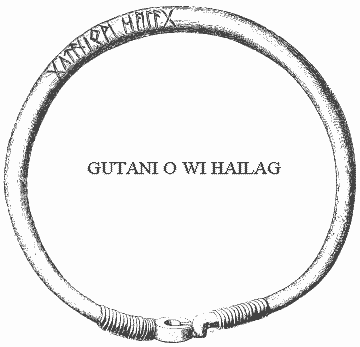
Conlang status
| Luthic Lûthica | |||||||||||||||||||||||||||||||||||||||||||||||||||||
|---|---|---|---|---|---|---|---|---|---|---|---|---|---|---|---|---|---|---|---|---|---|---|---|---|---|---|---|---|---|---|---|---|---|---|---|---|---|---|---|---|---|---|---|---|---|---|---|---|---|---|---|---|---|
| Progress: 96% | |||||||||||||||||||||||||||||||||||||||||||||||||||||
|
| |||||||||||||||||||||||||||||||||||||||||||||||||||||
| Type | |||||||||||||||||||||||||||||||||||||||||||||||||||||
| Fusional | |||||||||||||||||||||||||||||||||||||||||||||||||||||
| Alignment | |||||||||||||||||||||||||||||||||||||||||||||||||||||
| Nominative–accusative | |||||||||||||||||||||||||||||||||||||||||||||||||||||
| Head direction | |||||||||||||||||||||||||||||||||||||||||||||||||||||
| Initial | Mixed | Final | |||||||||||||||||||||||||||||||||||||||||||||||||||
|
| |||||||||||||||||||||||||||||||||||||||||||||||||||||
| Primary word order | |||||||||||||||||||||||||||||||||||||||||||||||||||||
| Subject-verb-object | |||||||||||||||||||||||||||||||||||||||||||||||||||||
| Tonal | |||||||||||||||||||||||||||||||||||||||||||||||||||||
| No | |||||||||||||||||||||||||||||||||||||||||||||||||||||
| Declensions | |||||||||||||||||||||||||||||||||||||||||||||||||||||
| Yes | |||||||||||||||||||||||||||||||||||||||||||||||||||||
| Conjugations | |||||||||||||||||||||||||||||||||||||||||||||||||||||
| Yes | |||||||||||||||||||||||||||||||||||||||||||||||||||||
| Genders | |||||||||||||||||||||||||||||||||||||||||||||||||||||
| 3 | |||||||||||||||||||||||||||||||||||||||||||||||||||||
| Nouns decline according to... | |||||||||||||||||||||||||||||||||||||||||||||||||||||
| Case | Number | ||||||||||||||||||||||||||||||||||||||||||||||||||||
| Definiteness | Gender | ||||||||||||||||||||||||||||||||||||||||||||||||||||
| Verbs conjugate according to... | |||||||||||||||||||||||||||||||||||||||||||||||||||||
| Voice | Mood | ||||||||||||||||||||||||||||||||||||||||||||||||||||
| Person | Number | ||||||||||||||||||||||||||||||||||||||||||||||||||||
| Tense | Aspect | ||||||||||||||||||||||||||||||||||||||||||||||||||||
- Ongoing projects:
- Etymological Leipzig-Jakarta;
- Paulistan Luthic.