Vadi: Difference between revisions
m →Gender |
m →Gender |
||
| Line 244: | Line 244: | ||
|} | |} | ||
The singulative forms seem to roughly correspond with animacy, | The singulative forms seem to roughly correspond with animacy. The ''-(r)i'' forms seem associated with animate nouns, whereas the ''-ka'' forms correspond largely with inananimates. However, exceptions do appear, as in ''uzáka'' instead of expected ''uzap(r)i'' "hand". | ||
Unfortunately, these body parts are the only ones attested from the Scriptum. The last two body parts listed were extracted from letters that became especially laced with various vulgar ad hominems between the two litigants. Note also that the two last terms have both the presumptive animate and inanimate forms. The inanimate forms appear to be used as proxy pronouns for the addressee (implying impotence), while the animate forms appear to be proxy pronouns for the addresser, especially in passages threatening physical violence. | Unfortunately, these body parts are the only ones attested from the Scriptum. The last two body parts listed were extracted from letters that became especially laced with various vulgar ad hominems between the two litigants. Note also that the two last terms have both the presumptive animate and inanimate forms. The inanimate forms appear to be used as proxy pronouns for the addressee (implying impotence), while the animate forms appear to be proxy pronouns for the addresser, especially in passages threatening physical violence. | ||
Revision as of 17:20, 2 August 2020
Introduction
Vadi is an extinct language once spoken in Minhay. A small parchment fragment was discovered in April 2015 in a cave outside of Peħħat, a small township in Sakkeb Prefecture. Soon larger fragments and then the wonderfully preserved Kalapái Scriptum were discovered in an isolated hut, dated as late as the mid to late 1800's CE. The Kalapái Scriptum is a collection of letters between two farmers who were embroiled in an ongoing feud regarding the property lines between their lands. The letters were written in a mixture of Vadi intermixed with words from the unrelated Peshpeg and Minhast languages. A few letters were written entirely in the the extinct Minhast Knife Speaker dialect. Also found among the letters are legal papers drawn from the Prefect of Dog Speaker Country. The farmers' letters contained several texts clearly indicating code-switching between Vadi and the Knife Speaker dialect. The portions containing the intermixed Knife Speaker and Peshpeg words were used to decipher the Vadi texts. The Dog Speaker papers did not contribute directly to the decipherment of the language, but as an external source it provided a great deal of context of the nature of the feud between the litigants. This external contextual source clarified the translation of otherwise ambiguous passages. The Kalapái Scriptum is thus popularly referred to as the "Minhast Rosetta Stone".
Phonology
Consonants
| Bilabial | Alveolar | Palatal | Velar | Uvular | Glottal | |
|---|---|---|---|---|---|---|
| Nasal | m | n | ||||
| Plosive | p b | t d | k g | ʔ | ||
| Fricative | v | s | h | |||
| Affricates | ||||||
| Approximants | w | j | ||||
| Flap | ɾ | |||||
| Lateral Approximant | l |
Vowels
| Front | Near- front | Central | Near- back | Back | ||
| Close | 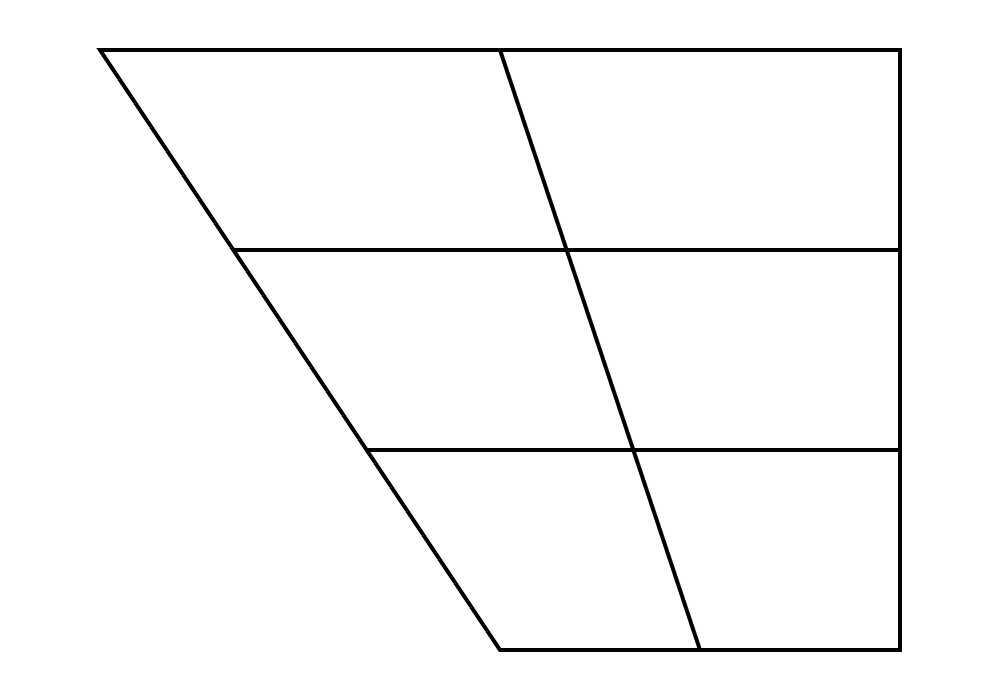
| |||||
| Near-close | ||||||
| Close-mid | ||||||
| Mid | ||||||
| Open-mid | ||||||
| Near-open | ||||||
| Open | ||||||
Prosody
Stress
Stress is highly variable in Vadi, but it tends to fall on the penultimate syllable. The orthography marks stress with an acute accent, which in turn implies that the vowel is lengthened, although exceptions abound. When a penultimate syllable is marked with an acute accent, one can generally assume that vowel lengthening has also occurred, although at times it may be an orthographic relic from a time when the vowel was lengthened in the past, but in modern speech has been shortened.
Intonation
Phonotactics
Morphophonology
Morphology
Vadi is an analytic language and has very few bound affixes, but even these have been determined by some linguists as clitics. Their status as bound clitics versus unbound morphemes remains unclear, but those that indicate position or direction continue to be represented as clitics in glosses, following J.F. Schumann's practice.
Nouns
Gender
Vadi nouns for the most part do not mark for gender, but there appear to be remnants of gender marking on special singulative forms, interestingly confined body parts:
| Body Part | Singulative | Non-Singulative |
|---|---|---|
| Head | jidari | jidar |
| Eye | kulúri | kulun |
| Ear | támika | taka |
| Hair | varláka | varlat |
| Lips | túnturi | tuntu |
| Tongue | nipázi | nipáz |
| Finger | patáka | pata |
| Hand | uzáka | uzap |
| Penis | niátari/niátak(a) | niat |
| Testicle | vúlari/vúluka | vula |
The singulative forms seem to roughly correspond with animacy. The -(r)i forms seem associated with animate nouns, whereas the -ka forms correspond largely with inananimates. However, exceptions do appear, as in uzáka instead of expected uzap(r)i "hand".
Unfortunately, these body parts are the only ones attested from the Scriptum. The last two body parts listed were extracted from letters that became especially laced with various vulgar ad hominems between the two litigants. Note also that the two last terms have both the presumptive animate and inanimate forms. The inanimate forms appear to be used as proxy pronouns for the addressee (implying impotence), while the animate forms appear to be proxy pronouns for the addresser, especially in passages threatening physical violence.
Regardless, the usual singulative determiner han/ha do not co-occur in any of the texts of the Scriptum, suggesting that double-marking with the determine is ungrammatical.
Number
Number exhibits a two-way distinction in nouns: singular and non-singular. Singular number is explicitly marked with the determiner han/ha, while plural and collectives are unmarked. Nouns beginning with a vowel are preceded by the allomorph han, while ha appears before nouns beginning with a consonant.
Case
Five postpositional morphemes have been identified:
| Case | Postposition |
|---|---|
| Dative-Benefactive | =li |
| Ablative | =ta |
| Locative | =éva |
| Instrumental | =eta |
| Comitative | =kalí |
Body part nouns may precede a head noun already marked with one of the case clitics to add more locational, directional, or positional precision. For example, the noun kilái "heart", often combines with a noun marked with the locative clitic =eva to convey an inessive sense:
- Júla kilái kileva ha mana nai, ukan hen!
ji-úla kilái kil=eva ha mana nai ukan hen
1S.NOM+2S.ACC.GEN heart SG house=LOC go FUT wreak.havok EMPH
I will enter your house and ruin you!
Core arguments take no marking. In transitive clauses, only word order distinguishes the subject and indirect object:
- Ji kusara iaviti nai.
ji kusara iaviti nai.
1S meat buy FUT
I shall buy meat.
An object may come before the subject only if it the particle ipan is inserted between it and its clause, followed by an audible pause:
- Kusara ipan, ji iaviti nai.
kusara ipan ji iaviti nai.
meat TOP 1S buy FUT
Meat, I shall buy (some).
Pronouns
Vadi pronouns do not mark for gender. Case marking on core arguments for transitive clauses do exhibit a nominative-accusative distinction, but only when both arguments are singular in number.
Plurality in the independent pronouns are indicated by the suffix -ta. This contrasts with number marking on nouns, where plurals are unmarked but singulars are preceded by the determiner han/ha.
| Person | Singular | Plural |
|---|---|---|
| First | ji | jita |
| Second | úla | ulta |
| Third | kani | kanta |
The nominative-accusative distinction occurs in the portmanteau forms, which are etymologically transparent. The first segment of the portmanteau affix marks the nominative argument, while the second marks the accusative argument:
| Agent | Person | Patient | ||
|---|---|---|---|---|
| First | Second | Third | ||
| First | -- | júla | jáni | |
| Second | uláji | -- | uláni | |
| Third | kaji | kula | káni | |
Adjectives
Verbs
Derivation
Derivational affixes occur in greater frequency, but the texts from the Scriptum suggest the overwhelming number of these affixes are no longer productive. For this reason, the general consensus among Vadists is that these affixes have been fossilized. A prefix pesa- occurs among some verbs that tends to give them causative meaning. For this reason some have speculated this is a borrowing from the Minhast causative prefix -šp-. This view is problematic however, because this prefix sometimes appears to intensify the meaning of the root. Moreover, it is also found attached to some nouns, but its addition does not appear to affect the semantics of the noun.
Causative pesa-:
- Anu úla pesadíka, hen.
Anu úla pesa-díka nai hen
PN 2P CAUS-run.off FUT EMPH
(Prefect) Annu will drive you out!
Intensive pesa-:
- Ji pesakúna, kaman uláta, ji nokan pesakúdi.
ji pesa-kúna nai, kaman uláta ji nokan pesa-akúdi.
1P CAUS-go FUT head úla=ABL 2S rock CAUS-throw.
I will climb (that mountain) above you (so that) I can rain down rocks (upon you).
Nominal pesa-:
- Pesarona hokun.
pesa-rona hokun
CAUS-snake eat.
Snakes will eat (you).
Contrast this with the actual use of the Minhast causative -šp-, by Prefect Annu (Minhast, Dog Speaker Dialect):
- Tašpintaknataheknessuš, tašpintaknaknessuš. Marantaħmankilmakš, yattax! Ikšitamaškidustitaħmāš!
ta-šp-nt-ikna-tahek-ness-u=š ta-šp-nt-ikna-k-ness-u=š maran-tahem-an-kilmakš yattax kš-tamašk-dust-tahem-an=š
NEG-CAUS-INT-go-2S.ACC+1S.NOM-FUT-TRNS=IRR NEG-CAUS-go-FUT-TRNS=IRR pest-2P.NOM-MIR.NEG DEPR CESS-stalk.while.hunting-REC.ADVS-2P.NOM-INTR=IRR
I don't plan on throwing you off your land, and I'm not planning on throwing him off his land. You two pests should leave each other alone!
Other derivational affixes, both prefixes and suffixes, are more common, some appear to be highly productive and suggest they can be spontaneously generated:
- -kai: a deverbal for creating place nouns, e.g. iavati-kai "a place for buying", i.e. marketplace.
- -pallái: another deverbal for creating place nouns, e.g. tukin-pallái "a place for sitting", i.e. hearth, dining room.
- -kattá: a deverbal affix deriving agent nouns, e.g. iavati-kattá "one who buys, a buyer"
Some affixes may be chained, as in tukimpallaikattá < tukin-pallai-kattá "a place for sitting ones", i.e. "dinner guests, diners". However, affix chaining is rather uncommon.
Syntax
Vadi, as an analytic language, relies on word order to indicate the case roles of the core arguments of a clause, to delineate the constituents of a noun phrase, and to indicate the pivot in multiclausal sentences. The language is primarily SOV, although the verb phrase may occur in different locations in the clause for pragmatic purposes. However, the S-argument invariably precedes the O-argument in transitive clauses. Tense particles always occur in clause-final position.
Constituent order
Noun phrase
Possessums precede their heads.
Verb phrase
Sentence phrase
Dependent clauses
Example texts
- Uláji tábila nikku úla hai, petta ulátane
/u:'lad͡zi 'ta:bɪla nɪk:u haɪ, petta u'la:tane/
úla-ji tábi-la nikku hai, petta úla-tane
2S.NOM+1S.ACC.GEN land-PL seize try PST, thief 2S-EMP
You tried to seize my lands, you are a thief indeed!
- Ka úla mai naha ji tábila, ji puni úla merkeva nai!
/ka 'u:la maɪ 'naha d͡zi 'ta:bɪla d͡zi 'pu:ni 'u:la 'mɛɾkɛva 'naɪ/
ka úla mai naha ji tábi-la nikku e, ji puni úla merkeva nai
if 2S come here 1S land-PL seize SJV, 1S RSLT 2S kill FUT
If you come here to seize my land, I will kill you!
- Júla nánani.
/d͡z'u:la 'na:nani/
ji-ula nanani
1S.NOM+2S.ACC RV~disgust
You truly disgust me.
- Valí ulaki úla píhala nai.
/va'li u'laki 'u:la 'pihala naɪ/
valí ulaki úla píhala nai
perhaps authorities 2S seize FUT
Perhaps the authorities shall arrest you.
- Dávan biri uláji kunet hai? Dumúla rani ikkúni siráhi ji?
/'da:van biɾi ul'a:ji kunet haɪ du'mu:la ɾani ik:'u:ni siɾ'a:hi ji/
dávan biri ulá-ji kunet hai dumúla rani ikkúni siráhi ji
why thus 2S.NOM-1S.ACC commit.wrong PST Q+2S know prefect stand.behind me
Why have you wronged me thus? Do you not know the Prefect has given me his support?
- Súnagun jibáitane! Ji súharak kanéneka, báti úla kimúdi nai, bia!
/'su:nagun d͡zi'baɪtane d͡zi 'su:haɾak ka'ne:neka 'ba:ti 'u:la: ki'm:udi naɪ bija/
súnagun ji-bai-tane ji súharak kanéneka báti ulá kimúdi nai bia
place.name 1S.ownership-EMP 1S papers hold.in.hand PART you read FUT behold
Súnagun is mine! I have the (legal) papers, [?] here, take them and read!
- Éro, úla peho te. Júla kanarídi nai. Ikkúni jili Súnagun parati nai.
/'e:ɾo 'u:la pɛho te 'd͡zu:la kana'ɾidi naɪ ɪ'k:u:ni 'd͡zili 'sunagun pa'rati naɪ/
éro úla peho te júla kanarídi nai ikkúni ji-li Súnagun parati nai
PN 2S fool truth 1S.NOM-2S.ACC win FUT prefect 1S-DAT place.name reward FUT
Éro, you indeed are a fool. I will prevail over you. The Prefect shall award me Súnagun.
OVS -> matrix clause SC -> dependent clause
SVO -> matrix clause, COND SOV -> dependent clause, RSLT
OSV