Éljansk: Difference between revisions
m Categories. |
|||
| (5 intermediate revisions by one other user not shown) | |||
| Line 1: | Line 1: | ||
{{Infobox language | |||
|name = Islander Norse | |||
|nativename = Éljansk | |||
|pronunciation = [eːʎansk] | |||
|creator = Neil Whalley | |||
|region = British Isles | |||
|states = Kingdom of the Isles | |||
|nation = Kingdom of the Isles | |||
|familycolor = Indo-European | |||
|fam2=[[Germanic languages|Germanic]] | |||
|fam3=[[North Germanic languages|North Germanic]] | |||
|fam4=[[Old West Norse|West Norse]] | |||
|ancestor=[[Old West Norse]] | |||
|ancestor2=[[Early Éljansk]] | |||
|script = [[w:Latin script|Latin script]] | |||
}} | |||
'''Éljansk''' /eːʎənsk/ or '''Islander Norse''' is a heavily Gaelic-influenced West Norse language that developed in the medieval Kingdom of the Isles from the 9th century. | '''Éljansk''' /eːʎənsk/ or '''Islander Norse''' is a heavily Gaelic-influenced West Norse language that developed in the medieval Kingdom of the Isles from the 9th century. | ||
| Line 277: | Line 294: | ||
=Morphology= | =Morphology= | ||
==Nouns== | ===Nouns=== | ||
Nouns are declined according to | Nouns are declined according to number only (singular or plural). There are no grammatical genders in Éljansk and case is not marked. | ||
The base form of the noun is always singular, e.g. ''man'' "man", ''barn'' "child", ''ríķ'' "kingdom". In most cases the plural is formed by adding ''-er'' to the singular form, e.g. ''maner'' "men", ''barner'' "children", ''ríkjer'' "kingdoms". | |||
The genitive of possession is shown by placing the possessor after the possessed, e.g. ''hús Duvan'' "Duvan's house", ''kirķ Patriķ'' "Patrick's church". When the possessor is a definite noun, the article ''en'' may be placed before it, e.g. ''Kong en Éljaner'' "King of the Isles". | |||
===Articles=== | |||
There is no indefinite article and the noun alone is considered indefinite, e.g. ''stól'' "(a) stool", ''ár'' "(an) oar". The definite article is ''en'' for both the singular and plural; it always precedes the noun, e.g. ''en stól'' "the stool", ''en árer'' "the oars". | |||
===Adjectives=== | |||
{| class="wikitable" width=" | ===Numerals=== | ||
| | {| class="wikitable" style="text-align: center;" | ||
|+ Numerals | |||
|- | |||
! width="50;" | !! width="200;" | Cardinal !! width="200;" | Ordinal | |||
|- | |||
! 1 | |||
| ''éin'' || ''first'' | |||
|- | |||
! 2 | |||
| ''twéi'' || ''aner'' | |||
|- | |||
! 3 | |||
| ''thrí'' || ''thridh'' | |||
|- | |||
! 4 | |||
| ''fjór'' || ''fjórdh'' | |||
|- | |||
! 5o | |||
| ''fim'' || ''fimt'' | |||
|- | |||
! 6 | |||
| ''ses'' || ''set'' | |||
|- | |||
! 7 | |||
| ''sjó'' || ''sjónd'' | |||
|- | |||
! 8 | |||
| ''át'' || ''átand'' | |||
|- | |- | ||
! | ! 9 | ||
| ''ní'' || ''nínd'' | |||
|- | |- | ||
! | ! 10 | ||
| '' | | ''tí'' || ''tínd'' | ||
|- | |- | ||
! | ! 11 | ||
|'' | | ''elif'' || ''elift'' | ||
|- | |- | ||
! | ! 12 | ||
| '' | | ''tólf'' || ''tólft'' | ||
|- | |- | ||
| | ! 13 | ||
| ''thrí tán'' || ''thrí tánd'' | |||
|- | |||
| | ! 14 | ||
| ''fjór tán'' || ''fjór tánd'' | |||
|- | |||
! 15 | |||
| ''fim tán'' || ''fim tánd'' | |||
|- | |||
! 16 | |||
| ''ses tán'' || ''ses tánd'' | |||
|- | |||
! 17 | |||
| ''sjó tán'' || ''sjó tánd'' | |||
|- | |||
! 18 | |||
| ''át tán'' || ''át tánd'' | |||
|- | |||
! 19 | |||
| ''ní tán'' || ''ní tánd'' | |||
|- | |||
! 20 | |||
| ''tutú'' || ''tutúnd'' | |||
|- | |||
! 21 | |||
| ''éin eg tutú'' || ''first eg tutú'' | |||
|- | |- | ||
! | ! 30 | ||
| ''þrítí'' || ''þrítínd'' | |||
|- | |- | ||
! | ! 40 | ||
| '' | | ''fjórtí'' || ''fjórtínd'' | ||
|- | |- | ||
! | ! 50 | ||
|'' | | ''fimtí'' || ''fimtínd'' | ||
|- | |- | ||
! | ! 60 | ||
| '' | | ''sestí'' || ''sestínd'' | ||
|- | |- | ||
| | ! 70 | ||
| ''sjótí'' || ''sjótínd'' | |||
| | |||
|- | |- | ||
! | ! 80 | ||
| ''átí'' || ''átínd'' | |||
|- | |- | ||
! | ! 90 | ||
| '' | | ''nítí'' || ''nítínd'' | ||
|- | |- | ||
! | ! 100 | ||
|'' | | ''títí'' || ''títínd'' | ||
|- | |- | ||
! | ! 110 | ||
| '' | | ''eliftí'' || ''eliftínd'' | ||
|- | |- | ||
! 120 | |||
| ''hunredh'' || ''hunrest'' | |||
|} | |} | ||
=== | ===Pronouns=== | ||
====Personal==== | |||
{| class="wikitable" style="text-align: center;" | |||
{| class="wikitable" width=" | |+ Personal Pronouns | ||
|- | |||
! width="75;" | !! width="40;" | !! width="100;" | Subject !! width="100;" | Object !! width="100;" | Prepositional | |||
|- | |||
! rowspan="5;" | Sing || 1 | |||
| ''ik'' || ''mik'' || ''mé'' | |||
|- | |||
! 2 | |||
| ''thú'' || ''thik'' || ''thé'' | |||
|- | |||
! 3m | |||
| colspan="2;" | ''han'' || ''ham'' | |||
|- | |- | ||
! | ! 3f | ||
| colspan="2;" | ''hon'' || ''hen'' | |||
|- | |- | ||
! | ! 3n | ||
| colspan="2;" | ''that'' || ''thí'' | |||
|- | |- | ||
! | ! rowspan="3;" | Plural || 1 | ||
| | | ''vé'' || colspan="2;" | ''os'' | ||
|- | |- | ||
! | ! 2 | ||
| '' | | ''é'' || colspan="2;" | ''í'' | ||
|- | |- | ||
! | ! 3 | ||
| '' | | ''théi''|| ''thá'' || ''them'' | ||
|- | |- | ||
|} | ! colspan="2;" | Reflexive | ||
| - || ''sik'' || ''sé'' | |||
|} | |||
====Demonstrative==== | |||
The demonstrative pronouns are: | |||
* ''then'' "this", ''thes'' "these" | |||
* ''that'' "that" (near you), ''thó'' "those" | |||
* ''hit'' "that" (at a distant, abstract), ''hin'' "those". | |||
These pronouns are used as stand-alone forms. When demonstratives qualify a noun it is more common to use the adverbs ''hér'' "here", ''thar'' "there" and ''than'' "yonder" with a definite noun, e.g. ''en man hér'' "this man", ''en hund thar'' "that dog". | |||
====Indefinite==== | |||
===Verbs=== | |||
=Syntax= | =Syntax= | ||
=Vocabulary= | =Vocabulary= | ||
[[Category:Languages]] | |||
[[Category:Indo-European languages]] | |||
[[Category:North Germanic languages]] | |||
[[Category:A posteriori]] | |||
Latest revision as of 15:20, 10 December 2019
| Islander Norse | |
|---|---|
| Éljansk | |
| Pronunciation | [[w:Help:IPA|eːʎansk]] |
| Created by | Neil Whalley |
| Native to | Kingdom of the Isles |
Indo-European
| |
Early forms | |
| Official status | |
Official language in | Kingdom of the Isles |
Éljansk /eːʎənsk/ or Islander Norse is a heavily Gaelic-influenced West Norse language that developed in the medieval Kingdom of the Isles from the 9th century.
Background
Phonology and Orthography
Vowels
| Front | Near- front | Central | Near- back | Back | ||
| Close | 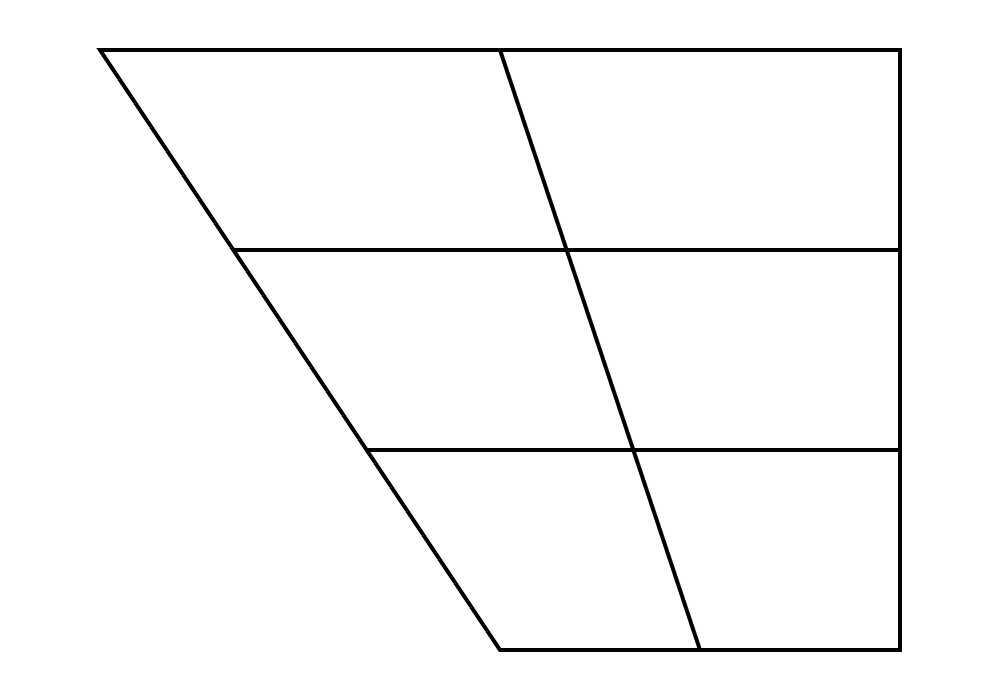
| |||||
| Near-close | ||||||
| Close-mid | ||||||
| Mid | ||||||
| Open-mid | ||||||
| Near-open | ||||||
| Open | ||||||
All vowels except /ə/ may be long or short; vowel length is phonemic and invariable. The obscure vowel /ə/ occurs only as an allophone of mid- and low vowels (i.e. /e, o, a/) in unstressed syllables.
There is only one diphthong, éi /ɛi̯/.
Consonants
| Bilabial | Dental | Alveolar | Postalveolar | Palatal | Velar | Guttural | ||||||||
|---|---|---|---|---|---|---|---|---|---|---|---|---|---|---|
| Plosive | p | b | t | d | c | ɟ | k | g | ||||||
| Nasal | m | n | ɲ | (ŋ) | ||||||||||
| Fricative | ɸ | β | θ | ð | ʃ | s | (x) | ɣ | h | |||||
| Affricate | t͡ʃ | d͡ʒ | ||||||||||||
| Approximant | j | |||||||||||||
| Lateral | l | ʎ | ||||||||||||
| Rhotic | r |
- /ŋ/ is an allophone of /n/ before /k, g/.
- /x/ is an allophone of /ɣ/ before /t/.
gh /ɣ/
The phoneme /ɣ/, written gh, has several allophonic variants, depending on its position. It is:
- /ɣ/ in word-final position and between vowels, e.g. hógh "hill" /hoːɣ/, borgh "fort" /borɣ/, dagher "days" /daɣər/
- /x/ before /t/, e.g. floght "flutter" /floxt/, láght "low" (neut.) /laxt/.
- /Ø/ (zero) before a consonant, causing the following vowel to lengthen when short, e.g. laghman "lawyer" /laːmən/, boghskot "bowshot" /boːskot/.
Stress
Primary stress is always on the first syllable of the word.
Spelling
Until the 13th century, Éljansk was primarily written using the Younger Futhark runes, but a spelling system using the Roman alphabet was already in use. The standardised form of the alphabet consists of the following letters:
- a b d e f g h i j k l m n o p r s t u v
The runic letters ð and þ continued to be used into the 15th century, but are replaced by the digraphs dh and th in the standard orthography. In addition to these letters, all vowels may take the acute accent (á, é, í, ó, ú) to symbolise long vowels, and the letters d, k, l, n, s, t occur with a cedilla (usually realised as a diacritical comma in digital text; e.g. ḑ, ķ, ļ, ņ, ș, ț) to symbolise palatal consonants.
Palatal Consonants
The consonants /t, d, k, g, l, n, s/ (written t, d, k, g, l, n and s) all have palatal variants: /t͡ʃ, d͡ʒ, c, ɟ, ʎ, ɲ, ʃ/. The method of writing these palatal sounds is dependent on the context:
- before i or í, the sounds are always palatal and the unmarked forms of the letters are used, so that ti is always /t͡ʃi/ etc., e.g. dim "dim, dark" /d͡ʒim/, sidhan "since" /ʃiðən/.
- before other vowels, the letters are followed by j, e.g. tjarn "pond" /t͡ʃarn/, ljú "lie" /ʎuː/.
- before a consonant or word-finally, the sounds are marked with a diacritical comma, e.g. veņ "custom" /βeɲ/, driķ "drinking" /dric/. An exception is the letter g, which is usually written gj even at the end of a syllable, e.g. legj "lie down" /leɟ/.
Sound to Spelling Correspondence
| Graph | IPA | Environment | Examples |
|---|---|---|---|
| a | /a/ | ||
| /a:/ | before gh + consonant (except t) |
||
| á | /aː/ | ||
| e | /e/ | ||
| é | /eː/ | ||
| éi | /ei̯/ | ||
| i | /i/ | ||
| í | /iː/ | ||
| o | /o/ | ||
| /oː/ | before gh + consonant (except t) |
||
| ó | /oː/ | ||
| u | /u/ | ||
| ú | /uː/ |
| Graph | IPA | Environment | Examples |
|---|---|---|---|
| b | /b/ | ||
| d | /d/ | ||
| /d͡ʒ/ | before i or í | ||
| dj ḑ |
/d͡ʒ/ | ||
| dh | /ð/ | ||
| f | /ɸ/ | ||
| g | /g/ | ||
| /ɟ/ | before i or í | ||
| gj | /ɟ/ | ||
| gh | /ɣ/ | ||
| /x/ | before t | ||
| /Ø/ | before any consonant except t* |
||
| h | /h/ | ||
| j | /j/ | ||
| /Ø/ | after t, d, k, g, s, n, l indicates palatalisation |
||
| k | /k/ | ||
| /c/ | before i or í | ||
| kj ķ |
/c/ | ||
| l | /l/ | ||
| /ʎ/ | before i or í | ||
| lj ļ |
/ʎ/ | ||
| m | /m/ | ||
| n | /n/ | ||
| /ɲ/ | before i or í | ||
| /ŋ/ | before k or g | ||
| nj ņ |
/ɲ/ | ||
| p | /p/ | ||
| r | /r/ | ||
| s | /s/ | ||
| /ʃ/ | before i or í | ||
| sj ș |
/ʃ/ | ||
| t | /t/ | ||
| /t͡ʃ/ | before i, í or j | ||
| tj ț |
/t͡ʃ/ | ||
| v | /β/ |
Notes:
- In some cases j signifies the palatal nature of the preceding consonant, rather than a distinct sound.
- When syllable-final palatal consonants written with a diacritic comma come to stand before a vowel, due to the addition of word-endings or compounding, the marked letter is replaced by Cj, e.g. ríķ "kingdom" → ríkjer "kingdoms", erviņ "heir" → ervinjum "heirs" (dat. pl.)
Morphology
Nouns
Nouns are declined according to number only (singular or plural). There are no grammatical genders in Éljansk and case is not marked.
The base form of the noun is always singular, e.g. man "man", barn "child", ríķ "kingdom". In most cases the plural is formed by adding -er to the singular form, e.g. maner "men", barner "children", ríkjer "kingdoms".
The genitive of possession is shown by placing the possessor after the possessed, e.g. hús Duvan "Duvan's house", kirķ Patriķ "Patrick's church". When the possessor is a definite noun, the article en may be placed before it, e.g. Kong en Éljaner "King of the Isles".
Articles
There is no indefinite article and the noun alone is considered indefinite, e.g. stól "(a) stool", ár "(an) oar". The definite article is en for both the singular and plural; it always precedes the noun, e.g. en stól "the stool", en árer "the oars".
Adjectives
Numerals
| Cardinal | Ordinal | |
|---|---|---|
| 1 | éin | first |
| 2 | twéi | aner |
| 3 | thrí | thridh |
| 4 | fjór | fjórdh |
| 5o | fim | fimt |
| 6 | ses | set |
| 7 | sjó | sjónd |
| 8 | át | átand |
| 9 | ní | nínd |
| 10 | tí | tínd |
| 11 | elif | elift |
| 12 | tólf | tólft |
| 13 | thrí tán | thrí tánd |
| 14 | fjór tán | fjór tánd |
| 15 | fim tán | fim tánd |
| 16 | ses tán | ses tánd |
| 17 | sjó tán | sjó tánd |
| 18 | át tán | át tánd |
| 19 | ní tán | ní tánd |
| 20 | tutú | tutúnd |
| 21 | éin eg tutú | first eg tutú |
| 30 | þrítí | þrítínd |
| 40 | fjórtí | fjórtínd |
| 50 | fimtí | fimtínd |
| 60 | sestí | sestínd |
| 70 | sjótí | sjótínd |
| 80 | átí | átínd |
| 90 | nítí | nítínd |
| 100 | títí | títínd |
| 110 | eliftí | eliftínd |
| 120 | hunredh | hunrest |
Pronouns
Personal
| Subject | Object | Prepositional | ||
|---|---|---|---|---|
| Sing | 1 | ik | mik | mé |
| 2 | thú | thik | thé | |
| 3m | han | ham | ||
| 3f | hon | hen | ||
| 3n | that | thí | ||
| Plural | 1 | vé | os | |
| 2 | é | í | ||
| 3 | théi | thá | them | |
| Reflexive | - | sik | sé |
Demonstrative
The demonstrative pronouns are:
- then "this", thes "these"
- that "that" (near you), thó "those"
- hit "that" (at a distant, abstract), hin "those".
These pronouns are used as stand-alone forms. When demonstratives qualify a noun it is more common to use the adverbs hér "here", thar "there" and than "yonder" with a definite noun, e.g. en man hér "this man", en hund thar "that dog".