Galatian: Difference between revisions
No edit summary |
Chrysophylax (talk | contribs) m Text replacement - "Category:Conlangs" to "Category:Languages" |
||
| (3 intermediate revisions by one other user not shown) | |||
| Line 2: | Line 2: | ||
|creator = [[User:Frederic Bayer|Frederic Bayer]] ([[User talk:Frederic Bayer|talk]]) | |creator = [[User:Frederic Bayer|Frederic Bayer]] ([[User talk:Frederic Bayer|talk]]) | ||
|name = Galatian | |name = Galatian | ||
|nativename = Τολιστεκά, | |nativename = Τολιστεκά, تٜلِصتٕكا, თოლისთექჺ | ||
|setting = Alternate history | |setting = Alternate history | ||
|region = Former Ottoman Empire | |region = Former Ottoman Empire | ||
| Line 137: | Line 137: | ||
<div style="font-size: smaller; line-height: 1.25em; margin-bottom: 0.33em"></div> | <div style="font-size: smaller; line-height: 1.25em; margin-bottom: 0.33em"></div> | ||
In addition to these vowel qualities, Galatian has a length distinction and a historical aspiration distinction (now only retained epenthetically or in conservative dialects, but still consistently written in the orthography). | In addition to these vowel qualities, Galatian has a length distinction and a historical aspiration distinction (now only retained epenthetically or in conservative dialects, but still consistently written in the orthography). In the Greek orthography this is marked using the rough or smooth breathing diacritic on a vowel. In the Arabic, it is marked using the letter ھ, while in Georgian it is marked using the letter ჰ. | ||
{| border="1" cellpadding="1" cellspacing="1" class="bluetable lightbluebg" style="text-align:center;" | {| border="1" cellpadding="1" cellspacing="1" class="bluetable lightbluebg" style="text-align:center;" | ||
! style="width: 60px; " | Phoneme | ! style="width: 60px; " | Phoneme | ||
! style="width: 60px; " | | ! style="width: 60px; " | Greek | ||
! style="width: 60px; " | Arabic | |||
! style="width: 60px; " | Georgian | |||
|- | |- | ||
|i, ɪ | |i, ɪ | ||
|ι | |ι | ||
|ِ | |||
|ი | |||
|- | |- | ||
|iː | |iː | ||
|ί | |ί | ||
|ي | |||
|ი̌ | |||
|- | |- | ||
|y, ʏ | |y, ʏ | ||
|υ | |υ | ||
|ٚ | |||
|ჲ | |||
|- | |- | ||
|yː | |yː | ||
|ύ | |ύ | ||
|ۈ | |||
|ჲ̌ | |||
|- | |- | ||
|u | |u | ||
|ου | |ου | ||
|ُ | |||
|უ | |||
|- | |- | ||
|uː | |uː | ||
|ού | |ού | ||
|و | |||
|უ̌ | |||
|- | |- | ||
|e, ɛ | |e, ɛ | ||
|ε, αι | |ε, αι | ||
|ٕ | |||
|ე, აი | |||
|- | |- | ||
|eː | |eː | ||
|η | |η | ||
|ہ | |||
|ჱ | |||
|- | |- | ||
|ɛː | |ɛː | ||
|έ, αί | |έ, αί | ||
|ې | |||
|ე̌, აი̌ | |||
|- | |- | ||
|o, ɔ | |o, ɔ | ||
|ο | |ο | ||
|ٜ | |||
|ო | |||
|- | |- | ||
|oː | |oː | ||
|ω | |ω | ||
|ۉ | |||
|ო̌ | |||
|- | |- | ||
|a | |a | ||
|α | |α | ||
|َ | |||
|ა | |||
|- | |- | ||
|aː | |aː | ||
|ά | |ά | ||
|ا | |||
|ჺ | |||
|} | |} | ||
===Vowel harmony=== | ===Vowel harmony=== | ||
Valmoric has limited vowel harmony for bound morphemes: Morphemes subject to harmony which contain an ι, ε, or η will change this to an υ, ο, or ω respectively if the adjacent syllable contains an υ, ου, ο, or ω. Such harmonised vowels are marked with the circumflex: υ̂, ô, ω̂. | Valmoric has limited vowel harmony for bound morphemes: Morphemes subject to harmony which contain an ι, ε, or η will change this to an υ, ο, or ω respectively if the adjacent syllable contains an υ, ου, ο, or ω. Such harmonised vowels are marked with the circumflex: υ̂, ô, ω̂. | ||
| Line 249: | Line 278: | ||
[[Category:{{PAGENAME}}]] | [[Category:{{PAGENAME}}]] | ||
[[Category: | [[Category:Languages]] | ||
Latest revision as of 06:54, 20 January 2017
| Galatian | |
|---|---|
| Τολιστεκά, تٜلِصتٕكا, თოლისთექჺ | |
| Created by | Frederic Bayer (talk) |
| Setting | Alternate history |
| Native to | Galatia, Turkey, Greece, Georgia, Syria, Lebanon, Egypt |
| Native speakers | 3,400,000 (2016) |
Indo-European
| |
| Official status | |
Official language in | Galatia |
Recognised minority language in | Greece, Georgia, Syria |
The Galatian language is a Celtic language spoken mainly in the Galatian Republic, with significant minority communities in Turkey, Greece, Georgia, Syria, Lebanon and Egypt.
Introduction
Phonology
Orthography
Consonants
Nasal mutation
| Unmutated | Mutated |
|---|---|
| π | β |
| τ | δ |
| κ | γ |
| β | μ |
| δ | ν |
| γ | γ̌ |
| ζ | ἰ |
Vowels
| Front | Near- front | Central | Near- back | Back | ||
| Close | 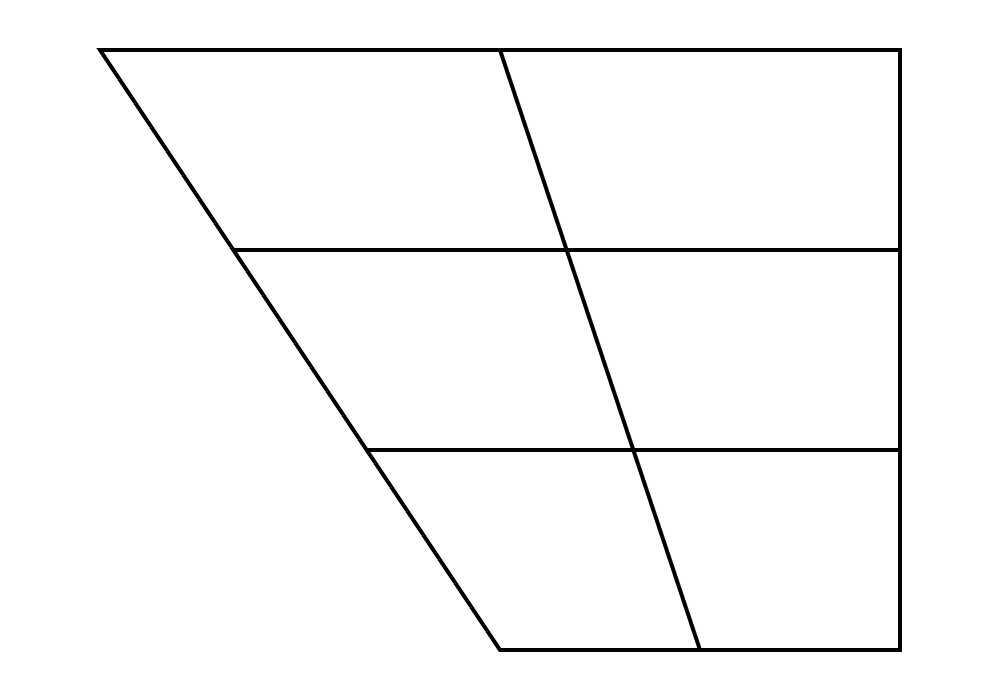
| |||||
| Near-close | ||||||
| Close-mid | ||||||
| Mid | ||||||
| Open-mid | ||||||
| Near-open | ||||||
| Open | ||||||
In addition to these vowel qualities, Galatian has a length distinction and a historical aspiration distinction (now only retained epenthetically or in conservative dialects, but still consistently written in the orthography). In the Greek orthography this is marked using the rough or smooth breathing diacritic on a vowel. In the Arabic, it is marked using the letter ھ, while in Georgian it is marked using the letter ჰ.
| Phoneme | Greek | Arabic | Georgian |
|---|---|---|---|
| i, ɪ | ι | ِ | ი |
| iː | ί | ي | ი̌ |
| y, ʏ | υ | ٚ | ჲ |
| yː | ύ | ۈ | ჲ̌ |
| u | ου | ُ | უ |
| uː | ού | و | უ̌ |
| e, ɛ | ε, αι | ٕ | ე, აი |
| eː | η | ہ | ჱ |
| ɛː | έ, αί | ې | ე̌, აი̌ |
| o, ɔ | ο | ٜ | ო |
| oː | ω | ۉ | ო̌ |
| a | α | َ | ა |
| aː | ά | ا | ჺ |
Vowel harmony
Valmoric has limited vowel harmony for bound morphemes: Morphemes subject to harmony which contain an ι, ε, or η will change this to an υ, ο, or ω respectively if the adjacent syllable contains an υ, ου, ο, or ω. Such harmonised vowels are marked with the circumflex: υ̂, ô, ω̂.
Morphophonology
Declension
First declension
Masculine
| Case | Singular | Plural |
|---|---|---|
| Nominative | (νο) -ο | (νοι) -οι |
| Accusative | (ὁ) -ω | (νους) -ους |
| Dative | (ἱ) -ει | (ὁς) -ους |
| Genitive | (νι) -ι | (οὑ) -ο |
| Ablative | (οὑ) -ου | (ἱ) -ι |
| Vocative | (νε) | (νους) -ους |
Syntax
Constituent order
Noun phrase
Verb phrase
Sentence phrase
Dependent clauses
Example texts
The Lord's Prayer
The Galatian version lacks the reference to forgiving sin, based on an omission in an apocryphal Q source translation into Galatian. Most Galatian Christians pray the prayer in Greek.
| Galatian | IPA | Proto-Celtic cognate | English |
|---|---|---|---|
| Αιρ Ἁθίr ὁ ἐστ ἐν ἱ νεμει, Ἐς ἵσνειμάς ἀμμα θῳ, Ἀγγετ φαλο θῳ, ζο βριθι θῳ, Ἐν ἱ νεμει οὑρ ἐν ἱ ἵφριο. Δά αἰρά βαραγενά τονις ὁδίο, Και νεπ φεδε νις εν ἵσουδου, Ἐθιπε βαριά νι γαλαρου. Αμήν. |
er aˈθiːr o ɛst ɛn iː ˈnɛ.mɛɪ, ɛs ˌiː.snɛɪˈmaːs amːa θɔːj ˈaŋ.gɛt ˈfa.lo θɔːj, co ˈvrɪ.θi θɔːj ɛn i ˈnɛ.mɛɪ uːr en i ˈhiː.fri.jo ðaː eˈraː va.ra.ɣɛˈnaː ˈtɔ.nɪs ɔjo kɛ nɛp fɛðɛ nɪs ɛn ˈiː.suˌðuː ˈɛ.θi.pɛ var.jaː ni ɣa.la.ruː aˈmiːn |
Ansere ɸatīr so esti eni sindei nemei, Es ɸīssu-neymātyo anman tewe, Anket walo tewe, kiyetyo briti tewe, Eni sindei nemei uɸor eni sindei ɸīweryon. Dā anserām baragenām tosnis so-dīyo Qe neqe wede snis eni ɸīssu-edwon Etiqe ɢariyā snis galarū. |
Our Father, which is in heaven, Hallowed be thy name, Thy rule come, thy will be done, In the heaven and in the Earth Give our bread to us today And do not lead us into trial But guide us from evil. Amen. |