Dragorean: Difference between revisions
mNo edit summary |
mNo edit summary |
||
| (4 intermediate revisions by the same user not shown) | |||
| Line 54: | Line 54: | ||
<gallery caption="Examples of known Mezhon runes"> Mezhon_A.png|/ɑː/ | <gallery caption="Examples of known Mezhon runes"> Mezhon_A.png|/ɑː/ | ||
Mezhon_AI.png|/aɪ/ | |||
Mezhon_B.png|/b/ | Mezhon_B.png|/b/ | ||
Mezhon_BH.png|/β̞/ | Mezhon_BH.png|/β̞/ | ||
Mezhon_F.png|/f/ | |||
Mezhon_HR.png|/r̝/ | |||
Mezhon_O.png|/oʊ/ | |||
Mezhon_T.png|/t/ | |||
Mezhon_CH.png|/tʃ/ </gallery> | Mezhon_CH.png|/tʃ/ </gallery> | ||
| Line 230: | Line 235: | ||
All numerals are primarily considered adjectives and so by default take the adjectival part-of-speech marker unless used as a pronoun, noun, or some other thing. In Dragorean mathematics, there is no official word for "zero"; however, the placeholder word ''al-ahovith'' exists, referring to the concept of nothing, which is typically used to stand in if discussion needs what would, in English mathematics, be called "zero". | All numerals are primarily considered adjectives and so by default take the adjectival part-of-speech marker unless used as a pronoun, noun, or some other thing. In Dragorean mathematics, there is no official word for "zero"; however, the placeholder word ''al-ahovith'' exists, referring to the concept of nothing, which is typically used to stand in if discussion needs what would, in English mathematics, be called "zero". | ||
==Examples== | |||
===Dragorean texts=== | |||
{| class="wikitable" | |||
|- | |||
! Dragorean alphabet !! Inglishized !! Rough translation !! Meaning | |||
|- | |||
| Álţūqūnīŕéżnálàkīqwīsá yōŕōlæk ábūályōíbīsŕákōpīŕékëwīsá. || Al-tzu-quni-rezhnala-kiq-wisa yo-rolak abu-al-yo-ibisrako-pirekë-wisa. || The-quick-brown-fox jumps above-the-sleeping-barker. || The quick brown fox jumps over the lazy dog. | |||
|} | |||
==See also== | |||
* [[IPA for Dragorean|IPA for Dragorean]] | |||
[[Category:Dragorean language]] | [[Category:Dragorean language]] | ||
Revision as of 15:28, 28 June 2026
 | This article is a construction site. This project is currently undergoing significant construction and/or revamp. By all means, take a look around, thank you. |
Introduction
Dragorean (Dragorean: Dathzhad, "dragon-word") is the primary modern form of the ancient family of languages known as Dathzhad, used in the Pick-n-Mix Comix universe (and related writings) by Thomas Castle, aka Teacat. Dragorean is used primarily by human, elven, dwarven, and dragonborn inhabitants of the Hearthlands in the 2112th Rhapsody, and is a primarily-agglutinative language with typically-SVO word order. Related languages include its sister-language in the , Mirzhat, as well as the syllabic dialect ksinkertazhi, which arose amongst some dragon speakers following the rise in popularity of the dragon Toveia's Tovoshok syllabary.
Writing systems typically used for Dragorean are Regatrian, Latin, the Dragorean alphabet, Mezhon, Lesima Wejma, and Tovoshok ksingirima.
Geographic distribution and in-universe users
The Dathzhad family of languages, in their original form, are spoken everywhere dragons have existed across both faces of the Universal Coin, and have as such influenced and been influenced by most other languages in its wake as well. Its primary two members, Mirzhat and Dragorean, are more limited, with Mirzhat being spoken primarily by Rusidran Mirs across the Chasm of Stars in the Protocosm.
Dragorean, on the other hand, is the second of the two primary languages spoken across much of the Valehold in the Hearthlands. It was used primarily by the humans who became known as Inglish people before the Regatrian occupations of 40–412 OE, as well as by the dragonborn Kholedzhuma of the Kholedzhar in the North Desert. After the creation of the World of Dragorea — a joint nation-creation effort between the Kingdom of Inglenook, the Commonwealth of the Hearth, and the Kholedzhar themselves — Dragorean became the primary language of the World of Dragorea, and of all humans and dragonborn living within that nation's borders, and remains to be the official secondary language of the Kingdom of Inglenook to this day, alongside Modern Inglish and Magetongue.
In the King's Reach of Fritherland, Dragorean is still considered a popular language and is spoken avidly by the Fritherlander dwarves alongside their native Frithanic and the original Rusidran language (before the Rusidran advent of Mirzhat) still spoken by the Rusidran imps left on the Isle of Volmanus where Fritherland is located.
Features
Word order
In almost every case, Dragorean is subject-verb-object order, meaning the subject is spoken first, then the verb, then the object. However, it has many grammatical and syntactic similarities with Inglish (and its real-world equivalent, English) to the point that its word order and active versus passive voice can occasionally be shifted in terms of different registers or preferred methods of speaking.
Clitics
Dragorean modifies its words with a wide variety of clitics, including honorifics, pluralizers, and possessive forms. In some cases, the usage of these clitics is considered a matter of folkloric and superstitious importance in regards to the way the form of its original speakers, the dragons themselves, can alter reality using the scale oil their bodies naturally produce; as they believe the words they speak can occasionally enable those alterations, they've developed a heavy amount of superstition surrounding their verbiage, and thus tend to couch the more crucial of their words in what they consider to be protective spoken cages to help cut down on potential alterations when not intended.
Part-of-speech marker clitics
One unique feature of Dragorean is that at least three of its primary parts of speech are couched in and marked with special clitic prefixes which are expected to be attached to those words in almost every case.
The Dragorean part-of-speech clitics are:
| Nouns | al- |
| Verbs | yo-, yodtai- yodta- |
| Adjectives | tzu- |
Usage notes
In informal contexts, if a word which would otherwise be couched with a part-of-speech marker is instead prefixes with other words, such as prepositional case prefixes, the part-of-speech marker can be dropped unless its other prefixes are other part-of-speech markers within a phase which includes multiple parts of speech as part of the same phrase.
When used for verbs, yo- is used for all present-tense verbs; yodtai- is used for all past-tense verbs; yodta- is used for all future-tense verbs. In some cases, a verb might be modified in such a way wherein it adopts a different marker instead; all infinitive forms inherently drop the markers altogether and behave more similar to Dragorean prepositions and conjunctions, while all participle forms are treated as adjectives and thus must be spoken using tzu- as their prefix rather than any of the verbal prefixes.
Writing systems and scripts
Mezhon runes (c. Pre-BOE–present day OE)
Mezhon was a system of phonological runes representing the different sounds of spoken Dathzhad back in the days when the dragons still ruled the Other Realms and the Chasm of Stars. With these runes, dragons were able to inscribe their names and other words into what they knew as memorial stones during their travels throughout reality; typically, this was done by carving them into stone with either spikes, horns, claws, or some sort of tool, but they could also be painted on scrolls and walls when need be as well.
After the Regatrian occupation of the Humble Valley from 40 OE to 412 OE, Mezhon was much more obscure for several centuries than it had before the turn of the new system of timekeeping, due to the fact that the Regatrians had been trying to destroy all memorial stones and evidence of Mezhon runes altogether so that their alphabet — the Regatrian alphabet — could survive, and Magetongue (a hybrid of Miric and Regatrian which developed over time as remnants of both languages were both remembered and forgotten) along with it. However, with the efforts of skilled sorcerers and archaeologists, evidence of what Mezhon once was have begun to come to light, giving a rough picture of how the dragons themselves once communicated their words to the world around them.
- Examples of known Mezhon runes
-
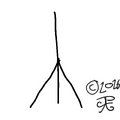 /ɑː/
/ɑː/ -
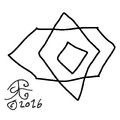 /aɪ/
/aɪ/ -
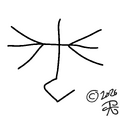 /b/
/b/ -
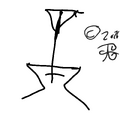 /β̞/
/β̞/ -
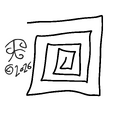 /f/
/f/ -
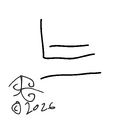 /r̝/
/r̝/ -
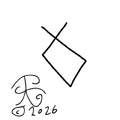 /oʊ/
/oʊ/ -
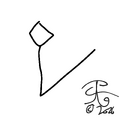 /t/
/t/ -
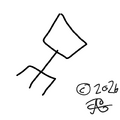 /tʃ/
/tʃ/


In most historical cases, Mezhon memorial stones were inscribed in quadrants of four runes in four blocks, read left-to-right and top-to-bottom; thus, one word would typically be displayed with one rune in the upper left of a four-rune quadrant, the next in the upper right, the next in the bottom left, and the next in the bottom right, before moving on to the next quadrant either adjacent to or below the first one, and repeating the pattern; this continues until the word is done.
Proper names of animate beings were always carved inside a square to keep them separate from other runes; regular words were left free-floating on the inscription surface.
The Dragorean alphabet (c. 1950s OE)
The Dragorean alphabet is one of the main ways to write the Dragorean language. Created in the 1950s in the Hearthlands as a joint effort between the Kingdom of Inglenook and the Kholedzhar, the alphabet was an attempt to format an alternate and heavily-marked version of the Regatrian alphabet which had already been used for nearly 2000 years for writing Dragorean, Frithanic, Inglish, and Magetongue, as well as the other Magelander languages such as Hesperian and Galatéan which all evolved from more or less the same place and around the same time.
A huge portion of the letters are marked with diacritics or other modifications in an attempt to provide a visual and clear way of noting the complex, phonological pronunciations in Dragorean — something the alphabet inherits from its main inspiration, the Mezhon runes, which was used to write Dragorean by the dragons themselves for centuries before Regatrians tried to start eliminating Mezhon from the public memory.
It has 35 consonants, 9 vowels, and 4 diphthongs in order to match up with a similar number of Dragorean's wide and diverse phonology system.
| |||||||||||||||||||||||||||||||||||||||||||||||||||||||||||||||||||||||||||
For the most part, content on this page uses the Inglishized versions and spellings, as these were the most common way of spelling and transliterating spoken Dragorean throughout most of Inglenook's history after the Regatrian occupations. However, if there are sections of text purporting to have been transferred from texts written with the Dragorean alphabet or transliterations of signage from the World of Dragorea or any similar cases of text using the alphabet which need to be presented, then they'll be presented using the Dragorean alphabet alongside the Inglishized transliterations.
Vocabulary
Dragorean's vocabulary is primarily based around verbs, nouns, and adjectives, with a wide variety of prepositions, conjunctions, interjections, and adverbs. It is primarily a conversational and expressive language, meant for the purpose of expressing a wide variety of diverse meanings and applying to a large number of situations, wherein its vocabulary is larger and more unwieldy rather than smaller and more efficient.
Numerals
Dragorean uses a base-12 system numbered from one to twelve, before moving up to the second set, which is considered doubled from the first one, before moving up to the third set, which is considered tripled from the first one, and so on.
The base 12 numerals in Dragorean are:
| Numeral | Dragorean |
|---|---|
| One | tzu-wanu |
| Two | tzu-towok |
| Three | tzu-teir |
| Four | tzu-kuradros |
| Five | tzu-apinkal |
| Six | tzu-khariztar |
| Seven | tzu-kseparin |
| Eight | tzu-katruya |
| Nine | tzu-ndarn |
| Ten | tzu-dukenda |
| Eleven | tzu-ebajo |
| Twelve | tzu-zhukam |
All numerals are primarily considered adjectives and so by default take the adjectival part-of-speech marker unless used as a pronoun, noun, or some other thing. In Dragorean mathematics, there is no official word for "zero"; however, the placeholder word al-ahovith exists, referring to the concept of nothing, which is typically used to stand in if discussion needs what would, in English mathematics, be called "zero".
Examples
Dragorean texts
| Dragorean alphabet | Inglishized | Rough translation | Meaning |
|---|---|---|---|
| Álţūqūnīŕéżnálàkīqwīsá yōŕōlæk ábūályōíbīsŕákōpīŕékëwīsá. | Al-tzu-quni-rezhnala-kiq-wisa yo-rolak abu-al-yo-ibisrako-pirekë-wisa. | The-quick-brown-fox jumps above-the-sleeping-barker. | The quick brown fox jumps over the lazy dog. |